Photo: Hobbykafe, CC BY-SA 3.0 · source

Houseplant · Apocynaceae
Sweetheart hoya
Hoya kerrii
In other languages: Hartjesplant (Nederlands) · Hoya (Français)
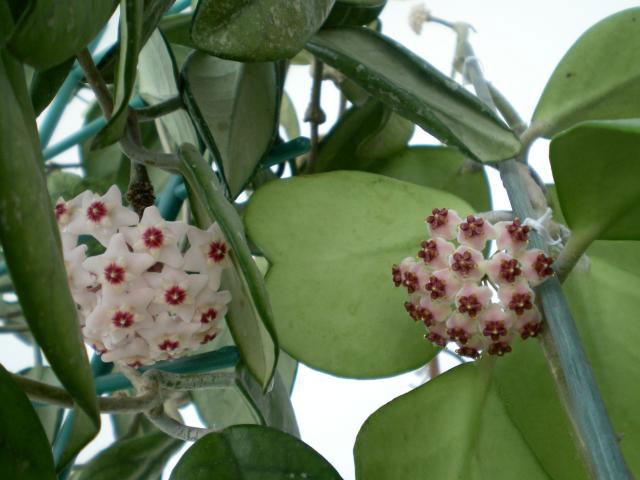
The sweetheart hoya is a wax plant from South-East Asia, where it climbs up trees. Its thick, fleshy leaves are heart-shaped, which is why it is often sold around Valentine’s Day as a single leaf in a small pot. Such a leaf stays green for years, but without a piece of stem it never grows any further. A proper plant makes long stems and in summer can produce rounded clusters of waxy, star-shaped flowers, creamy white with a red to brown centre. There are also variegated forms with a yellow or white edge.
Light
Sun or partial shade
preferably some sun
Moisture
Dry to normal
no wet feet
Legal basis
Potting soil
Hardiness
Houseplant
min. 15 °C
Size
2 m
tall, 0.5 m wide
Flowering
June–September
| Height | 2 m |
|---|---|
| Poisonous to people and pets | Not known to be poisonous |
| Flowering | June–September |
Identify
Sweetheart hoya: how do you recognise it?
- Habit
- Climbing or trailing plant with thick stems; slow-growing, up to 1–2 m long indoors.
- Leaves
- Thick, fleshy and heart-shaped, up to about 8 cm; dark green or variegated with a yellow or white edge.
- Flowers
- Rounded clusters of many small, star-shaped, waxy flowers, creamy white with a red to brown centre.
- Nectar
- The flowers produce drops of nectar that can drip: do not stand it above good furniture.
- Flower spurs
- The flowers come from short, permanent spurs, which flower again year after year.
Flowering: June–September · Plants: March–April
In your garden
Why grow it?
- Unusual heart-shaped leaves: a fun gift that needs little care.
- Succulent-like: it forgives the odd missed watering.
- With some patience it flowers with rounded clusters of waxy, starry flowers.
- Attractive as a trailing plant or wound around a hoop.
- Grows slowly, so it stays in place for a long time.
Sweetheart hoya: where does it grow best?
- Bright, with some morning or evening sun; with too little light it will not flower.
- Warm: 18–25 °C while growing and never below 15 °C.
- Airy, free-draining compost: cactus compost or potting compost mixed with orchid bark and perlite.
- A small pot: it flowers better when its roots are a little cramped.
- Light
- Sunny or bright, out of direct sun
- Potting soil
- Multi-purpose compost or airy, humus-rich compost
- Acidity
- Acid or neutral
- Watering
- Sparingly or moderately
- Size
- 2 m tall, 0.5 m wide
- Temperature
- Minimum 15 °C
Goes well with
- String of hearts: Another trailing succulent from the same family, with small heart-shaped leaves.
- String of pearls: Trailing ‘peas’ that need just as little water.
- Snake plant: Stiff, upright leaves that also tolerate drought.
- Mistletoe cactus: A light, trailing plant with thin stems, for a bright spot out of fierce sun.
Maintenance
Sweetheart hoya: when and how to plant it?
Plant in March–April.
- Repot only when really necessary, in March–April, every two or three years.
- Choose a pot only slightly larger, with a drainage hole; in terracotta the compost dries out faster.
- Use an airy mix: cactus compost or potting compost with orchid bark and perlite.
- Set the plant at the same depth as before and firm lightly.
- Wait a few days before watering, so damaged roots can heal first.
- Put a hoop or small trellis in the pot if you want to train the stems.
Care
- Watering
- Let the compost dry out completely between waterings; in summer roughly every one to two weeks, in winter much less.
- Feeding
- From April to August, half-strength houseplant feed once a month.
- Flower spurs
- Do not cut off spent flower spurs: new flowers appear in the same place the following year.
- Buds
- Do not turn or move it when it has buds, or it may drop them.
- Support
- Train the stems around a hoop or let them trail; do not shorten them if you want flowers.
Tip: Never cut off spent flower spurs: new flowers appear in the same place the following year.
Sweetheart hoya: when to prune it?
When: No pruning is needed. It grows slowly, and every stem can flower later.
How:
- Only cut out dead or shrivelled stems, just above a leaf.
- Leave long, bare stems in place: leaves and flowers will appear on them later.
- Never cut off the spent flower spurs.
Propagation
- Stem cuttings
- In spring or summer, take a piece of stem with at least one node and one or two leaves. Let the cut end dry for a day, then root it in airy compost or in water, somewhere warm (22–25 °C). Roots form within a few weeks.
- Leaf cutting
- A single leaf roots easily, but without a node it hardly ever makes a new stem. That is the ‘heart’ sold in shops.
- Layering
- Lay a stem with a node onto a small pot of compost alongside and pin it down; once it has rooted, cut it free.
Sweetheart hoya: how does it get through the winter?
- Houseplant: keep it in a bright spot in winter and never below 15 °C.
- Water sparingly in winter: every three to four weeks is often enough.
- No feeding from September to March.
- Keep it away from cold window panes and draughts, but not right above a radiator either.
Diseases and pests
- Mealybug: White, woolly tufts in the leaf axils and near the flowers. Dab them off with a cotton bud and repeat; cut away badly affected parts.
- Root rot: Yellow, soft leaves and a rotting stem base from overwatering. Let it dry out, repot into dry, airy compost and water less.
- Wrinkled leaves: Dry for too long or, if the compost is wet, rotten roots. Check the roots before you water.
- No flowers: Usually too little light, or a young plant in too big a pot. Move it somewhere brighter and be patient: a hoya often takes a few years to flower.
- Single leaf does not grow: A single ‘heart’ without a node stays unchanged for years. If you want a real plant, buy one with a stem.
Through the year
- January: Resting. Little water, bright spot.
- March: Repot if needed.
- April: Water more once it grows. Start feeding.
- May: Take cuttings. Train the stems.
- June: First flowers. Stop moving it.
- July: Flowering. Water when the compost is dry. Feed.
- August: Flowering. Last feed.
- September: Last flowers. Leave the spurs in place.
- October: Water less.
- December: Resting. Away from cold panes.
You and this species
Did you know?
- The genus Hoya is named after Thomas Hoy, an English gardener of around 1800.
- Because of their waxy flowers, hoyas are also known as wax plants or wax flowers.
- A single heart-shaped leaf can live in its pot for years without growing a millimetre.