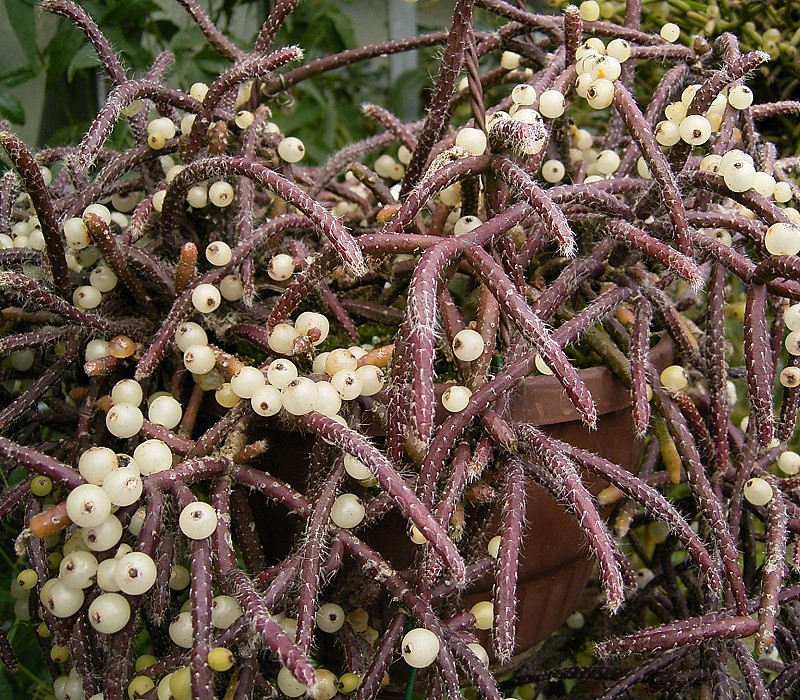
Photo: Frank Vincentz, CC BY-SA 3.0 · source

Houseplant · Cactaceae
Mistletoe cactus
Rhipsalis baccifera
In other languages: Rhipsalis (Nederlands) · Rhipsalis (Français)
The mistletoe cactus, Rhipsalis baccifera, is a rainforest cactus without spines. It grows naturally as an epiphyte in trees in tropical America and also in parts of Africa and Asia, and hangs down in long, thin, green stems like a curtain. After the small white flowers come white berries that resemble those of mistletoe, hence the name. Indoors it reaches about 80 cm long and 50 cm wide. Gardeners choose it as a sturdy, undemanding hanging plant for a bright spot without fierce sun.
Light
Partial shade
no harsh midday sun
Moisture
Normal
no wet feet
Legal basis
Potting soil
Hardiness
Houseplant
min. 10 °C
Size
0.8 m
tall, 0.5 m wide
| Height | 0.8 m |
|---|---|
| Poisonous to people and pets | Not known to be poisonous |
Identify
Mistletoe cactus: how do you recognise it?
- Habit
- Trailing, much-branched epiphytic cactus, about 80 cm long and 50 cm wide indoors.
- Stems
- Thin, round and green (a few millimetres thick), in long, branching strands without spines.
- Flower
- Small white to cream flowers, usually in winter or early spring.
- Fruit
- Small, round, white berries that resemble mistletoe.
- Roots
- Fine and shallow: as an epiphyte it likes airy, quick-draining compost.
- Origin
- Rainforests of tropical America; it also occurs in parts of Africa and Asia.
Plants: March–April
In your garden
Why grow it?
- A cactus without spines: safe and easy to handle.
- A distinctive trailing look: a green curtain of thin stems in a hanging pot or on a shelf.
- Very easy: little water and little feeding.
- Evergreen and attractive all year; the small flowers and berries are a fun bonus.
- Grows well in half shade and also likes a bright, humid room.
- Easy to propagate from cuttings.
Mistletoe cactus: where does it grow best?
- Half shade or a bright spot: plenty of light, but without fierce sun. Direct midday sun gives pale or red-brown stems.
- Very airy, humus-rich compost: cactus compost mixed with potting compost and perlite or orchid bark; slightly acid to neutral.
- Normal moisture: the compost can dry out at the top between waterings, but never completely.
- Room temperature of 15–25 °C and never below 10 °C.
- Hang it up or stand it high, so the strands can trail freely, and keep it out of draughts.
- Light
- Bright, out of direct sun
- Potting soil
- Multi-purpose compost or airy, humus-rich compost
- Acidity
- Acid or neutral
- Watering
- Moderately
- Size
- 0.8 m tall, 0.5 m wide
- Temperature
- Minimum 10 °C
Goes well with
- Christmas cactus: A related jungle cactus with the same care and rich winter flowers.
- Satin pothos: A trailing plant with silver-grey leaves that likes the same light.
- Hoya: A trailing plant with leathery leaves and scented flowers for a bright spot.
Maintenance
Mistletoe cactus: when and how to plant it?
Plant in March–April.
- Repot in March–April, when it starts growing again.
- Choose a shallow, wide pot or hanging pot with a drainage hole: the roots are fine and shallow.
- Mix cactus compost or potting compost with perlite and a little orchid bark for an airy mix.
- Set the plant at the same depth as before and firm lightly.
- Water a little and let the surplus drain away; keep the compost moderately moist for the first weeks.
- Hang or stand it in a bright spot without fierce sun.
Care
- Water
- Water as soon as the top 2–3 cm are dry and let the surplus drain away. More often in summer, less in winter; never let the compost dry out completely. Rainwater or low-lime water is ideal.
- Feeding
- From April to September, a cactus or houseplant fertiliser every 4 weeks at half strength. Do not feed in winter.
- Humidity
- It likes slightly humid air: mist now and then, especially in a heated room in winter.
- Repotting
- Rarely: every 2–3 years in spring, when the pot is full. It grows well in a small pot.
- Position
- Leave it where it grows well: moving it or a draught can make segments drop off.
Tip: Water a little too little rather than too much, but never let the compost dry out completely: when the stems start to shrivel, it is thirsty.
Mistletoe cactus: when to prune it?
When: It does not need pruning: only cut off stems that are too long, damaged or dead, preferably in spring.
How:
- Cut long strands back to just above a branch with clean scissors.
- Remove dead, shrivelled or rotten stems at the base.
- Use the cut pieces as cuttings.
Propagation
- Stem cuttings
- In April–August: cut pieces of 5–10 cm, leave them to dry in the air for 1–2 days, then lay or push them into airy, barely moist compost. They root within a few weeks.
- Several cuttings
- Push a few cuttings together into one pot for a full plant.
Mistletoe cactus: how does it get through the winter?
- Not hardy: keep it indoors at 10 °C or more; 12–18 °C is ideal.
- Give it a bright spot without draughts and not above the radiator.
- Water much less, only when the compost is largely dry, and do not feed.
- A cooler winter often encourages flowering.
Diseases and pests
- Shrivelled stems: Too dry, or rotten roots. Feel the compost: if it is dry, water; if it is wet, let it dry out and check the roots.
- Soft, brown base: Rot caused by too much water. Cut healthy pieces for cuttings, throw away the rest and use more open compost.
- Red or yellow stems: Too much sun. Move it somewhere brighter, but out of direct sun.
- Mealybug: White fluff between the stem segments. Dab it off with a cloth and soapy water.
- Dropping segments: Caused by draughts, moving or drought. Find a fixed spot and keep the compost lightly moist.
Through the year
- January: Rest. Bright and cool (12–18 °C). Little water.
- February: Rest. Little water. Flowering possible.
- March: Water a little more. Repot if the pot is full.
- April: Repot. Take cuttings. Start feeding.
- May: Feed every 4 weeks. Water when the top is dry.
- June: Feed. No fierce sun.
- July: Feed. Take cuttings. Mist if the air is dry.
- August: Feed. Water in warm weather.
- September: Last feed.
- October: Water less. Move somewhere cooler.
- November: Rest. Do not feed. Little water.
- December: Rest. Bright and cool; no draughts.
You and this species
Did you know?
- It is regarded as the only cactus that also grows wild outside the Americas. How it got there is not entirely certain: perhaps birds spread the berries.
- The species name baccifera means ‘berry-bearing’, after the white berries.
- Unlike desert cacti it grows in the humid tropics, in the tree canopy, and has no spines.