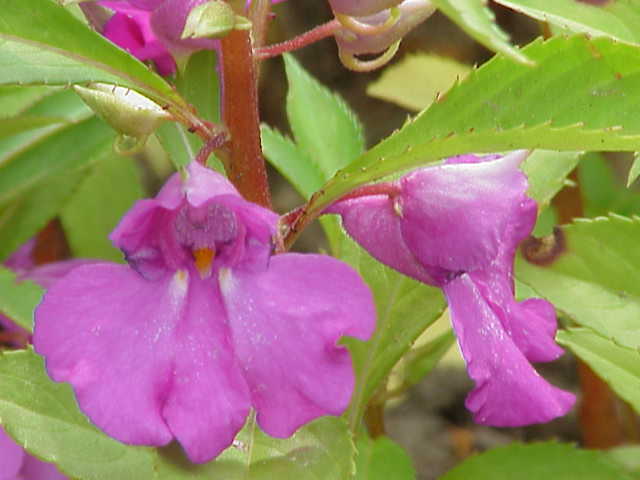
Photo: Kurt Stüber [1], CC BY-SA 3.0 · source

Annual · Balsaminaceae
Garden balsam
Impatiens balsamina
In other languages: Balsemien (Nederlands) · Balsamine des jardins (Français)
Garden balsam comes from India and South-East Asia and has been grown in gardens for centuries. It is an annual with thick, juicy, upright stems and lance-shaped, toothed leaves. From July to September, single or double flowers resembling small camellias open in the leaf axils, in white, pink, red, purple and bicolours. Bees visit them readily. After flowering, small seed capsules form that burst open at the slightest touch and fling out the seed. This is how the plant easily sows itself.
Light
Sun or partial shade
preferably some sun
Moisture
Normal to wet
must not dry out
Legal basis
Sand, loam or clay
acid to neutral
Hardiness
down to 2 °C
protect in harsh winters
Size
0.5 m
tall, 0.3 m wide
Flowering
July–September
| Height | 0.5 m |
|---|---|
| Native to Belgium | No, planted |
| Good for bees, butterflies and birds | Yes, for bees |
| Poisonous to people and pets | Not known to be poisonous |
| Flowering | July–September |
Identify
Garden balsam: how do you recognise it?
- Habit
- Annual, upright and bushy, about 50 cm high and 30 cm wide.
- Stem
- Thick, juicy and translucent; breaks easily.
- Leaves
- Lance-shaped, toothed, alternate along the stem, fresh green.
- Flower
- Single or double, 2–5 cm, in the leaf axils along the stem; from July to September.
- Fruit
- Small, hairy seed capsules that burst open at a touch and fling out the seed.
Flowering: July–September · Sowing: March–May · Plants: May–June
In your garden
Why grow it?
- Flowers from July to September in a rich palette of colours, with single or double blooms.
- Grows well in sun and half shade, on moist soil where many summer annuals struggle.
- Bees visit the flowers readily.
- Easy and cheap to grow from seed, and fun for children too.
- The seed capsules burst open at a touch: a fascinating sight for young and old.
Garden balsam: where does it grow best?
- Sun or half shade; in full sun it needs more water, in shade it flowers a little less.
- Humus-rich, moisture-retentive soil: sandy, loamy or clay, acid to neutral.
- Average to moist: never let the soil dry out, but do not let it become waterlogged either.
- Space plants 25–30 cm apart, in a spot sheltered from strong wind.
- Light
- Sun and partial shade
- Soil type
- Sand, loam or clay
- Acidity
- Acid or neutral
- Moisture
- Normal or wet
- Size
- 0.5 m tall, 0.3 m wide
- Hardiness
- Frost tender: plant out after the last frost (mid-May)
Goes well with
Maintenance
Garden balsam: when and how to plant it?
Plant in May–June.
- Sow indoors in March–April at 18–21 °C, or straight outdoors in mid-May where it is to flower. Cover the seed only lightly.
- The seed germinates in about 1–2 weeks. Prick the seedlings out into small pots as soon as they are large enough.
- Harden the young plants off and plant out in May–June, when frost is no longer expected; it needs at least 2 °C.
- Plant 25–30 cm apart in humus-rich soil, at the same depth as in the pot. Mix in a little compost.
- Water well straight away and keep the soil moist.
- If you sow outdoors, thin to 25–30 cm between plants.
Care
- Water
- Regular: the thick, juicy stems droop quickly in dry spells. In containers water daily in hot weather.
- Feeding
- Every 2–3 weeks a weak dose of liquid feed in containers; in the border, compost at planting is enough.
- Pinching
- Pinch out the tip of young plants at 10–15 cm for bushier growth and more flowers.
- Spent flowers
- No need to remove them; if you do not want self-seeding, cut off faded flowers.
- Support
- Usually not needed; tall plants may need support in windy spots.
Tip: Water regularly and put it in sun or light shade; in dry spells it drops its flowers. Touch the ripe seed capsules to watch them burst open, a fun game for children.
Garden balsam: when to prune it?
When: Pruning is not needed. Pinch young plants in May and clear up at the end of the season.
How:
- Pinch out the tip of young plants at 10–15 cm for bushier growth.
- Cut off withered flowers and leaves.
- Remove seed capsules before they burst if you do not want self-seeding.
Propagation
- Seed
- Sow indoors in March–April at 18–21 °C or outdoors in mid-May. The seed is large enough to handle easily; cover it lightly.
- Collecting seed
- Pick the seed capsules just before they burst, when they are plump and green, and let them dry in a paper bag. Store the seed dry and cool.
Garden balsam: how does it get through the winter?
Hardy to 2 °C: protect in harsh winters.
- Annual and not hardy: the plant tolerates no frost and dies with the first night frost.
- The seed often sows itself and germinates the following spring.
- Clear the dead plants in October; empty containers and store them dry.
Diseases and pests
- Aphids: Aphids on young shoots and flower buds. Wash off with water or let ladybirds deal with them.
- Red spider mite: In dry weather: fine webs and yellowed, speckled leaves. Water regularly and keep the air around the plant humid.
- Powdery mildew and grey mould: White powder or grey fuzz, especially in damp weather and on crowded plants. Allow space, remove affected parts and water at the base.
- Slugs: Young plants are quickly eaten. Use a slug barrier and collect slugs in the evening.
Through the year
- March: Sow indoors at 18–21 °C.
- April: Sow indoors. Prick out seedlings.
- May: Mid-May: sow outdoors. Harden plants off and plant out.
- June: Plant out. Pinch young plants. Water regularly.
- July: Flowering begins. Water and feed.
- August: Full flower. Water in dry spells.
- September: Last flowers. Collect seed.
- October: Clear dead plants.
Use
Good for wildlife
- Bees
- Nectar and pollen for honeybees and wild bees.
You and this species
Did you know?
- The genus name Impatiens means impatient in Latin and refers to the seed capsules, which burst open at the slightest touch.
- It belongs to the same family as busy Lizzie and New Guinea impatiens; their ripe seed capsules burst open too.
- The flowers sit in the leaf axils along the stem; on older plants they sometimes disappear partly under the foliage.