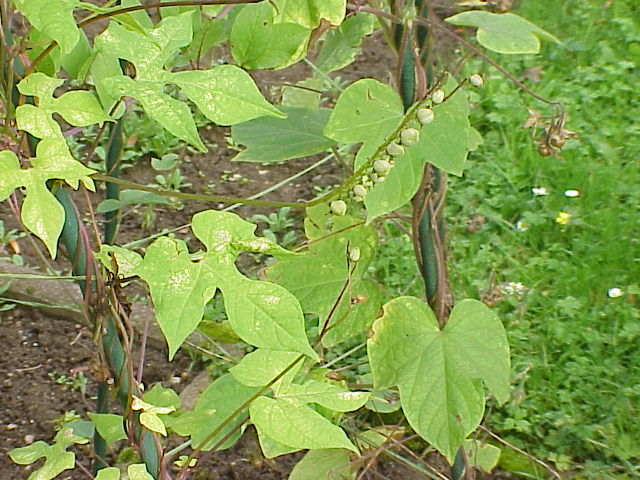
Photo: Kurt Stüber [1], CC BY-SA 3.0 · source

Annual · Convolvulaceae
Spanish flag
Ipomoea lobata
In other languages: Spaanse vlag (Nederlands) · Ipomée lobée (Français)
Spanish flag is a fast-growing twining climber from Mexico and Central America, where it is a perennial. Here it is grown as an annual: in a single summer it twines up to 3 m along a trellis, wires or an obelisk. It has three-lobed, fresh green leaves on reddish stems. From July until the first frost, one-sided sprays of narrow, tubular flowers appear that fade from red through orange to yellow and cream, so each spray carries several colours at once. It is related to the common morning glory and the sweet potato and used to be called Mina lobata. Against a sunny wall it is one of the finest annual climbers.
Light
Full sun
warm and bright
Moisture
Normal
no wet feet
Legal basis
Sand, loam or clay
any pH
Hardiness
down to 2 °C
protect in harsh winters
Size
3 m
tall, 0.5 m wide
Flowering
July–October
| Height | 3 m |
|---|---|
| Native to Belgium | No, planted |
| Good for bees, butterflies and birds | Yes, for bees |
| Poisonous to people and pets | Not known to be poisonous |
| Flowering | July–October |
Identify
Spanish flag: how do you recognise it?
- Habit
- Twining climber 2–3 m tall and about 50 cm wide; the stems wind themselves around wires and canes.
- Leaves
- Three-lobed, 5–10 cm, fresh green, with a heart-shaped base, on reddish stalks.
- Flower
- Narrow, tubular flowers about 2 cm long in one-sided sprays on long stalks, from July to October.
- Colour
- Red in bud, then orange, yellow and finally cream: every spray is multicoloured.
- Seed
- Large, hard seeds that are best soaked overnight before sowing.
Flowering: July–October · Sowing: March–April · Plants: May–June
In your garden
Why grow it?
- An exuberant fan of colour: red buds that open orange, yellow and cream.
- Flowers from July until the first frost, when many summer flowers are flagging.
- Covers a 2–3 m trellis, fence or pergola in a single summer.
- Bees and bumblebees visit the flowers.
- Lovely in a large pot with an obelisk on a sunny patio.
- The elegant three-lobed leaves already form a green screen before flowering starts.
Spanish flag: where does it grow best?
- Full sun and a warm spot: against a south- or west-facing wall it flowers most freely.
- Any free-draining garden soil: sand, loam or clay, acid to chalky, ideally rich in humus.
- Moderately moist: water in dry spells, especially against a wall or in a pot.
- Sheltered from cold winds, with a trellis, wires, mesh or an obelisk to climb.
- Plant 30–50 cm apart; two or three plants are enough for an obelisk.
- Light
- Sun
- Soil type
- Sand, loam or clay
- Acidity
- Not fussy
- Moisture
- Normal
- Size
- 3 m tall, 0.5 m wide
- Hardiness
- Frost tender: plant out after the last frost (mid-May)
Goes well with
- Black-eyed Susan vine: Another annual climber in orange and yellow, for a warm-coloured screen.
- Nasturtium: Adds colour at the base or climbs alongside, in the same warm shades.
- Runner bean: Red flowers and edible beans on the same support.
- Dahlia: At the foot of the support, with red and orange flowers until the frost.
Maintenance
Spanish flag: when and how to plant it?
Plant in May–June.
- Soak the seed overnight in lukewarm water so the hard seed coat swells.
- Sow indoors in March–April, two seeds per 9 cm pot, 1 cm deep, at 18–20 °C. They germinate in one to two weeks.
- Give the seedlings plenty of light and a small cane to twine around straight away.
- Harden the plants off in May and plant them out after mid-May, when the nights are warm too.
- Plant at the same depth as in the pot, at the foot of the support, and guide the stems towards it.
- Water well and spread a mulch of compost around the base.
Care
- Watering
- Regularly, especially against a wall and in pots: the soil must not dry out.
- Feeding
- In June–August, a liquid feed for flowering plants every two weeks. Too much nitrogen gives lots of leaves and few flowers.
- Support
- Wires, mesh or string give a good grip. Guide young shoots in the right direction; after that it twines up by itself.
- Pinching out
- Pinch out the tips of young plants at 20 cm: they will then make more stems.
- Spent sprays
- Snip them off to prolong flowering.
Tip: Wait until after mid-May to plant out, when the nights are warm too: in cold weather it stands still for weeks. Against a sunny wall with a trellis or wires it flowers most freely.
Spanish flag: when to prune it?
When: An annual climber that is not pruned. Pinching out in May and some steering during summer is enough.
How:
- Pinch out the tips of young plants at 20 cm for more side shoots.
- Guide stems that wave away from the support back to it, or cut them off.
- Snip off spent sprays so flowering continues until the frost.
- Remove the plant after the first frost; the dead stems come away easily from the support.
Propagation
- Seed
- Sow indoors in March–April at 18–20 °C after soaking overnight. You can collect seed in October from ripe, brown seed capsules, but our short summer does not always let it ripen.
Spanish flag: how does it get through the winter?
Hardy to 2 °C: protect in harsh winters.
- Not hardy: it does not tolerate frost and dies with the first frost.
- Grow it as an annual and sow again every spring.
- Clear the plant after frost and check the support, so it is ready for spring.
Diseases and pests
- Red spider mite: Fine yellow speckles and webbing under the leaves, especially against a hot wall. Mist the leaves regularly and do not let the soil dry out.
- Aphids: On young shoot tips. Hose them off or wipe them away with your fingers.
- Slugs: They eat young plants just after planting out. Check in the evening and protect the base.
- Slow growth: In cold weather in May it stands still and the leaves sometimes turn yellow. Wait until it is really warm before planting out.
- Few flowers: Too much shade or too much nitrogen. Give it full sun and use a feed for flowering plants.
Through the year
- March: Soak the seed overnight and sow indoors at 18–20 °C.
- April: Sow indoors. Give seedlings a small cane.
- May: Harden off young plants and plant out after mid-May. Pinch out.
- June: Plant out. Guide stems to the support. Water.
- July: First flowers. Feed and water in dry spells.
- August: Full flower. Watch for red spider mite against hot walls.
- September: Flowering. Snip off spent sprays.
- October: Flowers until the first frost, then clear.
Use
Good for wildlife
- Bees
- Nectar and pollen for honeybees and wild bees.
You and this species
Did you know?
- Each flower changes colour as it ages, from red through orange to yellow and cream. A single spray therefore carries all the colours at once, like a fluttering flag.
- It was long known as Mina lobata; it now belongs to Ipomoea, like the common morning glory and the sweet potato.
- In its homeland it is a perennial that keeps growing for years.