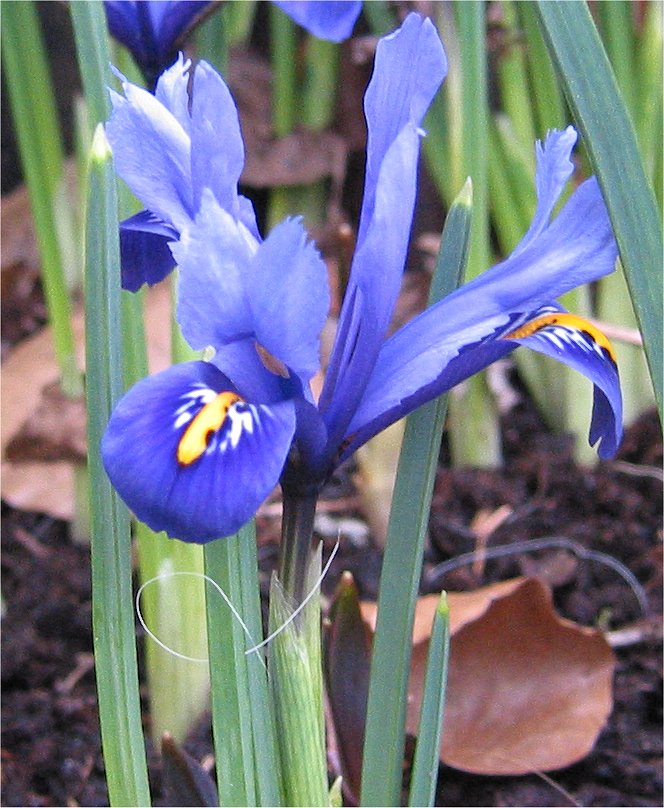
Photo: Wikimedia Commons, CC BY-SA 3.0 · source

Bulb or tuber · Iridaceae
Netted iris
Iris reticulata
In other languages: Netiris (Nederlands) · Iris réticulé (Français)
The netted iris is a small bulb from the mountains of Turkey, the Caucasus and Iran. As early as February and March it opens delicate iris flowers about 5–6 cm across in deep violet, purple or blue, with a yellow or orange blotch on the drooping petals. The flowers have a light, violet-like scent. The narrow, four-sided leaves are still short at flowering time and then grow on considerably. The name refers to the net-like tunic around the bulb. Well-known cultivars are ‘Harmony’, royal blue, and ‘J.S. Dijt’, reddish purple. It is ideal for a rock garden, gravel garden or pot.
Caution: The bulbs and leaves are poisonous. Keep children, dogs and cats away from the bulbs, including when you bring a pot indoors. The sap can irritate the skin: wear gloves if you have sensitive skin.
Light
Full sun
warm and bright
Moisture
Dry to normal
no wet feet
Legal basis
Sand or loam
neutral to chalky
Hardiness
Fully hardy
down to -25 °C
Size
0.12 m
tall, 0.05 m wide
Flowering
February–March
| Height | 0.12 m |
|---|---|
| Native to Belgium | No, planted |
| Good for bees, butterflies and birds | Yes, for bees |
| Poisonous to people and pets | Yes, take care with children and pets |
| Flowering | February–March |
Identify
Netted iris: how do you recognise it?
- Habit
- A small bulb 10–15 cm tall at flowering time; the leaves keep growing afterwards.
- Leaves
- Narrow, stiff and square in cross-section, grey-green; they reach 30–40 cm after flowering and die back in June.
- Flowers
- A delicate iris flower 5–6 cm across with three upright and three drooping petals, in February–March.
- Colour
- Violet, purple or blue, with a yellow or orange ridge and white markings on the drooping petals.
- Scent
- Light and sweet, rather like violets.
- Bulb
- Small, with a brown, net-like tunic; after flowering it often forms many small bulblets.
Flowering: February–March · Plants: September–November
In your garden
Why grow it?
- One of the first flowers of the year: true iris flowers in February and March.
- Deep, rich colours with fine markings, lovely to look at close up.
- A light violet scent, especially in a pot on a table by the door.
- Early bees and bumblebees visit the open flowers on sunny days.
- Small and ideal for a rock garden, gravel garden, the edge of a border or a pot.
Netted iris: where does it grow best?
- Full sun: the flowers open best in sunshine.
- Well-drained sandy or loamy soil, neutral to chalky.
- Dry to normally moist; in summer the bulb needs to rest warm and dry.
- Ideal in a rock garden, gravel garden, window box or pot; not in heavy, wet soil.
- Plant 5–8 cm apart, in groups of ten or more.
- Light
- Sun
- Soil type
- Sand or loam
- Acidity
- Neutral or chalky
- Moisture
- Dry or normal
- Size
- 0.12 m tall, 0.05 m wide
- Hardiness
- Hardy (to -25 °C)
Goes well with
- Crocuses: Flower in the same weeks in yellow, white and lilac.
- Winter heath: A low evergreen shrub that flowers pink or white at the same time and tolerates lime.
- Thyme: Covers the spot in summer where the bulbs are resting.
- Stonecrop: A drought-loving ground cover that needs no watering.
- Blue fescue: Fine, blue-grey tufts in a gravel garden.
Maintenance
Netted iris: when and how to plant it?
Plant in September–November.
- Plant the bulbs from September to November.
- Choose a sunny spot and lighten heavy soil with coarse sand or fine gravel.
- Plant the bulbs 8–10 cm deep, pointed end up.
- Space them 5–8 cm apart.
- Firm the soil and only water if it is bone dry.
- In a pot: use a mix of compost and coarse sand and top with a thin layer of fine gravel.
Care
- Watering
- Not needed in open ground. In a pot, water when the compost is dry, as long as the leaves are green.
- Feeding
- After flowering, a little high-potash fertiliser, so the bulbs grow big enough to flower again.
- Leaves
- Let the leaves turn completely yellow before removing them.
- Spent flowers
- Cut them off so the plant does not put energy into seed.
- Summer rest
- Do not plant anything on top that needs a lot of water in summer.
- Indoors
- In January you can bring pots into a cool, light room; they will then flower a little earlier. Put them back outside after flowering.
Tip: Give a little high-potash fertiliser after flowering and let the leaves die back completely: this keeps the bulbs large enough to flower year after year.
Netted iris: when to prune it?
When: The netted iris is not pruned. You only cut off spent flowers and clear away the leaves once they have died back.
How:
- Cut off faded flowers just below the bloom.
- Let the leaves keep growing until they turn yellow in June.
- Then clear away the dead leaves.
Caution: Never cut the leaves while they are green: the bulb needs them to flower again.
Propagation
- Bulblets
- Every 3–4 years, in June–July when the leaves have died back, lift a clump. Store the bulbs dry and airy and replant them in autumn. Small bulblets need a few years to flower.
- Seed
- Sow fresh seed in autumn in a pot of sandy compost and leave it outdoors. Seedlings only flower after a few years.
Netted iris: how does it get through the winter?
Hardy to −25 °C.
- Fully hardy, to about −25 °C: no protection needed.
- It actually needs a cold winter to flower well.
- Wet soil is more dangerous than frost: make sure drainage is good.
- In a pot it can stay outdoors; stand it on pot feet so excess water can drain away.
Diseases and pests
- Bulbs splitting: After the first flowering, many bulbs split into small bulblets that do not flower for years. Plant deep enough, give high-potash fertiliser after flowering and top up with new bulbs.
- Ink disease: Black patches on the bulb and yellowing, dying leaves. Throw away affected bulbs and plant new ones elsewhere.
- Slugs: They eat the buds and flowers. Pick them off in the evening.
- Mice and squirrels: They dig up the bulbs. Lay wire mesh over the spot or plant in a wire basket.
Through the year
- January: The first buds appear. Bring pots into a cool room if you wish.
- February: In flower. Bees on sunny days.
- March: Last flowers. Cut off spent flowers and give high-potash fertiliser.
- April: The leaves keep growing. Watch out for slugs.
- June: The leaves turn yellow; clear them away afterwards. Lift clumps if needed.
- July: Rest: keep dry.
- September: Plant bulbs.
- October: Plant bulbs.
- November: Plant the last bulbs. A thin layer of gravel on top.
Use
Edible and useful
Not edible. All parts of these bulbous irises are poisonous, especially the bulb: eating any causes vomiting, stomach ache and diarrhoea, and dogs and cats fall ill from it too. In autumn the small bulbs look like shallots or onion sets: do not store them with the kitchen onions, plant them straight away and clear up empty bags and loose bulbs. Dogs that dig easily bring them up, and dwarf irises in a pot indoors are often at a child’s height. People who cut a lot of flowers or plant a lot of bulbs sometimes get red, itchy skin from the sap: wear gloves and wash your hands afterwards. If an animal has eaten some, call your vet. If any is swallowed, call a poison centre (in Belgium 070 245 245) or your doctor at once.
Good for wildlife
- Bees
- Nectar and pollen for honeybees and wild bees.
You and this species
Did you know?
- The name reticulata means ‘net-like’ and refers to the tunic around the bulb, which looks like a fine net.
- The leaves are square in cross-section, unlike those of most other irises.
- The yellow blotch on the drooping petals acts as a signpost that guides bees to the nectar.