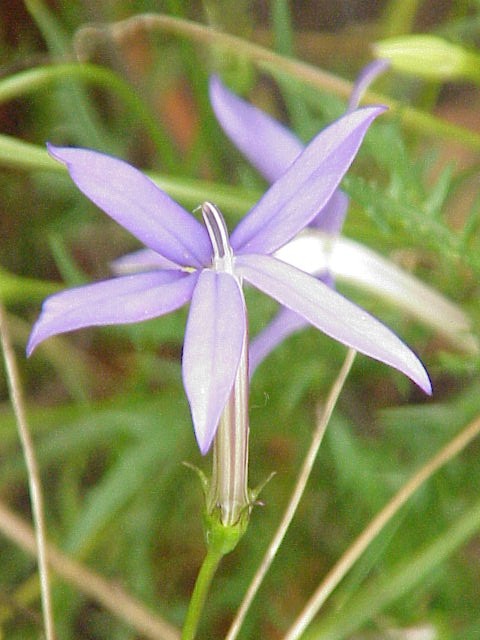
Photo: Wikimedia Commons, CC BY-SA 3.0 · source

Annual · Campanulaceae
Rock isotome
Isotoma axillaris
In other languages: Isotoma (Nederlands) · Isotoma (Français)
Rock isotome is a compact, bushy plant from Australia that we grow in Belgium as an annual. It forms a cushion of fine, cut foliage covered from June until autumn with small, blue, star-shaped flowers. You may also see it sold as Laurentia or Solenopsis. It suits pots, window boxes, hanging baskets and the front of a sunny border, and asks little of you. The milky sap irritates skin and eyes: wear gloves when potting.
Caution: The milky sap irritates skin and eyes and is toxic if swallowed. Keep the plant away from children and pets (dogs, cats), wear gloves when pruning and potting and wash your hands afterwards.
Light
Full sun
warm and bright
Moisture
Normal
no wet feet
Legal basis
Sand or loam
acid to neutral
Hardiness
down to 0 °C
protect in harsh winters
Size
0.3 m
tall, 0.3 m wide
Flowering
June–September
| Pruning months | July |
|---|---|
| Height | 0.3 m |
| Native to Belgium | No, planted |
| Good for bees, butterflies and birds | Yes, for bees |
| Poisonous to people and pets | Yes, take care with children and pets |
| Flowering | June–September |
Identify
Rock isotome: how do you recognise it?
- Habit
- Compact cushion 20–30 cm tall and as wide; usually grown as an annual in Belgium.
- Leaves
- Fine, deeply cut and dark green, on thin, bushy stems.
- Flowers
- Small five-pointed star flowers in pale to deep blue, from June to September.
- Flower position
- The flowers sit in the leaf axils along the stems, so the plant becomes covered.
- Milky sap
- All parts contain a white sap that irritates skin and eyes.
Flowering: June–September · Sowing: February–March · Plants: May–June · Pruning: July
In your garden
Why grow it?
- Flowers non-stop from June into autumn, with little deadheading.
- Compact and neat: ideal for pots, window boxes and hanging baskets.
- Blue is a rare colour among summer flowers; here in a soft, pure shade.
- Bees and other insects visit the little flowers.
- Copes with a sunny position and stays fresh all summer.
- Goes with almost any other summer flower, especially white and yellow.
Rock isotome: where does it grow best?
- Full sun; in partial shade it flowers less freely.
- Light, well-drained soil or potting compost, acid to neutral; sand or loam.
- Evenly moist, not wet. Do not let the soil dry out completely.
- Not frost-hardy (down to about 0 °C): put it out only after the last night frost, from mid May.
- In a border 20–25 cm between plants; in a 30 cm container 3–4 plants.
- Light
- Sun
- Soil type
- Sand or loam
- Acidity
- Acid or neutral
- Moisture
- Normal
- Size
- 0.3 m tall, 0.3 m wide
- Hardiness
- Frost tender: plant out after the last frost (mid-May)
Goes well with
- Geranium (pelargonium): Red or white flowers that go well with the blue.
- Petunia: A free-flowering neighbour in the same sunny pot.
- Silver ragwort: Silver-grey foliage that makes the blue stand out.
- Marigold: Warm yellow or orange as a contrast.
Maintenance
Rock isotome: when and how to plant it?
Plant in May–June.
- Sow in February–March indoors at 18–20 °C in moist seed compost. The seed is dust-fine: scatter it, press it in and barely cover it.
- Prick out the seedlings into small pots as soon as they are big enough to handle.
- Harden the plants off from early May: outdoors by day, indoors at night.
- Plant out in May–June, after the last night frost, 20–25 cm apart.
- Water in straight away. In pots use good potting compost and a pot with a drainage hole.
- Pinch the tips lightly in the first weeks for a bushier plant.
Care
- Water
- Regular and even, at the base. In pots often daily in summer; never let the root ball dry out completely.
- Feeding
- In pots a flowering-plant feed every two weeks in the water. In borders once or twice in summer.
- Trimming
- After the first flush in July cut back by a third for new flowers in late summer.
- Spent flowers
- They drop off by themselves; extra deadheading is rarely needed.
- Gloves
- Wear gloves for all work on the plant: the milky sap irritates the skin.
Tip: Flush over? Cut the plant back by a third in July and give a little flowering-plant feed: you will get new flowers until autumn. Always wear gloves when you do.
Rock isotome: when to prune it?
Pruning months: July.
When: A light trim after the first flush of flowers, in July.
How:
- Cut the plant back by about a third with scissors, just above a leaf.
- Remove dead or yellowed stems.
- Then water and give a little flowering-plant feed for a new flush.
Caution: The milky sap irritates skin and eyes: wear gloves and wash your hands after cutting.
Propagation
- Sowing
- In February–March indoors without covering the seed (see planting). Raising it takes patience.
- Cuttings
- In August take 5–8 cm cuttings from non-flowering tips, set them in sandy potting compost and keep them moist in a bright spot. Overwinter them frost-free.
Rock isotome: how does it get through the winter?
Hardy to 0 °C: protect in harsh winters.
- Not hardy: the plant does not tolerate frost and is grown as an annual in Belgium.
- To keep it, take cuttings in August and overwinter them in a bright, frost-free spot (5–10 °C) with little water.
- Bring pots indoors at the first cold nights in autumn.
Diseases and pests
- Drying out: Limp, brown stems and leaves when the root ball is dry. Stand the pot in a bowl of water and trim off the dead parts; the plant often recovers.
- Root rot: A yellow plant and rotten roots from too much water or a pot without holes. Water less and ensure good drainage.
- Aphids: On young shoots in warm weather. Spray with water or wipe the aphids off by hand.
- Grey mould: Grey fuzz on the dense plant in a damp summer. Cut off affected parts and water at the base.
Through the year
- February: Sow indoors at 18–20 °C.
- March: Sow and prick out.
- April: Grow on in a bright, frost-free spot.
- May: Harden off and put out after mid May.
- June: Flowering begins. Water weekly, feed every two weeks.
- July: Cut back by a third after the first flush.
- August: Second flush. Take cuttings.
- September: Flowers until the first cold nights.
- October: Bring pots in or clear the plants. Keep cuttings frost-free.
Use
Edible and useful
Not edible. The milky sap of isotoma is poisonous and strongly irritant: on the skin it causes redness and itching, in the eyes pain and inflammation, and swallowing it causes a burning mouth, vomiting and diarrhoea. The sap flows when you break a stem or cut flowers: wear gloves, do not rub your eyes and wash your hands afterwards, and rinse sap out of the eyes at once with plenty of water. Keep window boxes and pots out of reach of children, dogs and cats. If any is swallowed, call a poison centre (in Belgium 070 245 245) or your doctor at once.
Good for wildlife
- Bees
- Nectar and pollen for honeybees and wild bees.
You and this species
Did you know?
- The species name axillaris refers to the flowers that sit in the leaf axils.
- Rock isotome belongs to the bellflower family and is related to lobelia.
- Many plants in the bellflower family have milky sap, and so does this one.