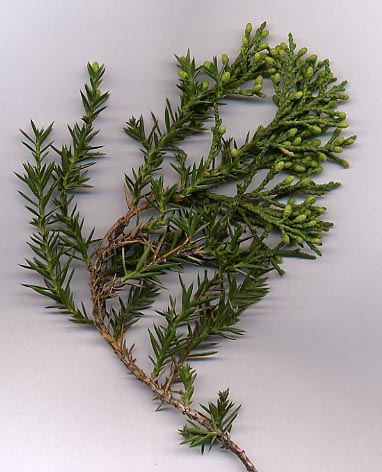
Photo: MPF at English Wikipedia, CC BY-SA 3.0 · source

Shrub · Cupressaceae
Pfitzer juniper
Juniperus × pfitzeriana
In other languages: Sierjeneverbes (Nederlands) · Genévrier de Pfitzer (Français)
Pfitzer juniper, Juniperus × pfitzeriana, is a cross between Chinese juniper and savin juniper that arose in a German nursery. It is a wide-spreading evergreen conifer with obliquely rising branches arranged in tiers. The shrub grows about 1.5 m high but up to 3 m wide. The foliage is a mix of fine scales and short, sharp needles, in shades from grey-green to golden yellow. It is very hardy, loves sun and dry soil and also tolerates light shade. Well-known cultivars are ‘Old Gold’ with golden tips and ‘Mint Julep’ with fresh green foliage.
Light
Sun or partial shade
preferably some sun
Moisture
Dry to normal
no wet feet
Legal basis
Sand, loam or clay
any pH
Hardiness
Fully hardy
down to -35 °C
Size
1.5 m
tall, 3 m wide
| Pruning months | April and August |
|---|---|
| Height | 1.5 m |
| Native to Belgium | No, planted |
| Poisonous to people and pets | Not known to be poisonous |
Identify
Pfitzer juniper: how do you recognise it?
- Habit
- Wide, flat shrub about 1.5 m high and up to 3 m wide, with obliquely rising, arching branches.
- Foliage
- Evergreen; mostly fine scales with short, sharp needles here and there. Grey-green, fresh green or golden yellow depending on the cultivar.
- Fruit
- Small blue-black berries, which are really fleshy cones, on female plants.
- Branches
- Long, obliquely tiered branches that arch gracefully.
- Roots
- Branching and deep; the plant tolerates drought but not waterlogged soil.
Plants: April–May and September–October · Pruning: April and August
In your garden
Why grow it?
- Green and dense all year: a solid structure plant for winter.
- Covers large areas: a single plant soon fills several square metres, also as ground cover on a slope.
- Very hardy and tolerant of drought and wind, so ideal for difficult spots.
- Cultivars with grey-green, fresh green or golden yellow foliage bring colour to the garden.
- Low maintenance: hardly any pruning and no feeding needed.
Pfitzer juniper: where does it grow best?
- Full sun or partial shade; in sun the foliage colour stays best and growth is densest.
- Well-drained soil: sand, loam or clay, acid to chalky. Dry to moderately moist.
- Tolerates wind and drought, but not wet feet or standing water in winter.
- Give it plenty of room: allow 2.5–3 m per plant, as it grows much wider than tall.
- Light
- Sun and partial shade
- Soil type
- Sand, loam or clay
- Acidity
- Not fussy
- Moisture
- Dry or normal
- Size
- 1.5 m tall, 3 m wide
- Hardiness
- Hardy (to -35 °C)
Goes well with
- Heather: A low, flowering patch of colour in front of the grey-green branches.
- Lavender: Likes the same sun and dry soil; scented flowers against a green backdrop.
- Stonecrop: A succulent for dry spots with late flowers.
- Ornamental grasses: The fine foliage of blue fescue contrasts nicely with the broad branches.
Maintenance
Pfitzer juniper: when and how to plant it?
Plant in April–May and September–October.
- Plant in April–May or in September–October, when the soil is neither frozen nor waterlogged.
- Dig a hole twice as wide as the root ball; in heavy clay mix in sand or grit for better drainage.
- Set the plant at the same depth as in its pot; the base of the stem must not end up deeper.
- Water thoroughly straight away and keep the soil moist, but never wet, in the first year.
- Cover the soil with grit, bark or wood chips to suppress weeds.
Care
- Water
- In the first year, once a week in dry weather. After that it looks after itself, perhaps an extra soaking in long dry summers.
- Feeding
- Usually not necessary. On poor soil a thin layer of compost in spring is enough.
- Mulching
- A layer of bark or grit keeps weeds down; do not pile it against the stem.
- Weeding
- Keep young plants weed-free for the first few years, until the branches cover the soil.
- Tidying branches
- Now and then remove branches that hang over the edge or the path.
Tip: Give it plenty of room: it grows much wider than tall. Plant it straight in its final position, as old plants are hard to move.
Pfitzer juniper: when to prune it?
Pruning months: April and August.
When: Late April–May or in August; one light trim a year is enough.
How:
- Cut overly long branches back to a side shoot you want to keep growing.
- Remove dead or damaged branches completely, back to living wood.
- Keep the natural shape: cut out a few branches rather than clipping it into a ball.
- Wear gloves and long sleeves: the needles are prickly and can irritate sensitive skin.
Caution: Never cut into bare, old wood: it does not regrow from there and leaves a gap.
Propagation
- Semi-ripe cuttings
- In September–October: take 10–15 cm cuttings with a heel, in sandy compost in a cold frame. Rooting takes several months.
- Layering
- Branches that touch the ground sometimes root by themselves. Pin them down; after a year you can sever and replant them.
Pfitzer juniper: how does it get through the winter?
Hardy to −35 °C.
- Very hardy, to about −35 °C: no protection is needed in Belgian winters.
- Shake heavy wet snow off the branches, otherwise they may break or splay apart.
- In a pot: choose a large pot with drainage and put it in a sheltered spot; do not let the compost dry out completely.
Diseases and pests
- Root rot: The plant declines and the foliage turns brown in a spot that is too wet. Plant in well-drained soil and do not overwater.
- Twig dieback: Brown, dying shoot tips. Cut affected parts back to healthy wood and dispose of them.
- Spider mites: In hot, dry summers the foliage turns grey-yellow and you see fine webs. Spray the plant with a jet of water.
- Pear rust: Orange, jelly-like swellings on the branches in spring. It mostly occurs on junipers near pear trees; remove affected branches.
Through the year
- March: Prepare the planting site. Remove dead branches.
- April: Plant. Trim lightly after growth starts.
- May: Plant. Water young plants in dry weather.
- July: Watch for spider mites in dry weather.
- August: Trim lightly. Remove affected branches.
- September: Plant. Take cuttings.
- October: Plant. Take cuttings.
- December: Shake heavy snow off the branches.
You and this species
Did you know?
- The name refers to the German nurseryman Wilhelm Pfitzer, who spread this hybrid in the late nineteenth century.
- It is a cross between Juniperus chinensis and Juniperus sabina.
- The juniper ‘berries’ are really small, fleshy cones.