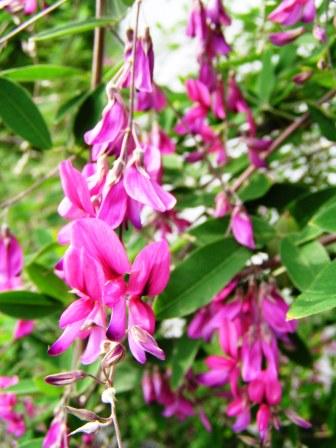
Photo: VoDeTan2, CC BY-SA 3.0 · source

Shrub · Fabaceae
Thunberg’s bush clover
Lespedeza thunbergii
In other languages: Lespedeza (Nederlands) · Lespédèze (Français)
Lespedeza thunbergii, Thunberg’s bush clover, comes from Japan, China and Korea. In our climate it behaves like a perennial: in winter the above-ground wood often freezes back and in spring it regrows from the base into a fountain-shaped shrub about 1.5 m high and 2 m wide. Only late in summer, from August into October, do the branches fill with long clusters of pink-purple pea flowers. It does well on poor, dry soil in the sun and is a good bee plant for the late season. Well-known cultivars are ‘Gibraltar’ with deep pink flowers and the white ‘White Fountain’.
Light
Full sun
warm and bright
Moisture
Dry to normal
no wet feet
Legal basis
Sand, loam or clay
any pH
Hardiness
Fully hardy
down to -20 °C
Size
1.5 m
tall, 2 m wide
Flowering
August–October
| Pruning months | March |
|---|---|
| Height | 1.5 m |
| Native to Belgium | No, planted |
| Good for bees, butterflies and birds | Yes, for bees |
| Poisonous to people and pets | Not known to be poisonous |
| Flowering | August–October |
Identify
Thunberg’s bush clover: how do you recognise it?
- Habit
- Fountain-shaped shrub about 1.5 m high and 2 m wide, with long, arching stems. Regrows from the base each spring.
- Leaves
- Made up of three oval leaflets (clover-like), blue-green. They appear only late in spring.
- Flowers
- Long, loose clusters of small pink-purple pea flowers, from August to October.
- Fruit
- Small, flat pods that seldom ripen in our conditions.
- Roots
- Deep and branching; it tolerates drought and lives with nitrogen-fixing bacteria.
Flowering: August–October · Plants: April–May · Pruning: March
In your garden
Why grow it?
- Flowers late, from August into October, when many other plants have finished.
- Arching, graceful stems full of pink-purple flower clusters create a fountain effect.
- Attracts bees at a time when little nectar is available.
- Does well on poor, dry soil in full sun; as a legume it makes its own nitrogen.
- Little work: one cut back a year is enough.
Thunberg’s bush clover: where does it grow best?
- Full sun; in a warm, sunny spot it flowers best and earliest.
- Well-drained soil: sand, loam or clay, acid to chalky. Poor, dry soil is fine too.
- Tolerates drought, but not waterlogged soil or standing water in winter.
- Allow about 1.5–2 m of space per plant; give it room to arch over.
- Light
- Sun
- Soil type
- Sand, loam or clay
- Acidity
- Not fussy
- Moisture
- Dry or normal
- Size
- 1.5 m tall, 2 m wide
- Hardiness
- Hardy (to -20 °C)
Goes well with
- Fountain grass: Soft plumes and the same sunny, dry spot.
- Ice plant: Flowers at the same time with pink flower heads.
- Autumn aster: Violet or white flowers in the same late period.
- Coneflower: Large flowers in late summer; lots of insects.
Maintenance
Thunberg’s bush clover: when and how to plant it?
Plant in April–May.
- Plant in April–May, so the plant can root before winter.
- Dig a hole twice as wide as the root ball; in heavy clay mix sand into the soil for better drainage.
- Set the plant at the same depth as in its pot and firm the soil well.
- Water thoroughly straight away and keep the soil lightly moist in the first year.
- Put a thin layer of mulch around the plant; avoid extra fertiliser, which gives lots of leaves and few flowers.
Care
- Water
- In the first year, water weekly in dry weather. After that it is very drought-tolerant and rarely needs extra water.
- Feeding
- Usually not necessary: it makes its own nitrogen. Too much fertiliser gives lots of leaves and few flowers.
- Mulching
- A thin layer of compost or bark in spring keeps weeds down and protects the roots in winter.
- Weeding
- Keep young plants weed-free in the first few years.
- Support
- Usually not needed; the arching stems are the charm of the plant.
Tip: Cut everything back to just above the ground in March, as you would a perennial, and do not worry if it is slow to shoot. Do not feed: it costs flowers.
Thunberg’s bush clover: when to prune it?
Pruning months: March.
When: In March, before the new shoots start to grow.
How:
- Cut all stems back to 5–10 cm above the ground, just above a few buds, as you would a perennial.
- Remove all dead stems completely.
- Leave the faded clusters in autumn and winter as winter decoration; they also protect the base.
- Put the clippings on the compost heap or chop them up and use them as mulch.
Caution: It flowers on new wood: hard pruning in spring costs no flowers, pruning in summer does. Do not cut back early in winter, as the dead stems protect the plant.
Propagation
- Division
- In spring, dig up the clump and divide it into pieces with roots and buds. Replant straight away.
- Seed
- In spring: the hard seed germinates better after a night in lukewarm water or after light scarification. Sow in pots and plant out when the seedlings are strong enough.
- Softwood cuttings
- In June–July: take 8–10 cm cuttings from young shoots, remove the lower leaves and insert them in moist compost under plastic.
Thunberg’s bush clover: how does it get through the winter?
Hardy to −20 °C.
- Hardy to about −20 °C: the above-ground wood often freezes back, but the plant regrows from the base in spring.
- In the first year, put a layer of leaves or compost over the base.
- In a pot: place it in a sheltered spot and wrap the pot in hessian or bubble wrap so the roots do not freeze.
Diseases and pests
- Late to shoot: The plant looks dead until May–June. This is normal: it is late. Only remove dead wood if nothing has moved by June.
- Few flowers: Too little sun or too much fertiliser. Plant in full sun and do not feed.
- Aphids: On young shoots in spring. Ladybirds usually clear them up; otherwise spray them off with water.
- Wet soil: Root rot and decline on waterlogged soil. Plant in free-draining soil and mix sand into clay.
Through the year
- March: Cut all stems back to 5–10 cm above the ground.
- April: Plant. Apply mulch.
- May: Plant. The shoots appear late.
- June: Take softwood cuttings. Water in dry weather.
- July: Growth. Water young plants in dry weather.
- August: Flowering begins.
- September: Full flower, lots of bees.
- October: Flowering fades. Leaves fall.
- November: Leave the faded clusters as winter decoration.
Use
Good for wildlife
- Bees
- Nectar and pollen for honeybees and wild bees.
You and this species
Did you know?
- In Japan the plant is called ‘hagi’ and counts as one of the seven classic autumn flowers.
- As a legume it lives with bacteria that fix nitrogen from the air, which makes it a good plant for poor soil.
- The species is named after the Swedish naturalist Carl Peter Thunberg, who studied the Japanese flora in the eighteenth century.