Photo: Ghislain118 http://www.fleurs-des-montagnes.net, CC BY-SA 3.0 · source

Bulb or tuber · Liliaceae
Coral lily
Lilium pumilum
In other languages: Lilium pumilum (Nederlands) · Lilium pumilum (Français)
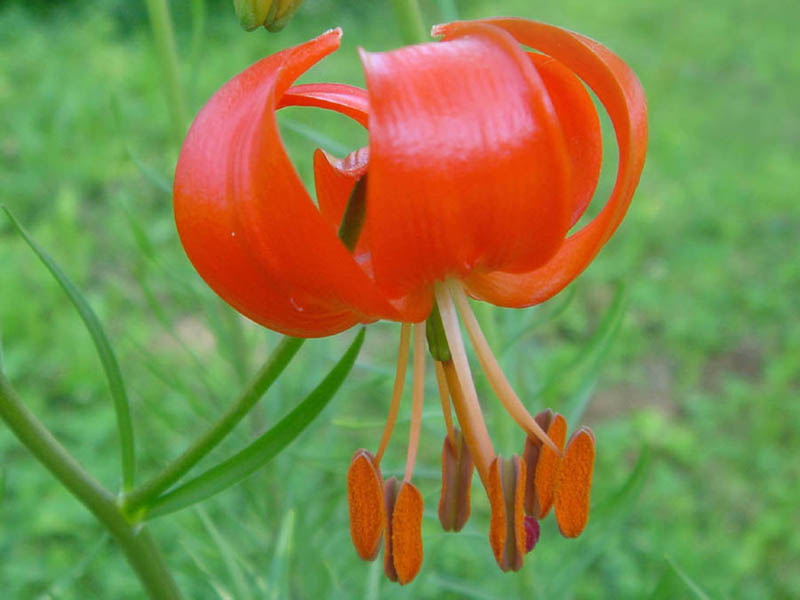
Lilium pumilum, the coral lily, grows wild from Siberia and Mongolia to northern China and Korea. It is a small, fine lily with slender stems of about 45 cm and leaves so narrow that they look like grass. In June, earlier than most lilies, it bears drooping turk’s-cap flowers in brilliant coral red with a light, sweet scent. It is fully hardy and, because of its size, suits the rock garden and the front of the border very well. It is short-lived, but easy to raise from seed.
Caution: Poisonous to cats: all parts, including pollen and water from the vase, can cause serious poisoning in cats; go to the vet at once if you suspect it. The plant is also harmful to dogs and children if eaten.
Light
Full sun
warm and bright
Moisture
Dry to normal
no wet feet
Legal basis
Sand or loam
neutral to chalky
Hardiness
Fully hardy
down to -30 °C
Size
0.45 m
tall, 0.15 m wide
Flowering
June
| Height | 0.45 m |
|---|---|
| Native to Belgium | No, planted |
| Poisonous to people and pets | Yes, take care with children and pets |
| Flowering | June |
Identify
Coral lily: how do you recognise it?
- Habit
- Slender bulbous plant about 45 cm tall and 15 cm wide, with straight, thin stems.
- Leaves
- Very narrow, almost grass-like, dark green, scattered along the stem.
- Flower
- Drooping flowers with curled-back petals (turk’s-cap shape), a few per stem, in June.
- Colour
- Bright coral red, sometimes with small dark spots.
- Scent
- Light and sweet; strongest on warm days.
Flowering: June · Plants: March–April and October–November
In your garden
Why grow it?
- Brilliant coral-red turk’s-cap flowers in June, earlier than most lilies.
- Small and fine in build: suits a rock garden, a gravel bed or the front of a border.
- Fully hardy (down to about −30 °C) and not fussy.
- Light, sweet scent and flowers that attract bees.
- Easy to raise from seed, so you always have new plants.
Coral lily: where does it grow best?
- Full sun in a warm, free-draining spot; it tolerates some drought.
- Free-draining soil: sandy or loamy, lime is fine. Heavy clay makes the bulb rot.
- Normal to dry: standing water in winter is its worst enemy.
- It does best on a slight rise or in a rock garden.
- Plant the bulbs 10–15 cm apart, in groups of three or five.
- Light
- Sun
- Soil type
- Sand or loam
- Acidity
- Neutral or chalky
- Moisture
- Dry or normal
- Size
- 0.45 m tall, 0.15 m wide
- Hardiness
- Hardy (to -30 °C)
Goes well with
- Lavender: Same sunny, dry spot; purple contrasts with the coral red.
- Saxifrage: A low rock-garden plant near the lily keeps the soil covered.
- Ornamental grasses: A tuft of fine grass fills the space between the bulbs.
- Stonecrop: Likes the same warm, dry spot and keeps the soil covered.
Maintenance
Coral lily: when and how to plant it?
Plant in March–April and October–November.
- Plant in October–November or March–April; autumn planting gives the best roots.
- Dig a hole 10–12 cm deep and mix heavy soil with coarse sand or grit.
- Set the bulb upright, on a thin layer of sand against rot, 10–15 cm apart.
- Cover with soil and water well, then only in dry spells.
- Spread a thin layer of grit or coarse sand over the soil.
Care
- Water
- In the first year, water occasionally in dry weather. After that rarely; avoid wet feet in winter.
- Feeding
- Little needed. In spring, perhaps a little bulb fertiliser or compost.
- Mulching
- A thin layer of coarse sand or grit keeps the soil free-draining; no thick layer of compost.
- Spent flowers
- If you want to collect seed, leave the seed pods; otherwise cut them off to spare the bulb.
- Dividing
- Divide crowded clumps every 3–4 years or let seedlings grow to renew the group.
Tip: Let a few seed pods ripen and sow the seed: the seedlings replace the old bulbs, which do not live long.
Coral lily: when to prune it?
When: Pruning is not needed. Cut off spent flowers (or leave the seed pods) and remove the stems only when they are completely withered, in October–November.
How:
- Cut off spent flowers just below the flower.
- Leave the stem and leaves until they turn yellow: they feed the bulb.
- Cut the withered stem off in autumn, just above the ground.
Caution: Never cut a green stem too early: the bulb needs the leaves to recharge for next year.
Propagation
- Seed
- Sow the seed in spring or autumn in pots with free-draining compost; it germinates quickly and flowers after a few years.
- Division
- Divide crowded clumps in October–November and replant the small bulbs at once at 10–12 cm.
- Scales
- In autumn, snap a few healthy scales off the bulb and place them in moist sand or perlite in a plastic bag at room temperature; new bulblets form after a few weeks.
Coral lily: how does it get through the winter?
Hardy to −30 °C.
- Fully hardy in Belgium (down to about −30 °C): no protection needed if the soil is free-draining.
- A thin layer of leaves or compost over the bulb keeps moisture in and frost out; remove it in spring.
- In a pot: place the pot in a sheltered, dry spot against a wall and do not let it stand in water.
Diseases and pests
- Lily beetle: A bright red beetle and slimy larvae (covered in their own droppings) eat the leaves from April to July. Hand-picking is the best remedy.
- Botrytis: Brown spots on the leaves in wet weather. Cut off affected leaves, leave space between plants and do not water over the foliage.
- Bulb rot: In wet soil the bulbs rot. Plant in free-draining soil and mix clay with sand.
- Short life: A single bulb lives only a few years. Let a few seed pods ripen or divide the group so that new plants always follow.
Through the year
- March: Plant. Young shoots appear.
- April: Plant. Watch for lily beetles.
- May: Buds form. Keep slugs away.
- June: Flowering. Cut flowers for the vase.
- July: Cut off spent flowers, or let the seed pods ripen.
- August: Seed pods ripen. Collect seed when the pods split.
- September: Leaves turn yellow. Leave them.
- October: Plant. Cut off withered stems.
- November: Plant or divide.
- December: Resting underground.
Use
Edible and useful
Not edible. Lilies are life-threatening to cats: every part, even the pollen and the water in the vase, causes acute kidney failure in very small amounts, which is often fatal without prompt treatment. A little pollen licked off the fur can be enough. If your cat has been at a lily or has pollen on its coat, call your vet at once, even if it shows no signs yet. Do not bring cut lilies into the house if you have a cat (removing the stamens is not enough) and do not plant them where cats often go. For children and dogs lilies are far less dangerous, but they can still cause stomach upsets. Do not confuse them with daylilies (Hemerocallis), whose buds and flowers are edible (though they too are dangerous to cats): never eat a true lily. If any is swallowed, call a poison centre (in Belgium 070 245 245) or your doctor at once.
You and this species
Did you know?
- The species name pumilum means ‘dwarf’, after its modest size.
- An older scientific name is Lilium tenuifolium, ‘thin-leaved lily’, after its grass-like leaves.
- In the wild it grows as far as Siberia and Mongolia: it is therefore very cold tolerant.