Photo: No machine-readable author provided. Cookie assumed (based on copyright claims)., CC BY-SA 3.0 · source

Houseplant · Arecaceae
Chinese fan palm
Livistona chinensis
In other languages: Livistona (Nederlands) · Latanier de Chine (Français)
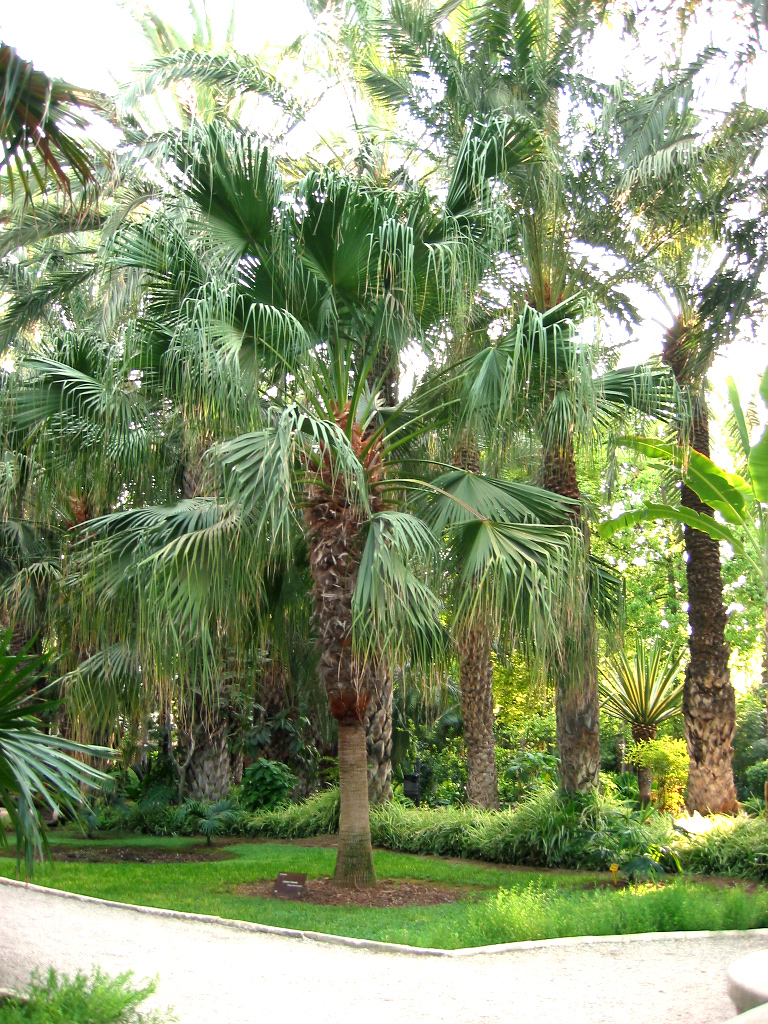
The Chinese fan palm (Livistona chinensis) grows wild in southern Japan, Taiwan and southern China. It is a slow-growing, single-trunked palm with large, fan-shaped leaves on long stalks that carry small spines along the edges. The leaf tips are deeply cut and hang down gracefully, giving the plant the look of a fountain. Indoors it reaches about 2 m tall and 1.5 m across. It is sturdy, tolerates a little less light than many other palms and can spend the summer outdoors. A handsome, calm green plant for a bright hall or living room.
Light
Sun or partial shade
preferably some sun
Moisture
Normal
no wet feet
Legal basis
Potting soil
Hardiness
Houseplant
min. 5 °C
Size
2 m
tall, 1.5 m wide
| Height | 2 m |
|---|---|
| Poisonous to people and pets | Not known to be poisonous |
Identify
Chinese fan palm: how do you recognise it?
- Habit
- Palm with a single upright trunk and a crown of fans; about 2 m tall and 1.5 m across when grown indoors.
- Leaves
- Fan-shaped, glossy dark green, up to about 50–60 cm wide, with deeply split, drooping tips. The leaf stalks carry small spines.
- Flower
- Small yellow flowers in long sprays, but only on old plants and in the wild; it almost never flowers indoors.
- Fruit
- On older plants, round to oval blue-green fruits about 1–2 cm long.
- Roots
- Fibrous, strong roots that dislike disturbance: repot only when it is really necessary.
Plants: April–May
In your garden
Why grow it?
- An imposing, tropical-looking palm that changes the feel of a room at once when grown in a large pot.
- Green all year round: the leaves stay on the plant for years.
- Tougher and easier than many other palms, and not fussy about a cool winter spot.
- Can spend the summer outdoors in a sheltered, partly shaded place.
- Grows slowly, so it stays neat for a long time and suits a permanent corner.
Chinese fan palm: where does it grow best?
- Bright light to partial shade: plenty of light with some gentle morning or evening sun is ideal. Strong midday sun behind glass can scorch the leaves.
- Heavy, humus-rich potting compost with some loam or clay: slightly acid to neutral and well drained.
- Evenly moist but never soggy: regular watering and humid air, without water standing in the pot.
- Keep it away from radiators and draughts; leave room around the leaves, as it grows about 1.5 m wide.
- Light
- Sunny or bright, out of direct sun
- Potting soil
- Multi-purpose compost or airy, humus-rich compost
- Acidity
- Acid or neutral
- Watering
- Moderately
- Size
- 2 m tall, 1.5 m wide
- Temperature
- Minimum 5 °C
Goes well with
- Kentia palm: A second palm with a very different, feathery leaf shape in the same corner.
- Swiss cheese plant: Large, cut leaves that contrast nicely with the fans.
- Rubber plant: Sturdy, broad leaves as a backdrop to the lighter palm.
- Ferns: Soft, fine foliage in front; they enjoy the same humid air.
Maintenance
Chinese fan palm: when and how to plant it?
Plant in April–May.
- Repot in April–May, when roots come out of the drainage holes or the pot is full; usually every 2–3 years.
- Choose a heavy, deep pot with drainage holes, one size up from the old one. Palms are top-heavy and would otherwise tip over.
- Put a layer of clay pebbles at the bottom and fill with a mix of potting compost, a little loam or clay and one fifth coarse sand or perlite.
- Plant it at the same depth as before and disturb the root ball as little as possible; do not cut roots.
- Water well afterwards and let the excess drain away.
Care
- Water
- Keep the compost evenly moist during the growing season (April–September); let only the top few centimetres dry out. Use low-lime water (rainwater is ideal) and never let water stand in the pot or saucer.
- Feeding
- From April to September every 2–4 weeks, give palm or foliage plant feed at the recommended dose. Do not feed in winter.
- Humidity
- Mist the leaves now and then and wipe them with a damp cloth: this keeps them glossy and prevents brown tips and spider mite.
- Light
- Plenty of light, but no strong midday sun behind glass. Turn the pot now and then so that it grows evenly.
- Repotting
- Every 2–3 years in spring, and only when the roots fill the pot. In between, replace the top layer of compost with fresh compost.
Tip: Put the heavy pot on a wheeled stand and rinse the leaves under a lukewarm shower now and then: it keeps the palm dust-free and prevents spider mite.
Chinese fan palm: when to prune it?
When: A palm is not pruned. You only remove leaves that are completely brown, preferably in spring or as soon as a leaf is really dead.
How:
- Cut a completely brown or withered leaf off with its stalk, close to the trunk, using clean, sharp scissors.
- For brown leaf tips, trim away only the brown part, following the shape of the leaf and leaving a narrow brown edge.
- Leave yellow or half-brown leaves in place: the plant is still drawing nutrients from them.
- Wear gloves: the leaf stalks have small spines along the edges.
Caution: Never cut off the top or the growing point in the centre of the crown: a palm grows from a single point and will die afterwards.
Propagation
- Seed
- Sow fresh seed in spring in a moist mix of potting compost and sand at about 25 °C or more, under clear film. Germination is slow and uneven (weeks to months), and the young palms grow slowly for years. At home it is a long road.
Chinese fan palm: how does it get through the winter?
- Not hardy in Belgium: keep it above 5 °C. The best winter spot is bright and cool, at 10–15 °C.
- Water less in winter: the compost may dry out a little further between waterings, but never completely. Do not feed.
- Keep it away from radiators and cold draughts; dry heating air causes brown tips and spider mite.
- If it spent the summer outdoors, bring it in during October, before temperatures fall below about 10 °C.
Diseases and pests
- Brown leaf tips: Caused by dry air, hard water or irregular watering. Trim away the brown, use low-lime water and provide more humid air and even watering.
- Spider mite: Fine webbing and speckled, dull leaves, especially in dry heating air. Rinse the leaves in the shower and keep the air more humid.
- Scale insects: Brown bumps with sticky droplets on the stalks and under the leaves. Wipe them off with a cloth and a little soapy water; repeat after a week.
- Yellow leaves and rot: Yellow lower leaves and soggy compost point to too much water or a pot without drainage. Let it dry out and water less; for rotten roots, repot in fresh compost.
Through the year
- January: Keep bright and cool (10–15 °C). Water very sparingly.
- February: Bright and cool. Wipe the leaves now and then.
- March: Dust the leaves. At the end of the month, water more again.
- April: Repot if necessary. Start feeding.
- May: From mid-May it may go outside in partial shade, out of full sun.
- June: Water regularly and feed.
- July: Extra water in dry weather. Mist the leaves now and then.
- August: Water regularly and feed.
- September: Stop feeding. Check for pests.
- October: Bring indoors before it turns cold. Keep bright and cool.
- November: Winter rest: less water, away from radiators.
- December: Winter rest: water very sparingly.
You and this species
Did you know?
- It is also called the fountain palm because of its drooping leaf tips.
- In the wild this palm can grow taller than 10 m, far taller than in a pot.
- The genus name Livistona recalls Patrick Murray, Baron of Livingston, who founded a botanic garden near Edinburgh in the 17th century.