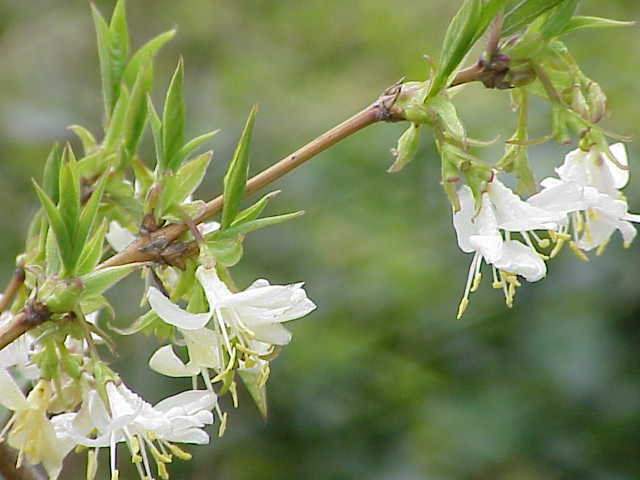
Photo: Kurt Stüber [1], CC BY-SA 3.0 · source

Shrub · Caprifoliaceae
Winter honeysuckle
Lonicera fragrantissima
In other languages: Winterkamperfoelie (Nederlands) · Chèvrefeuille d’hiver (Français)
Winter honeysuckle is a shrubby honeysuckle from eastern China, brought to Europe in 1845 by the Scottish plant hunter Robert Fortune. It is a broad, rather loose shrub about 2 m tall and 2.5 m wide, with long, arching stems and oval, slightly leathery leaves that partly stay on in mild winters. From January to March, small creamy-white flowers, always in pairs, open on the almost bare stems and give off a strong, sweet, lemony scent. On a mild winter’s day you can smell them from several metres away. It is easy, grows in almost any soil and is fully hardy. Its hybrid with Lonicera standishii, Lonicera × purpusii, looks very similar and is planted just as often.
Light
Sun or partial shade
preferably some sun
Moisture
Normal
no wet feet
Legal basis
Sand, loam or clay
any pH
Hardiness
Fully hardy
down to -25 °C
Size
2 m
tall, 2.5 m wide
Flowering
January–March
| Pruning months | April |
|---|---|
| Height | 2 m |
| Native to Belgium | No, planted |
| Good for bees, butterflies and birds | Yes, for bees |
| Poisonous to people and pets | Not known to be poisonous |
| Flowering | January–March |
Identify
Winter honeysuckle: how do you recognise it?
- Habit
- Broad, loose shrub about 2 m tall and 2.5 m wide, with long, arching stems.
- Leaves
- Oval, 3–7 cm long, slightly leathery and dull green, in opposite pairs. Semi-evergreen: some stay on the stems in mild winters.
- Flowers
- Small, creamy-white flowers of 1–1.5 cm, always in pairs, with prominent yellow stamens, from January to March.
- Scent
- Strong, sweet and lemony, best noticed on a mild, still day.
- Fruit
- A few red berries in late spring, joined in pairs at the base; they are not very noticeable.
Flowering: January–March · Plants: March–April and October–November · Pruning: April
In your garden
Why grow it?
- Flowers in the depths of winter, from January to March, when almost nothing else is in bloom.
- One of the most fragrant winter shrubs: on mild days the lemony scent fills the whole front garden.
- Early nectar and pollen for bumblebees and honeybees flying on mild winter days.
- A few sprigs in a vase are surprisingly fragrant in a warm room.
- Easy and tough: grows in sun or partial shade, on sand, loam and clay.
Winter honeysuckle: where does it grow best?
- Sun to partial shade. It flowers most freely in sun.
- Any ordinary garden soil: sand, loam or clay, acid to chalky.
- Moderately moist, well-drained soil; no waterlogging.
- Plant it where you often pass in winter: by the front door, along a path or under a window, ideally sheltered so the scent lingers.
- Allow 2–2.5 m; in an informal hedge, plant 1–1.5 m apart.
- Light
- Sun and partial shade
- Soil type
- Sand, loam or clay
- Acidity
- Not fussy
- Moisture
- Normal
- Size
- 2 m tall, 2.5 m wide
- Hardiness
- Hardy (to -25 °C)
Goes well with
- Witch hazel: Another winter bloomer, with yellow or orange flowers beside the small white ones.
- Snowdrop: A white carpet under the shrub in February.
- Lenten rose: Flowers at the same time and tolerates the partial shade under the stems.
- Winter aconite: Small yellow flowers at the base, early in the year.
- Red-barked dogwood: Red stems that stand out nicely against the flowers in winter.
Maintenance
Winter honeysuckle: when and how to plant it?
Plant in March–April and October–November.
- Plant in March–April or October–November, when the soil is neither frozen nor waterlogged.
- Dig a hole twice as wide as the root ball and loosen the bottom.
- Mix a few spadefuls of compost into the soil you dug out.
- Set the shrub at the same depth as in the pot and firm the soil well.
- Water in thoroughly straight away.
- Spread a mulch of compost or wood chips around the base.
Care
- Water
- Regularly in dry spells during the first year. After that, only in long dry periods.
- Feeding
- In April, after pruning, a spadeful of compost or some organic fertiliser. Nothing more is needed.
- Mulching
- A layer of compost or leaf mould in spring keeps the soil moist and weed-free.
- Spent flowers
- No need to remove them: they drop by themselves.
- Space
- Give it enough room to grow; constant trimming costs flowers.
Tip: Plant it by the front door or along a path you often use in winter. Prune only after flowering, in April, by taking out a few old stems at the base.
Winter honeysuckle: when to prune it?
Pruning months: April.
When: In April, straight after flowering. It flowers on the previous year’s wood.
How:
- Every year or every other year, remove a quarter to a third of the oldest stems right at the base.
- Cut out dead and crossing stems and shorten over-long stems to a side branch.
- An old, neglected shrub can be cut back to 30–50 cm in April; it will hardly flower the following winter.
Caution: Do not prune in summer or autumn: you would remove the stems that are due to flower in winter.
Propagation
- Semi-ripe cuttings
- In July–August: cuttings of 10–15 cm, lower leaves removed, in moist cutting compost under plastic. They root easily.
- Hardwood cuttings
- In November–December: 20 cm lengths of ripe stems, pushed two thirds into the soil in a sheltered spot. Transplant after a year.
- Layering
- In spring, peg a low stem into the soil; sever it a year later.
Winter honeysuckle: how does it get through the winter?
Hardy to −25 °C.
- Fully hardy to about −25 °C: no protection needed.
- In hard frost, open flowers may turn brown; buds that are still closed open normally afterwards.
- In mild winters some leaves stay on, in harsh winters they drop. Both are normal.
Diseases and pests
- Aphids: On young shoots in spring. Ladybirds and birds usually deal with them; otherwise hose them off with water.
- Powdery mildew: White powder on the leaves in summer, especially in drought. Water, keep the shrub open and cut off affected shoots.
- Few flowers: Usually caused by pruning in summer or autumn, or by too much shade. From now on, prune only after flowering.
- Bare and tangled: An old shrub becomes bare at the base. Remove a few old stems at ground level each year so young shoots can come through.
Through the year
- January: Flowering: fragrant flowers on bare stems. Cut sprigs for the vase.
- February: Full flower. Bumblebees visit on mild days.
- March: Last flowers. Plant.
- April: Prune after flowering: remove old stems at the base. Add compost. Plant.
- May: New leaves. Watch for aphids.
- June: A few red berries. Water in dry spells.
- July: Take semi-ripe cuttings. Water in dry spells.
- October: Plant.
- November: Plant. Take hardwood cuttings.
- December: The flower buds swell; leave the shrub alone.
Use
Good for wildlife
- Bees
- Nectar and pollen for honeybees and wild bees.
You and this species
Did you know?
- The Scottish plant hunter Robert Fortune brought winter honeysuckle from China to Europe in 1845.
- Lonicera × purpusii is a hybrid of winter honeysuckle and Lonicera standishii, and is just as fragrant in winter.
- As in all honeysuckles, the flowers come in pairs; the berries also grow in pairs, joined at the base.