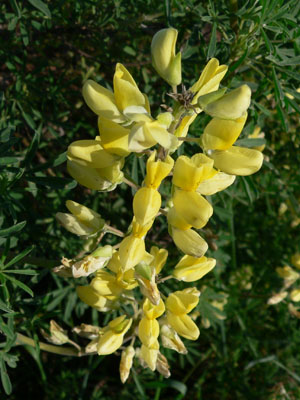
Photo: Clickie (talk) (Uploads), CC BY 2.5 · source

Shrub · Fabaceae
Tree lupin
Lupinus arboreus
In other languages: Boomlupine (Nederlands) · Lupin arbustif (Français)
The tree lupin (Lupinus arboreus) comes from the coast of California and is a fast-growing, woody lupin. Unlike the familiar border lupin, it forms a medium-sized shrub of about 1.5 m high and wide, with silvery green, palmate leaves. From May to July it carries upright flower spikes, usually yellow and sweetly scented, which attract bumblebees and bees. It loves sun and poor, well-drained sandy soil, where it grows quickly. It is short-lived and not always fully hardy, so in Flanders it often looks good for only a few years.
Caution: Poisonous: all parts of the tree lupin, especially the seeds in the pods, are poisonous to people and animals. Keep children, dogs, cats and grazing livestock away from the seeds and pods, and do not eat any part of the plant.
Light
Full sun
warm and bright
Moisture
Dry
tolerates drought
Legal basis
Sand or loam
acid to neutral
Hardiness
down to -15 °C
protect young plants
Size
1.5 m
tall, 1.5 m wide
Flowering
May–July
| Pruning months | April and July |
|---|---|
| Height | 1.5 m |
| Native to Belgium | No, planted |
| Good for bees, butterflies and birds | Yes, for bees |
| Poisonous to people and pets | Yes, take care with children and pets |
| Flowering | May–July |
Identify
Tree lupin: how do you recognise it?
- Habit
- Loose, rounded, medium-sized shrub of 1–1.5 m, sometimes 2 m, with a woody base.
- Leaves
- Palmate, divided into 5–12 narrow leaflets, silvery green and softly hairy.
- Flowers
- Upright spikes of 10–20 cm, mostly yellow, sometimes lilac or white, sweetly scented, from May to July.
- Fruit
- Hairy pods with hard seeds; the pods burst open in summer and fling the seeds away.
- Roots
- Deep taproot with nitrogen-fixing nodules; dislikes being moved.
Flowering: May–July · Plants: April–May · Pruning: April and July
In your garden
Why grow it?
- Fast growth: a sizeable flowering shrub in just one or two seasons.
- Fragrant yellow flower spikes from May to July, a feast for bumblebees and bees.
- Silvery green foliage that stays attractive all season.
- Tolerates drought and poor sandy soil where little else will grow.
- A legume that fixes nitrogen from the air in root nodules and improves the soil.
Tree lupin: where does it grow best?
- Full sun; in shade it becomes thin and flowers poorly.
- Poor, well-drained sandy or light loamy soil, acid to neutral; in rich soil it grows lush and is less hardy.
- Dry to normal soil; it tolerates drought but not wet feet.
- Sheltered from cold winter wind. Allow 1–1.5 m of space per plant.
- Light
- Sun
- Soil type
- Sand or loam
- Acidity
- Acid or neutral
- Moisture
- Dry
- Size
- 1.5 m tall, 1.5 m wide
- Hardiness
- Hardy (to -15 °C)
Goes well with
- Lavender: Likes the same poor, dry sandy soil and sun.
- Marram grass: A soft grass that suits coastal-style, loose planting.
- Evening primrose: Yellow flowers that suit a natural dry border.
- Stonecrop: A drought-tolerant perennial for the front.
- Yarrow: Flowers at the same time on poor ground.
Maintenance
Tree lupin: when and how to plant it?
Plant in April–May.
- Plant in April–May, after the hardest frosts are over, preferably young plants from a pot.
- Dig a hole as deep as the rootball and generously wide; the taproot must not be damaged.
- Set the plant at the same depth as in its pot and backfill with the native sandy soil, without rich compost or fertiliser.
- Leave 1–1.5 m between plants.
- Water in generously after planting, then only in long droughts.
Care
- Water
- In the first year water generously now and then in dry weather; afterwards it is usually not needed.
- Feeding
- Not needed and not wanted: legumes make their own nitrogen. In soil that is too rich it grows floppy and less hardy.
- Mulching
- A thin layer of grit or sand around the base keeps the soil dry and prevents wet feet.
- Deadheading
- Cut off the spikes after flowering before the pods ripen: this prevents self-seeding and keeps the plant vigorous for longer.
- Support
- In a windy spot, add a stake or support ring if the plant leans.
Tip: Plant it in poor, dry sandy soil without manure or compost, and raise spare plants from seed, because the shrub lives only a few years. Cut off the seed pods after flowering.
Tree lupin: when to prune it?
Pruning months: April and July.
When: Cut off faded flower spikes in July. In April cut back frost-damaged tips as soon as the new buds are visible.
How:
- Cut off the faded spikes with their seed pods, just above a healthy leaf.
- In spring remove frosted or dead tips back to live wood.
- Shorten the shrub lightly after flowering, by no more than a third, to keep it compact.
- Keep the pruning light and stay with your secateurs in green, leafy wood.
Caution: Do not cut back into bare old wood: tree lupin usually does not regrow from it. This is a well-known problem with lupins.
Propagation
- Seed
- The seeds have a hard coat. Soak them overnight in lukewarm water or nick them lightly, then sow in March–April in pots (taproot, so avoid pricking out). Plant out after the last frost.
- Cuttings
- In spring or summer take cuttings with a heel of old wood; the success rate is low, so take more than you need.
Tree lupin: how does it get through the winter?
Hardy to −15 °C: protect young plants.
- Hardy to about −15 °C, but in severe winters the above-ground parts can freeze; on wet soil it dies off sooner.
- Plant it in a dry, sheltered spot and protect young plants with a layer of dry leaves or horticultural fleece.
- Raise replacement plants from seed: the shrub is short-lived and is often replaced after a few years.
Diseases and pests
- Lupin aphid: Large grey-green aphids packed on the flower spike in May–June. Rinse them off with water or cut off the affected parts; ladybirds help.
- Slugs: Young plants are eaten bare in spring. Collect them in the evening or use slug barriers.
- Root rot: Limp, yellow plant on wet or heavy soil. Plant in free-draining soil and avoid wet places.
- Powdery mildew and leaf spot: White powder or brown spots in humid summers. Allow space and air, and remove affected leaves.
Through the year
- March: Sow in pots. Do not plant out yet.
- April: Plant, cut off frosted tips.
- May: First flowers. Watch for slugs on young plants.
- June: Full bloom. Watch for aphids.
- July: Cut off faded spikes before the pods ripen.
- August: Collect seed if you want to sow. Water in long droughts.
- September: Check the shrub is growing well and raise young plants if desired.
- October: Check the dry, sheltered spot. Clear fallen leaves.
Use
Edible and useful
Not edible. All parts of tree lupin are poisonous, especially the seeds in the pods: they contain bitter alkaloids that cause nausea, vomiting and dizziness. They look like lupini beans, but those come from other lupin species and are boiled and then soaked for days to remove the bitterness; never eat the seeds of an ornamental lupin. Keep children, dogs, cats and livestock away from the pods, and cut off the faded flower spikes if you do not want seed. If any is swallowed, call a poison centre (in Belgium 070 245 245) or your doctor at once.
Good for wildlife
- Bees
- Nectar and pollen for honeybees and wild bees.
You and this species
Did you know?
- Lupins belong to the pea family (Fabaceae) and live with bacteria in root nodules that fix nitrogen from the air.
- The tree lupin grows naturally along the Californian coast, on sandy soils and dunes.
- In some countries, such as New Zealand, the tree lupin has become naturalised on sandy soils and dunes.