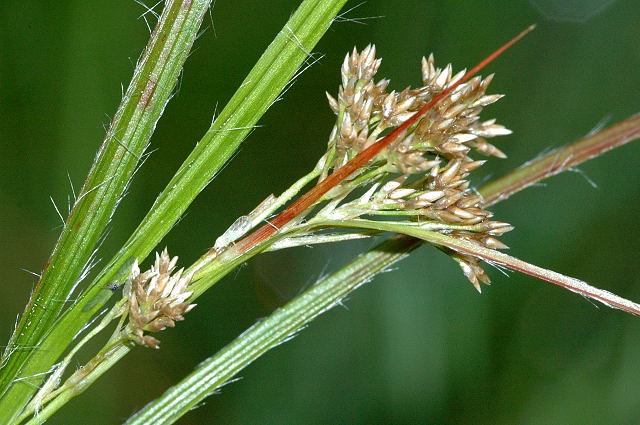
Photo: James K. Lindsey, CC BY-SA 3.0 · source

Ornamental grass · Juncaceae
White wood-rush
Luzula luzuloides
In other languages: Witte veldbies (Nederlands) · Luzule blanchâtre (Français)
The white wood-rush is a native woodland plant that grows naturally in deciduous and coniferous woods on acid soil in Europe. It is an evergreen, grass-like plant that forms loose, dense tufts about 50 cm tall (with the flowers) and 30 cm wide. The flat, soft green leaves carry long white hairs along the edge. From May to July airy, off-white flower clusters appear above the foliage. In the garden it is a low-maintenance plant for dry shade under trees, where many other plants fail.
Caution: Spreads by short rhizomes and by seed and in favourable conditions can cover large areas. Dig out runners and seedlings where you do not want them.
Light
Partial shade or shade
tolerates little sun
Moisture
Dry to normal
no wet feet
Legal basis
Sand or loam
acid
Hardiness
Fully hardy
down to -25 °C
Size
0.5 m
tall, 0.3 m wide
Flowering
May–July
| Height | 0.5 m |
|---|---|
| Native to Belgium | Yes |
| Poisonous to people and pets | Not known to be poisonous |
| Flowering | May–July |
Identify
White wood-rush: how do you recognise it?
- Habit
- Loose, dense, evergreen tuft 30–50 cm tall (with flowers) and about 30 cm wide. Spreads slowly by short rhizomes.
- Foliage
- Flat and grass-like, soft green; the edge carries long white hairs.
- Flower
- Airy, loose panicles of off-white flowers, from May to July.
- Seed
- Small capsules with seeds that have an oily appendage, which ants carry away.
- Roots
- Shallow, fibrous roots and short rhizomes.
Flowering: May–July · Plants: March–May and September–October
In your garden
Why grow it?
- Evergreen, soft, grass-like foliage that covers the ground all year round.
- Grows where little else will: dry shade under trees on acid soil.
- Airy, off-white flower clusters from May to July.
- Native, so ideal for natural gardens with a woodland feel.
- Very low maintenance and fully hardy down to about −25 °C.
- A good ground cover under oaks, beeches and hazels.
White wood-rush: where does it grow best?
- Half shade to shade: ideal for dry shade under trees.
- Acid, sandy to loamy soil, preferably with some leaf humus. No lime.
- Dry to normally moist: tolerates a temporary dry spell, but not permanently wet, waterlogged soil.
- A sheltered, woodland-style spot where the soil does not dry out in the wind.
- Plant 30–40 cm apart, about 6–10 plants per m².
- Light
- Partial shade and shade
- Soil type
- Sand or loam
- Acidity
- Acid
- Moisture
- Dry or normal
- Size
- 0.5 m tall, 0.3 m wide
- Hardiness
- Hardy (to -25 °C)
Goes well with
- Ferns: Fresh green foliage in the same dry shade.
- Wood anemone: White flowers in spring, before the wood-rush flowers.
- Solomon’s seal: Elegant arching stems with white bells in May.
- Rhododendron: Likes the same acid soil and half shade.
Maintenance
White wood-rush: when and how to plant it?
Plant in March–May and September–October.
- Plant in March–May or in September–October, when the soil is not frozen.
- Loosen the soil, also between tree roots, and work in a little leaf mould or leaf compost. Do not add lime.
- Set the plant at the same depth as in its pot, with the crown at soil level.
- Plant in groups 30–40 cm apart: they knit together within a few years.
- Water in well and keep the soil lightly moist during the first season.
- Cover the soil with a thin layer of leaves or leaf compost.
Care
- Water
- In the first year during dry weather. After that usually not needed, except in very dry summers under large trees.
- Feeding
- Not needed: the leaf fall from the trees and a little leaf compost are enough.
- Mulching
- A thin layer of leaf compost keeps the soil acid, cool and moist.
- Maintenance
- In spring, pull the dead leaves out of the tuft and remove thick layers of autumn leaves.
- Spread
- Dig out runners and seedlings where you do not want them.
Tip: Use it as an evergreen ground cover under oaks and beeches and give it acid soil: it tolerates neither lime nor a spot that is too wet.
White wood-rush: when to prune it?
When: Do not prune. Just pull the brown leaves out of the tuft in March–April.
How:
- Comb through the tuft with your fingers or a hand rake to remove dead leaves.
- Cut off the spent flower stems in late summer if you want to limit self-seeding.
- Do not cut the tuft itself short: it recovers slowly.
Caution: Cut off the flower stems before the seeds ripen if you want to limit self-seeding.
Propagation
- Division
- In March–April or September: separate pieces of the tuft or a runner with roots and replant them straight away.
- Seed
- In autumn or spring on damp compost, barely covering the seeds if at all, and keep them cool. Germination is slow.
White wood-rush: how does it get through the winter?
Hardy to −25 °C.
- Fully hardy down to about −25 °C: no protection needed.
- The leaves stay green, but may look brown for a while after hard frost. New leaves appear in spring.
- In a pot: use acid compost, place the pot in a sheltered spot and wrap it to prevent the roots from freezing.
Diseases and pests
- Drying out: Brown leaf tips in prolonged summer drought. Water and lay a thin layer of leaf compost.
- Yellow leaves: Caused by lime in the soil or water. Keep the soil acid and use rainwater, especially in a pot.
- Smothering by leaves: A thick layer of autumn leaves can smother the tuft. Remove thick leaves from the tuft.
- Too much spread: In favourable conditions it spreads a lot. Dig out runners and seedlings and cut flower stems in good time.
Through the year
- March: Comb dead leaves out of the tuft. Plant or divide.
- April: Plant or divide.
- May: Plant. Flowering begins.
- June: Flowering.
- July: Flowering ends. Water in prolonged drought.
- August: Cut off spent stems to limit self-seeding.
- September: Plant or divide.
- October: Plant. Remove thick layers of leaves from the tuft.
- November: Dormant. The tuft stays green.
You and this species
Did you know?
- The seeds have an oily appendage that ants love: the ants disperse the seeds.
- Wood-rushes are not grasses but belong to the rush family (Juncaceae). You recognise them by the long white hairs along the leaf edge.
- In the wild it often grows in deciduous and coniferous woods on acid soil, also in the uplands of central Europe.