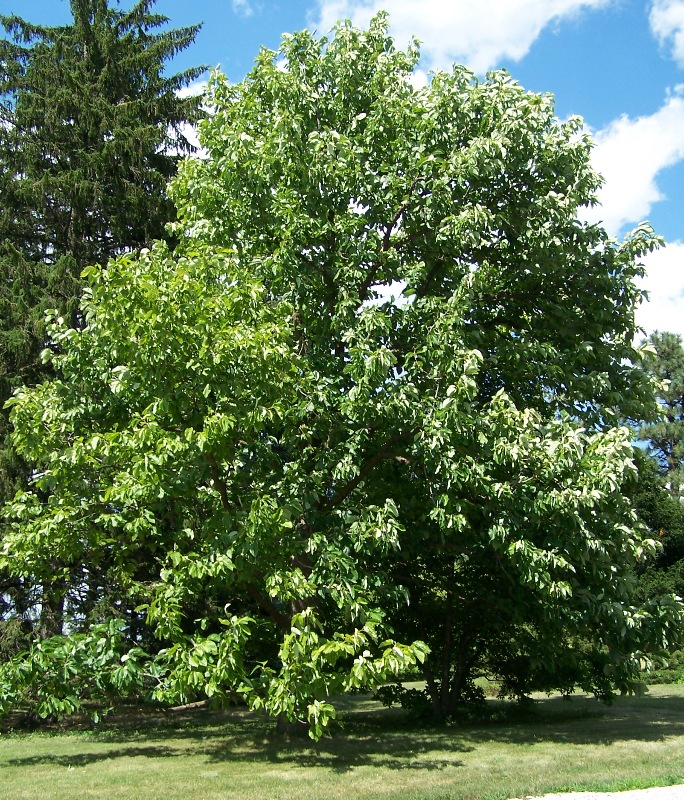
Photo: Bruce Marlin, CC BY 3.0 · source

Tree · Magnoliaceae
Cucumber tree
Magnolia acuminata
In other languages: Komkommerboom (Nederlands) · Magnolia acuminé (Français)
The cucumber tree is a large deciduous tree from eastern North America and the only magnolia that grows naturally as far north as Canada. Young trees have a narrow, pyramidal crown; later it becomes a broad, rounded tree of 20 m or more. The tulip-shaped, greenish-yellow flowers appear in May–June among the young leaves and are easily overlooked. In autumn it bears knobbly fruits that look like small cucumbers and split open red to reveal orange-red seeds. It is one of the hardiest magnolias and an impressive specimen tree for a spacious garden or a park.
Light
Sun or partial shade
preferably some sun
Moisture
Normal
no wet feet
Legal basis
Sand or loam
acid to neutral
Hardiness
Fully hardy
down to -30 °C
Size
20 m
tall, 12 m wide
Flowering
May–June
| Pruning months | July–August |
|---|---|
| Height | 20 m |
| Native to Belgium | No, planted |
| Poisonous to people and pets | Not known to be poisonous |
| Flowering | May–June |
Identify
Cucumber tree: how do you recognise it?
- Habit
- Large tree about 20 m tall and 12 m wide; narrow and pyramidal when young, later broad and rounded, with a straight trunk.
- Leaves
- Alternate, elliptical with a pointed tip, 10–25 cm long; green above, paler beneath; yellow to brown in autumn.
- Flowers
- Tulip-shaped, 6–8 cm, greenish yellow, in May–June; they hardly stand out among the foliage.
- Fruit
- Knobbly, cone-shaped fruit of 5–8 cm that resembles a small cucumber; red in autumn, with orange-red seeds hanging on threads.
- Roots
- Thick, fleshy and sparsely branched: it dislikes being moved, so plant it young in its final position.
Flowering: May–June · Plants: March–April and October–December · Pruning: July–August
In your garden
Why grow it?
- One of the hardiest magnolias: it tolerates frost down to about −30 °C.
- Unusual greenish-yellow, tulip-shaped flowers in May–June among the young leaves.
- Striking fruits like small cucumbers, turning red in autumn with orange-red seeds hanging on threads.
- Large leaves that turn from yellow to brown in autumn.
- A stately shade tree for a large garden or park, with a broad crown when mature.
- Crossed with other magnolias, it has produced yellow-flowered garden hybrids.
Cucumber tree: where does it grow best?
- Sun to partial shade; it flowers and fruits best in full sun.
- Deep, humus-rich, well-drained soil: sand or loam, acid to neutral. Avoid heavy, waterlogged clay.
- Normally moist: it likes moisture-retentive soil but not wet feet.
- Sheltered from strong wind, which can damage the large leaves.
- Allow plenty of space: 12 m wide. Plant it at least 8–10 m from the house and pipework.
- Light
- Sun and partial shade
- Soil type
- Sand or loam
- Acidity
- Acid or neutral
- Moisture
- Normal
- Size
- 20 m tall, 12 m wide
- Hardiness
- Hardy (to -30 °C)
Goes well with
- Rhododendron: Likes the same acid, humus-rich soil and flowers in spring beneath the crown.
- Hosta: Large leaves as ground cover in partial shade.
- Ferns: Soft green underplanting for the light shade beneath the tree.
- Japanese maple: Turns red in autumn and enjoys the same sheltered, humus-rich soil.
Maintenance
Cucumber tree: when and how to plant it?
Plant in March–April and October–December.
- Plant in March–April or from October to December, when the soil is neither frozen nor waterlogged. A young tree is best.
- Dig a hole twice as wide as the root ball and just as deep. Loosen the sides so the roots can grow out easily.
- Set the tree at the same depth as in its pot or root ball: the root collar stays at soil level.
- Add a stake and tie the trunk loosely with a tree tie.
- Water generously straight away, even if it is raining.
- Spread a 5–8 cm layer of mulch (leaf mould or wood chips) around the tree, keeping it clear of the trunk.
Care
- Water
- For the first two years, water generously every week in dry spells. After that it usually manages on its own, though it appreciates an extra soak in long, dry summers.
- Feeding
- Usually not needed. On poor soil, give some compost or organic fertiliser in March.
- Mulching
- Leaf mould or bark keeps the soil cool and moist and protects the shallow roots.
- Stake
- Leave the stake in place for 2–3 years and check that the tie does not cut into the bark.
- Root zone
- Do not dig or hoe deeply around the tree: the roots lie just below the surface.
Tip: Plant it young in its final position, because the fleshy roots dislike being moved. Do not dig beneath the crown; lay a mulch layer instead.
Cucumber tree: when to prune it?
Pruning months: July–August.
When: It rarely needs pruning. If it does, prune in July–August, when the tree is in leaf and wounds heal quickly.
How:
- Remove dead, damaged and crossing branches with a sharp saw or secateurs.
- Take out a double leader so that a single continuous trunk remains.
- Guide a young tree with light cuts only; avoid large saw wounds.
- Do not shorten a tall tree: the natural shape is the most attractive.
Caution: Do not prune in winter: large wounds heal slowly then and let fungi in.
Propagation
- Seed
- In autumn, remove the red flesh from the seeds and sow them outdoors in pots, or keep them for a few months in damp sand in the fridge and sow in spring. A seedling takes years to flower.
- Grafting
- Selections and hybrids are grafted by nurseries; this is difficult at home. Buying a young tree is the simplest route.
Cucumber tree: how does it get through the winter?
Hardy to −30 °C.
- Very hardy, to about −30 °C: no protection is needed in Belgium.
- A layer of mulch around the base protects the roots of young trees in the first winters.
- Because it flowers late, the blooms are at little risk from late frosts.
Diseases and pests
- Yellow leaves: Yellow leaves with green veins (chlorosis), especially on chalky or waterlogged soil. Mulch with acid leaf mould, avoid lime and improve drainage.
- Brown leaf edges: Drought or strong, dry wind scorches the edges. Water generously in dry spells, especially young trees, and choose a sheltered spot.
- Root rot: In soil that stays wet for long periods the tree wilts and the crown dies back. Plant on a well-drained spot and do not overwater.
- Scale insects: Small brown or white bumps on twigs, sometimes with sticky honeydew. Brush them off with a soft brush and soapy water.
Through the year
- March: Planting is possible. Fit a stake, apply mulch.
- April: Plant. On poor soil, give compost. Water new plantings in dry weather.
- May: The first flowers appear among the young leaves. Water in dry weather.
- June: Flowering. Water young trees weekly in dry weather.
- July: If needed, remove dead or crossing branches. Water in dry weather.
- August: Prune if needed. Water in hot weather.
- September: The fruits ripen and turn red.
- October: Plant. Autumn colour yellow to brown. Collect seed.
- November: Plant. Mulch around young trees.
- December: Planting still possible in mild weather. Rest.
You and this species
Did you know?
- The name cucumber tree refers to the young green fruits, which look like small cucumbers; acuminata means ‘pointed’ and describes the tip of the leaf.
- It is the only magnolia that grows naturally in Canada: in southern Ontario, where it is very rare.
- Magnolias are among the oldest flowering plants and have long been pollinated by beetles.