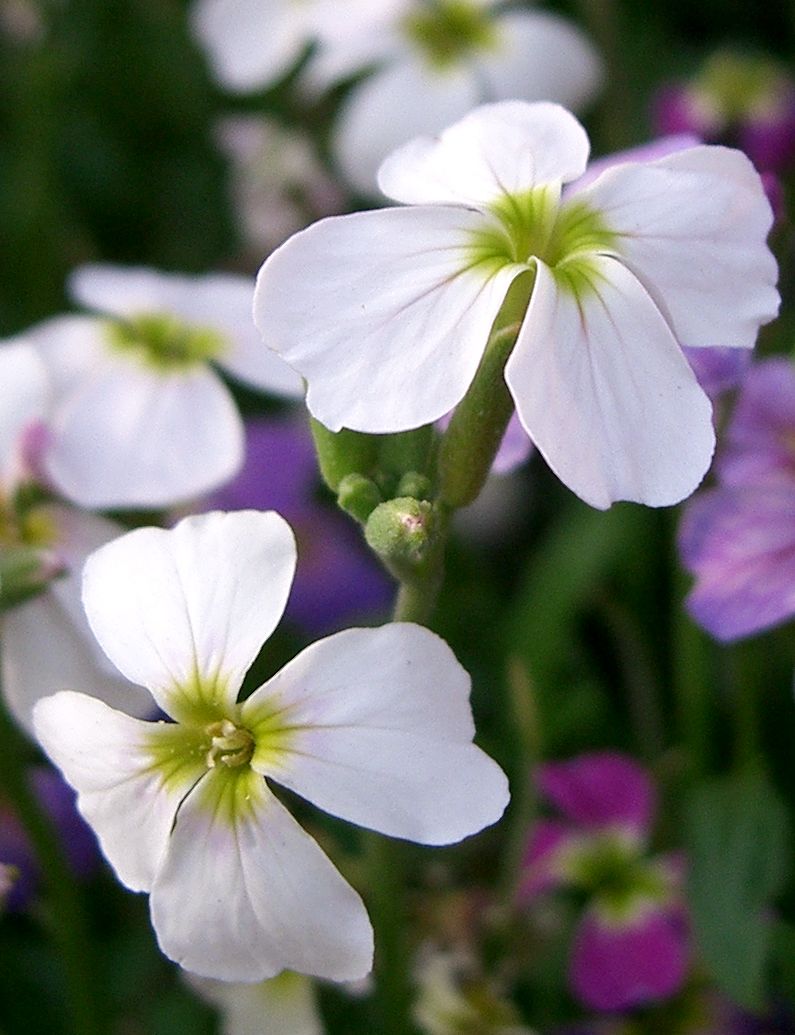
Photo: KENPEI, CC BY-SA 3.0 · source

Annual · Brassicaceae
Virginia stock
Malcolmia maritima
In other languages: Zeeviolier (Nederlands) · Julienne de Mahon (Français)
Virginia stock is a quick, low-growing annual from the eastern Mediterranean, from Greece and Albania. Despite its English name it does not come from Virginia. It forms soft, grey-green cushions with small, scented flowers with four petals in pink, lilac, red and white. The scent is strongest in the evening. It flowers just four weeks after sowing, and by sowing again every few weeks you have flowers from May to September.
Light
Sun or partial shade
preferably some sun
Moisture
Normal
no wet feet
Legal basis
Sand, loam or clay
any pH
Hardiness
down to -5 °C
protect in harsh winters
Size
0.2 m
tall, 0.15 m wide
Flowering
May–September
| Height | 0.2 m |
|---|---|
| Native to Belgium | No, planted |
| Good for bees, butterflies and birds | Yes, for bees |
| Poisonous to people and pets | Not known to be poisonous |
| Flowering | May–September |
Identify
Virginia stock: how do you recognise it?
- Habit
- Low, bushy annual 15–30 cm tall and 10–15 cm wide.
- Leaves
- Narrow, lance-shaped to elliptical, 2–5 cm, grey-green and slightly hairy.
- Flowers
- Small cross-shaped flowers with four petals in pink, lilac, red or white, in clusters, from May to September.
- Scent
- Sweet; strongest in the evening and in warm weather.
- Fruit
- A long, narrow pod holding fine seeds.
Flowering: May–September · Sowing: March–July
In your garden
Why grow it?
- One of the fastest annuals: it flowers four weeks after sowing.
- Sweetly scented little flowers, especially in the evening: ideal near a terrace, window or seating area.
- Bees and other insects visit the flowers.
- With staggered sowings it flowers from May to September.
- Low and bushy: lovely as an edging, in containers and among bulbs and perennials.
- Easy for children and beginners.
Virginia stock: where does it grow best?
- Sun to partial shade; it flowers best in sun.
- Sand, loam or clay, neutral to chalky; ordinary garden soil is enough.
- Normally moist; flowering soon stops in drought.
- Keep 10–15 cm between plants, in drifts or as an edging.
- Sow it close to a terrace or window so you can enjoy the scent.
- Light
- Sun and partial shade
- Soil type
- Sand, loam or clay
- Acidity
- Not fussy
- Moisture
- Normal
- Size
- 0.2 m tall, 0.15 m wide
- Hardiness
- Tolerates light frost (to -5 °C)
Goes well with
- Lobelia: Little blue flowers beside the pink and white scented ones.
- Marigold: Warm yellow or orange as a contrast.
- Mignonette: Another annual with a strong evening scent.
- Petunia: A free-flowering neighbour for pots and containers.
Maintenance
Virginia stock: when and how to plant it?
- Sow from March to July outdoors, in place, in a sunny or lightly shaded spot.
- Loosen the soil, remove weeds and rake the seedbed fine.
- Scatter the seed thinly and cover it with about 0.5 cm of soil.
- Keep the soil moist; the seed germinates within 1–2 weeks.
- Thin the seedlings to 10–15 cm apart.
- Sow a new patch every 3 weeks for continuous flowering.
Care
- Water
- Water regularly in dry weather; moist soil keeps the flowers coming.
- Feeding
- Not needed; in rich soil it mostly makes leaf and flowers less.
- Weeding
- Keep the young seedlings free of weeds.
- Spent plants
- Remove plants that have finished flowering and resow on the spot.
- Successive sowing
- Sow every 3 weeks until July for flowers into September.
Tip: Sow it right beside the terrace or an open window and repeat every few weeks: the scent is lovely especially in the evening, and you have flowers all summer.
Virginia stock: when to prune it?
When: Pruning is not needed; it is an annual.
How:
- Cut off spent stems to extend flowering a little.
- Remove plants that have finished and resow.
- At the end of the season let a few pods ripen if you want it to self-seed.
Propagation
- Sowing
- From March to July in place (see planting). Store the seed dry and cool.
- Self-seeding
- Let a few pods ripen in September: the seed comes back by itself on open soil.
Virginia stock: how does it get through the winter?
Hardy to −5 °C: protect in harsh winters.
- Annual: the plant dies in autumn. Seed and young seedlings tolerate frost to about −5 °C.
- For very early flowers you can sow in September in a sheltered spot, but spring sowing is the safest.
- Clear the plants in autumn.
Diseases and pests
- Flea beetles: Small holes in the leaves of young plants in dry spring weather. Keep the soil moist or cover with fine insect mesh.
- Clubroot: It belongs to the cabbage family. Swollen, misshapen roots and failing plants. Do not sow where cabbages grew.
- Slugs: May strip young seedlings. Collect them in the evening or spread a ring of coarse material.
- Aphids: On young shoots in warm weather. A jet of water is usually enough.
Through the year
- March: First sowing in place.
- April: Sow. Thin the seedlings.
- May: Sow. First sowing flowers.
- June: Flowering. Sow again for flowers in late summer.
- July: Last sowing. Water in dry weather.
- August: Flowering. Clear spent plants.
- September: Last flowers. Let a few pods ripen.
- October: Clear the plants.
Use
Good for wildlife
- Bees
- Nectar and pollen for honeybees and wild bees.
You and this species
Did you know?
- Despite its English name Virginia stock, it comes from the Mediterranean region, not from Virginia.
- It belongs to the cabbage family, like cabbage and radish: hence the flower with four petals in a cross.
- The scent is stronger in the evening, which attracts moths.