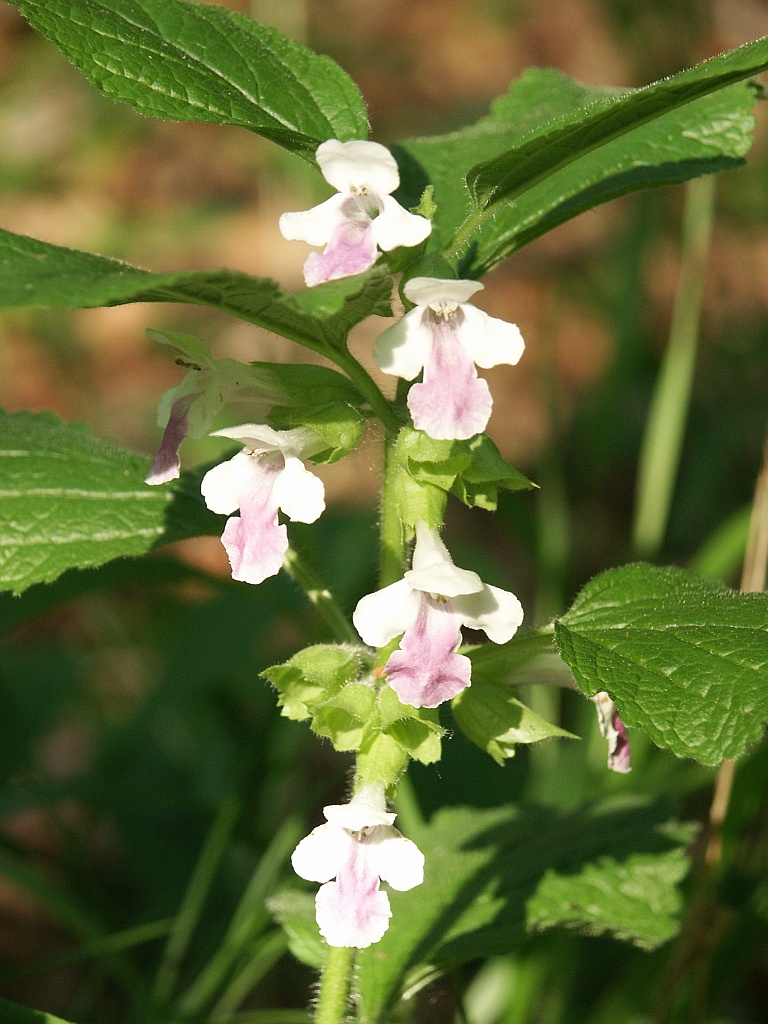
Photo: Wikimedia Commons, CC BY-SA 3.0 · source

Perennial · Lamiaceae
Bastard balm
Melittis melissophyllum
In other languages: Bijenblad (Nederlands) · Mélitte à feuilles de mélisse (Français)
Bastard balm is a low perennial from the deciduous woods and woodland edges of western and southern Europe. Its foliage resembles that of lemon balm: oval, wrinkled, finely hairy and soft to the touch, with a sweet, aromatic scent. In May and June, large two-lipped flowers of 3–4 cm appear in the leaf axils, white with a pink to purple lower lip. It is a plant for a quiet corner: it grows slowly, gets better every year and dislikes being moved. As a bee plant and as an ornament for light shade it is a small treasure.
Light
Partial shade or shade
tolerates little sun
Moisture
Normal
no wet feet
Legal basis
Loam or clay
neutral to chalky
Hardiness
Fully hardy
down to -25 °C
Size
0.4 m
tall, 0.4 m wide
Flowering
May–June
| Pruning months | March |
|---|---|
| Height | 0.4 m |
| Native to Belgium | No, planted |
| Good for bees, butterflies and birds | Yes, for bees |
| Poisonous to people and pets | Not known to be poisonous |
| Flowering | May–June |
Identify
Bastard balm: how do you recognise it?
- Habit
- Compact clump 30–40 cm tall and wide, with upright, square stems.
- Foliage
- Oval with a toothed edge, wrinkled and softly hairy; sweetly aromatic.
- Flower
- Large lipped flowers of 3–4 cm in whorls in the leaf axils, in May and June.
- Colour
- White with a pink to purple lower lip.
- Roots
- Thick, deep roots; the plant is slow to start and dislikes being moved.
Flowering: May–June · Plants: March–April and September–October · Pruning: March
In your garden
Why grow it?
- Strikingly large white and pink lipped flowers in May and June, rare in a shady border.
- A true bee plant: its name refers to the bees that visit the flowers.
- Soft, aromatic foliage with a sweet scent, especially when you crush it.
- Grows in light shade and on chalky soil, where many other flowering plants struggle.
- Very little work: cutting off the old stems once a year is enough.
Bastard balm: where does it grow best?
- Partial or full shade, for instance at the edge of trees or shrubs; it dislikes full midday sun.
- Humus-rich, well-drained loam or clay, neutral to chalky.
- Moderately moist: not too dry, but not where water stands.
- Plant 40 cm apart or as a single specimen; give it room, because it dislikes disturbance.
- Light
- Partial shade and shade
- Soil type
- Loam or clay
- Acidity
- Neutral or chalky
- Moisture
- Normal
- Size
- 0.4 m tall, 0.4 m wide
- Hardiness
- Hardy (to -25 °C)
Goes well with
- Solomon’s seal: Arching stems with white bells, in the same light shade.
- Ferns: Fresh green foliage that strengthens the woodland-edge feel.
- Hardy geranium: Geranium macrorrhizum or another shade-tolerant species closes the ground between the clumps.
- Wood anemone: Flowers earlier; bastard balm takes over afterwards.
Maintenance
Bastard balm: when and how to plant it?
Plant in March–April and September–October.
- Plant in March–April or in September–October, when the soil is moist and not frozen.
- Dig a hole twice as wide as the root ball and loosen the bottom; mix in a little compost.
- Take the plant carefully out of its pot and set it at the same depth, without damaging the roots.
- Keep 40 cm from its neighbours and firm the soil.
- Water in at once and lay a layer of leaf mould around the plant, without covering the base of the stems.
Care
- Water
- In the first year, water regularly in dry weather; after that only in long dry spells.
- Feeding
- A spade of compost in spring is enough; no strong chemical fertiliser.
- Mulching
- A thin layer of leaf mould in autumn keeps the soil loose and moist, as in a wood.
- Moving
- Avoid it: it recovers slowly. Choose a permanent spot straight away.
- Tidying
- Leave the stems standing until late winter or cut them in March; that way you can see where the new shoots come from.
Tip: Put it in its permanent spot straight away and leave it alone: it grows slowly and moving it costs years. A little leaf mould each year is enough.
Bastard balm: when to prune it?
Pruning months: March.
When: It is hardly pruned. Cut off the dead stems in March, just before the new shoots appear.
How:
- Cut last year’s withered stems to just above the ground.
- Remove dead or damaged parts and leave the new shoots alone.
- There is no need to deadhead; leave the seed capsules if you want to collect seed.
Propagation
- Seed
- Sow fresh seed outdoors in autumn in a seed tray and let it spend the winter outside. It germinates slowly and unevenly; be patient.
- Division
- Only on large, old plants, in March or September, losing as few roots as possible. It does not always tolerate this well.
Bastard balm: how does it get through the winter?
Hardy to −25 °C.
- Fully hardy, down to about −25 °C: no protection is needed in Belgian winters.
- The stems die back in winter; leave them as protection and cut them off in March.
- Do not plant it where water stands in winter: wet feet are more dangerous than frost.
Diseases and pests
- Slugs: Young shoots nibbled in spring. Collect them in the evening, or lay a ring of coarse grit around the plant.
- Powdery mildew: White powder on the leaves in a dry, stuffy summer. Mulching and watering in dry weather prevent it; bin affected leaves.
- Root rot: Yellow leaves and a limp plant in a wet spot. Improve drainage with coarse sand, or choose another position.
- Slow to establish: In the first years it hardly grows: that is normal. Do not move it; be patient and give compost.
Through the year
- March: Cut back old stems. Add compost. Plant.
- April: Plant. Mulch. Watch for slugs.
- May: Flowering starts. Watch the bees.
- June: Full flower. Water in long dry spells.
- July: Seed set; collect seed for sowing.
- August: Water in dry weather. Watch for mildew.
- September: Plant. Sow fresh seed.
- October: Plant. Leaf mould as mulch.
Use
Good for wildlife
- Bees
- Nectar and pollen for honeybees and wild bees.
You and this species
Did you know?
- The Latin name comes from the Greek word for bee: the flowers are heavily visited by bees and bumblebees.
- The genus Melittis contains only one species, bastard balm itself.
- It belongs to the mint family, like mint, sage and lemon balm; its foliage indeed closely resembles that of lemon balm.