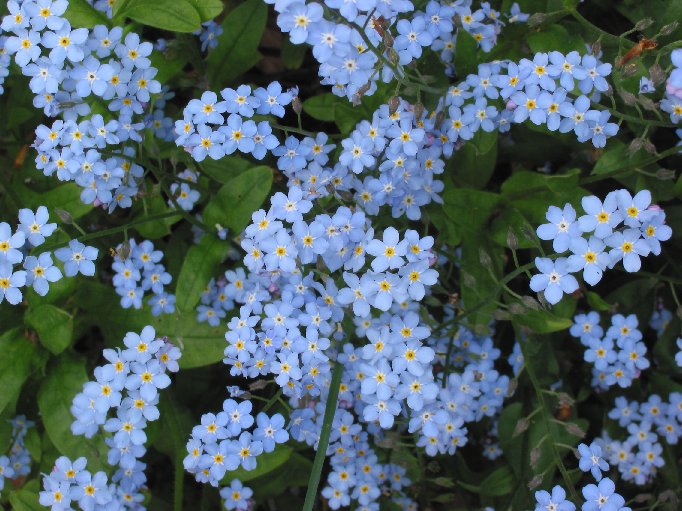
Photo: Rasbak at Dutch Wikipedia, CC BY-SA 3.0 · source

Annual · Boraginaceae
Wood forget-me-not
Myosotis sylvatica
In other languages: Bosvergeet-mij-nietje (Nederlands) · Myosotis des bois (Français)
Wood forget-me-not is a native plant of damp woods and woodland edges across Europe, Belgium included. It is a biennial used as a bedding plant: you sow it in summer, it forms a rosette of leaves and flowers the following spring, from April to June. Clouds of small sky-blue flowers with a yellow eye then appear above the soft, hairy leaves. There are also varieties with pink or white flowers and compact varieties for beds and pots. It is the classic partner for tulips and afterwards self-seeds freely all over the place.
Light
Sun to shade
not fussy
Moisture
Normal to wet
must not dry out
Legal basis
Sand, loam or clay
any pH
Hardiness
Fully hardy
down to -20 °C
Size
0.25 m
tall, 0.2 m wide
Flowering
April–June
| Height | 0.25 m |
|---|---|
| Native to Belgium | Yes |
| Good for bees, butterflies and birds | Yes, for bees |
| Poisonous to people and pets | Not known to be poisonous |
| Flowering | April–June |
Identify
Wood forget-me-not: how do you recognise it?
- Habit
- Loose, upright clump 20–30 cm tall and about 20 cm wide, growing from a leaf rosette.
- Leaves
- Oblong to lance-shaped, soft and densely hairy; grey-green.
- Flower
- Small flowers of 6–10 mm with five rounded petals, in coiled sprays that slowly unroll, from April to June.
- Colour
- Sky blue with a yellow eye; the buds are often pink. There are also pink and white varieties.
- Fruit
- Tiny, glossy black nutlets in a calyx with hooked hairs, which clings to clothing and animal fur.
Flowering: April–June · Sowing: May–July · Plants: September–October
In your garden
Why grow it?
- A sea of blue flowers in April and May, just when the tulips are out.
- Native and an early source of nectar for bees and bumblebees.
- Grows in sun, partial shade and even shade, including on damp soil.
- Self-seeds: sow it once and it returns every spring.
- Fully hardy and easy, ideal for beginners and children.
Wood forget-me-not: where does it grow best?
- Sun, partial shade or shade; it flowers longest in partial shade.
- Humus-rich sandy, loamy or clay soil, acid to chalky.
- Normal to moist: it likes soil that does not dry out.
- Plant 15–20 cm apart, among bulbs or as underplanting beneath shrubs.
- Light
- Sun, partial shade and shade
- Soil type
- Sand, loam or clay
- Acidity
- Not fussy
- Moisture
- Normal or wet
- Size
- 0.25 m tall, 0.2 m wide
- Hardiness
- Hardy (to -20 °C)
Goes well with
- Tulip: The classic combination: a blue carpet beneath pink, white or orange tulips.
- Wallflower: Scented orange and yellow flowers in the same spring bed.
- Bleeding heart: Pink hearts above a blue sea, in partial shade.
- Ferns: Fresh green foliage that takes over once the forget-me-nots have finished.
Maintenance
Wood forget-me-not: when and how to plant it?
Plant in September–October.
- Sow outdoors in May–July in a seedbed or in rows and cover the seed thinly with fine soil.
- Keep the seedbed moist until the seedlings come up.
- Thin the seedlings or prick them out 10 cm apart so they form sturdy rosettes.
- In September–October, plant them where they are to flower, 15–20 cm apart, at the same time as your tulip bulbs.
- Set the rosettes at the same depth as before, firm in and water.
Care
- Water
- Keep the soil moist, especially in a dry spring: in dry weather flowering ends sooner and powdery mildew appears faster.
- Feeding
- Not needed; a little compost at planting time is enough.
- After flowering
- Pull the plants up after flowering, especially if mildew appears. Leave a few if you want it to self-seed.
- Seedlings
- Seedlings that are too crowded or in the wrong place are easy to move or weed out in autumn.
Tip: Sow in June–July and plant the rosettes among your tulip bulbs in autumn. Pull the plants up after flowering if mildew appears: it will self-seed generously anyway.
Wood forget-me-not: when to prune it?
When: No pruning is needed. After flowering, in June, pull the plants up or leave them to set seed.
How:
- Leave a few plants until the seed is ripe if you want it to self-seed; then shake them out over the border.
- Pull up the other plants, roots and all, after flowering.
- If you do not want seedlings, clear the plants before the seed ripens.
Propagation
- Seed
- Outdoors in May–July in a seedbed, covering the seed thinly. Plant out in September–October where they are to flower.
- Self-seeding
- Leave a few plants to set seed after flowering. Seedlings appear in late summer and autumn and can be moved.
Wood forget-me-not: how does it get through the winter?
Hardy to −20 °C.
- Fully hardy to about −20 °C: the leaf rosettes overwinter without protection.
- The rosettes stay green through winter and start growing again in March.
- In a pot or trough: make sure there is a drainage hole so excess winter water can escape.
Diseases and pests
- Powdery mildew: A white powder on the leaves, especially towards the end of flowering and in dry weather. Water in dry spells, give the plants space and pull up affected plants after flowering.
- Too many seedlings: It self-seeds very freely. Weed out or move surplus seedlings in autumn; you can recognise them by their hairy leaves.
- Slugs: They eat young rosettes in autumn. Pick them off in the evening, or lay down a board as a hiding place and clear it in the morning.
- Rot: In a mild, wet winter, rosettes can rot away. Do not plant too closely and remove dead leaves.
Through the year
- March: The rosettes start growing again. Weed and add a little compost if you like.
- April: Flowering begins, together with the tulips.
- May: In full flower. Sow in a seedbed.
- June: Flowering ends. Pull up the plants or let them self-seed. Sow more.
- July: Last month for sowing. Keep seedlings moist.
- August: Thin or prick out seedlings.
- September: Plant out where they are to flower, together with tulip bulbs.
- October: Still time to plant. Move self-sown seedlings.
- November: The rosettes overwinter in the ground.
Use
Good for wildlife
- Bees
- Nectar and pollen for honeybees and wild bees.
You and this species
Did you know?
- Myosotis means ‘mouse ear’, from the Greek mys (mouse) and ous (ear): the small, hairy leaf looks like a mouse’s ear.
- The flower buds are often pink and turn blue as they open. This colour change is also seen in other plants of the borage family, such as lungwort.
- Many languages give it the same name: forget-me-not, vergeet-mij-niet, Vergissmeinnicht and ne-m’oubliez-pas. The little flower is therefore a symbol of faithfulness and remembrance.