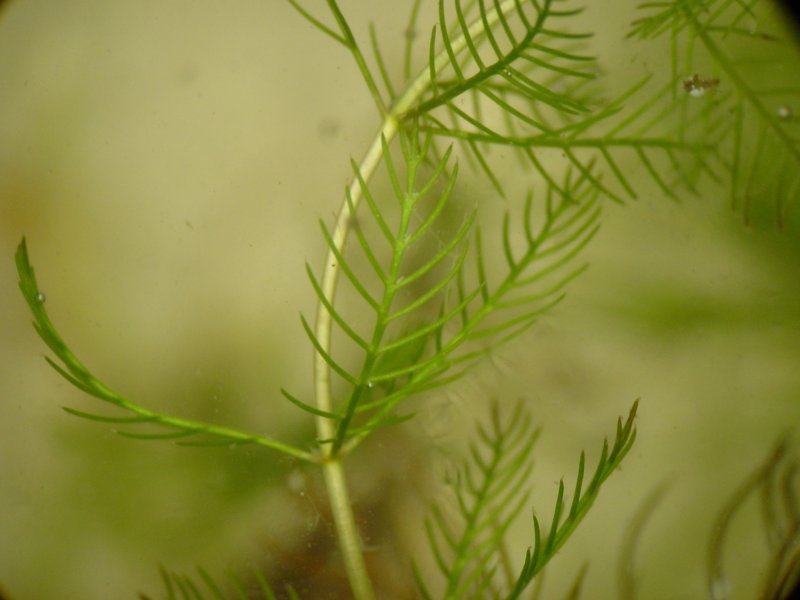
Photo: Kristian Peters -- Fabelfroh 10:43, 2 March 2006 (UTC), CC BY-SA 3.0 · source

Water or marginal plant · Haloragaceae
Spiked water-milfoil
Myriophyllum spicatum
In other languages: Aarvederkruid (Nederlands) · Myriophylle en épi (Français)
Spiked water-milfoil is a native submerged aquatic plant found across much of Europe and Asia in lakes, canals, ditches and slow rivers, especially in lime-rich water. It forms long, branching stems with whorls of usually four finely divided, feathery leaves that float in the water like little green plumes. The plant grows almost entirely underwater; only its small, inconspicuous flower spikes sometimes poke just above the surface. Pond keepers value it as a strong oxygenator that takes up nutrients and so holds back algae. It grows fast and also copes with deeper water, down to 1.5 m.
Caution: A fast-growing plant that can regrow from every broken piece of stem. Keep it in check in the garden pond and never put stems or plant waste into ditches, streams or ponds in the wild. Buy only correctly labelled plants: the related non-native species parrot’s feather and variable-leaf water-milfoil are banned in the European Union as invasive species.
Light
Sun or partial shade
preferably some sun
Moisture
Moist to wet
must not dry out
Legal basis
Loam, clay or peat
neutral to chalky
Hardiness
Fully hardy
down to -25 °C
Size
0.05 m
tall, 1 m wide
| Pruning months | July–August |
|---|---|
| Height | 0.05 m |
| Native to Belgium | Yes |
| Poisonous to people and pets | Not known to be poisonous |
Identify
Spiked water-milfoil: how do you recognise it?
- Habit
- Long, branching stems that lengthen with the water depth and spread out just below the surface; one plant soon covers 1 m across.
- Leaves
- In whorls of usually four around the stem, feathery and divided into thread-like segments; olive to dark green, sometimes reddish.
- Flowers
- Small, inconspicuous reddish flowers on an upright spike that rises just above the water; they are wind-pollinated.
- Roots
- Fine roots at the stem base and at the nodes; broken-off pieces root again easily.
- Pond zone
- Submerged plant or oxygenator for 30–150 cm depth.
Plants: April–August · Pruning: July–August
In your garden
Why grow it?
- A strong oxygenator: the fine leaves take up nutrients from the water, which holds back algae.
- Also grows in deeper water, down to 1.5 m, where few other plants manage.
- Fish lay their eggs among the fine leaves, and young fish, tadpoles and water insects shelter there.
- Native and easy: a bunch of stems weighted to the bottom with a stone is all it takes.
- Its fine, feathery foliage is surprisingly beautiful underwater in a clear pond.
Spiked water-milfoil: where does it grow best?
- Sun or partial shade; in deep shade it grows slowly.
- Clear, neutral to lime-rich water; it does less well in soft, acid water.
- Planting depth 30–150 cm below the surface, on the bottom or in a basket.
- Loam or clay on the pond floor, or a basket of heavy soil; no potting compost.
- A few bunches are enough for an ordinary garden pond: it fills out quickly.
- Light
- Sun and partial shade
- Soil type
- Loam, clay or peat
- Acidity
- Neutral or chalky
- Moisture
- Wet
- Size
- 0.05 m tall, 1 m wide
- Hardiness
- Hardy (to -25 °C)
Goes well with
- Yellow water lily: Large floating leaves above the fine foliage, in the same deep zone.
- Frogbit: Floats on the water and casts shade, holding back algae even more.
- Mare’s-tail: Straight stems in shallower water, around the oxygenators.
- Fringed water lily: Yellow flowers on the water in summer, in the same lime-rich water.
Maintenance
Spiked water-milfoil: when and how to plant it?
Plant in April–August.
- Plant from April to August, once the water has warmed and growth is rapid.
- Tie a bunch of five to ten stems, 15–20 cm long, at the base to a small stone with a piece of string; preferably avoid lead weights.
- Lower the bunch to 30–150 cm deep so the stone holds it on the bottom, or push the base 5 cm deep into a basket of heavy soil.
- Top a basket with gravel so fish do not dig up the soil.
- Rinse new plants first and check them for unwanted plants, snail eggs and blanketweed.
- A few bunches are enough; it fills out a great deal in one season.
Care
- Thinning
- In July–August, rake or pull out some of the stems if it fills more than a third of the pond.
- Feeding
- Never: it takes its nutrients from the water and the pond floor.
- Algae
- Twist blanketweed out from between the stems with a stick.
- Water level
- Top up with rainwater so the water stays clear and low in nutrients.
- Autumn
- Net fallen leaves out of the pond so no thick layer of sludge builds up.
Tip: Thin it out every summer so it fills no more than a third of the pond: that way it stays a useful oxygenator rather than a thug.
Spiked water-milfoil: when to prune it?
Pruning months: July–August.
When: Thin out in July and August, when it takes up too much space.
How:
- Pull or rake out part of the stems; always leave a good amount as an oxygenator.
- Cut or pull away stems that form a dense mat at the surface.
- Leave thinned stems on the bank for a day so small creatures can crawl back into the pond.
- Gather broken fragments carefully: every piece can root again.
Caution: Put thinned stems on the compost heap, never into a ditch, stream or pond in the wild.
Propagation
- Stem cuttings
- From April to August, tie 15–20 cm pieces of stem to a small stone and let them sink, or push them into a basket. They root within a few weeks.
- Division
- In spring, lift a rooted clump from a basket, split it and replant the pieces.
Spiked water-milfoil: how does it get through the winter?
Hardy to −25 °C.
- Hardy to about −25 °C: it overwinters underwater on the bottom.
- In autumn some of the stems die back; in spring new shoots grow from the base.
- Make sure the pond does not freeze to the bottom; in a garden pond with a deep section that is rarely a problem in a Belgian winter.
Diseases and pests
- Spreading: In a small, nutrient-rich pond it soon fills all the water. Thin out every summer.
- Blanketweed: Forms woolly masses between the stems. Twist it out with a stick and tackle the cause: no fertiliser and not too much fish food.
- Fish: Goldfish and koi eat the young shoots and pull the bunches loose. Plant in a basket and protect young bunches with mesh if needed.
- Limp, bare stems: Too little light or water that is too soft. Move it to a sunnier spot or shallower water.
Through the year
- April: Plant: sink bunches weighted with a stone.
- May: Plant. Rapid growth begins.
- June: Plant. Remove blanketweed.
- July: Thin out if it fills more than a third of the pond.
- August: Thin out. Last month for planting.
- October: Net fallen leaves out of the pond.
- December: Resting on the pond floor.
You and this species
Did you know?
- In North America, where it was introduced, spiked water-milfoil has become one of the most troublesome invasive aquatic plants.
- Myriophyllum means ‘countless leaves’ in Greek, after the finely divided foliage.
- The flowers are wind-pollinated, which is why the flower spike rises above the water.