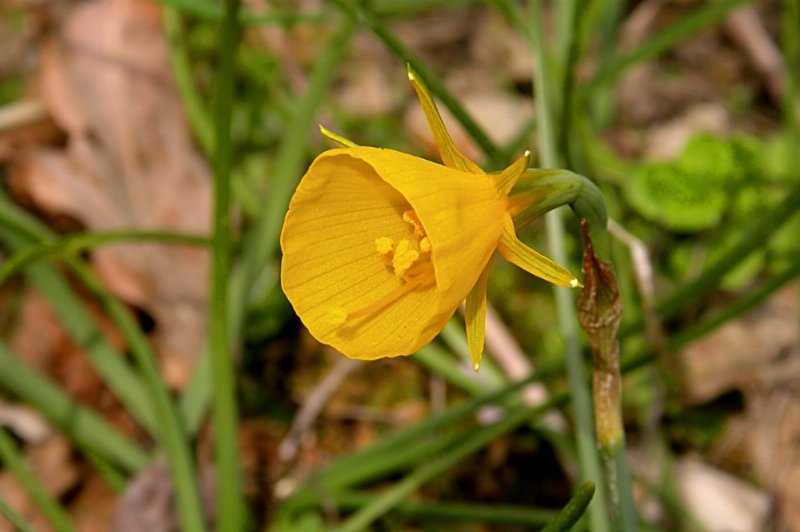
Photo: Jean-Jacques MILAN, CC BY-SA 3.0 · source

Bulb or tuber · Amaryllidaceae
Hoop-petticoat daffodil
Narcissus bulbocodium
In other languages: Hoepelroknarcis (Nederlands) · Narcisse bulbocode (Français)
The hoop-petticoat daffodil comes from damp meadows and mountain pastures in Spain, Portugal, south-west France and Morocco. It is a small, unusual bulb, 10–20 cm tall. The yellow flower is almost all trumpet, with narrow, tiny petals behind it: the shape recalls a hooped skirt. The leaves are thin and rush-like. It flowers in March and April and suits short grass, a rock garden or a dish of grit, as long as the soil is moist in spring and can dry out in summer.
Caution: All parts of the plant, especially the bulb, are poisonous. Do not eat them: children, cats, dogs and grazing livestock are at risk. The sap can irritate the skin of some people: wear gloves when planting.
Light
Sun or partial shade
preferably some sun
Moisture
Normal
no wet feet
Legal basis
Sand or loam
acid to neutral
Hardiness
down to -15 °C
protect young plants
Size
0.15 m
tall, 0.1 m wide
Flowering
March–April
| Height | 0.15 m |
|---|---|
| Native to Belgium | No, planted |
| Poisonous to people and pets | Yes, take care with children and pets |
| Flowering | March–April |
Identify
Hoop-petticoat daffodil: how do you recognise it?
- Habit
- Small bulb, 10–20 cm tall and 10 cm wide, growing in clumps.
- Leaves
- Thin, dark green and rush-like, almost round; the leaves are often taller than the flower.
- Flower
- One yellow flower per stem, with a wide, cone-shaped trumpet and narrow, short petals; in March–April.
- Bulb
- Small, round bulb with a dark skin; it dries out fast if left above ground for long.
Flowering: March–April · Plants: September–October
In your garden
Why grow it?
- An unusual, quirky flower shape: a wide yellow trumpet without the usual broad petals.
- Flowers in March and April, early in the year when little else is in bloom.
- Small and compact: fits a rock garden, a shallow bowl or a spring lawn.
- Spreads slowly and returns year after year in a good spot.
- Low maintenance: no pruning, hardly any feeding and not bothered by deer.
Hoop-petticoat daffodil: where does it grow best?
- Sun or light partial shade; it flowers best in an open, sunny spot.
- Free-draining sandy or loamy soil, acid to neutral; preferably not too heavy.
- Moist in spring, drier in summer: the bulb rots in wet soil during its rest.
- Plant in groups of at least 10 small bulbs, 8–10 cm apart.
- Light
- Sun and partial shade
- Soil type
- Sand or loam
- Acidity
- Acid or neutral
- Moisture
- Normal
- Size
- 0.15 m tall, 0.1 m wide
- Hardiness
- Hardy (to -15 °C)
Goes well with
- Crocus: Flowers at the same time and brightens short-mown grass.
- Grape hyacinth: A blue carpet under the yellow trumpets.
- Glory-of-the-snow: Blue stars that flower at the same time.
- Horned violet: A low flowering plant for the space between the bulbs.
Maintenance
Hoop-petticoat daffodil: when and how to plant it?
Plant in September–October.
- Plant in September or October; the small bulbs dry out quickly, so plant them soon after buying.
- Choose a sunny spot; in heavier soil, mix in some coarse sand or fine grit.
- Set the bulb pointed end up, 5–8 cm deep.
- Leave 8–10 cm between bulbs and plant in groups of 10 or more so the flowers stand out.
- Water once after planting, unless it rains.
- In a pot or bowl: use a mix of potting compost and sharp sand, with drainage holes.
Care
- Water
- Keep the soil lightly moist in spring while the plant is growing. Leave it dry in summer; it tolerates drought while the bulb is resting.
- Feeding
- Little needed. If you like, give a little bulb fertiliser or compost after flowering.
- Leaves
- Leave the leaves until they turn yellow on their own, so the bulb can build up reserves.
- Mowing in grass
- Mow only once the leaves are yellow, usually in June–July.
- Weeds
- Keep the spot free of rampant grass and weeds, because this small plant is easily swamped.
Tip: Give it a spot with short grass or grit that is moist in spring and can dry out in summer. Plant the little bulbs straight after buying, because they dry out quickly.
Hoop-petticoat daffodil: when to prune it?
When: No pruning is needed. Just wait until the leaves die back on their own, in June.
How:
- Leave the faded flowers or snip them off; it makes little difference to the bulb.
- Leave the leaves until they are completely yellow and limp, and only then remove them.
- In grass, wait to mow until the leaves are yellow.
Caution: Mowing or cutting the leaves too early weakens the bulb and gives fewer flowers next year.
Propagation
- Division
- In June–July, when the leaves are yellow: lift the clump carefully, separate the offsets and replant them straight away, 5–8 cm deep.
- Seed
- In a good spot it self-seeds. You can sow fresh seed in summer in a tray; seedlings take a few years to flower.
Hoop-petticoat daffodil: how does it get through the winter?
Hardy to −15 °C: protect young plants.
- Hardy to about −15 °C: no protection is needed in Belgian winters.
- The leaf tips sometimes appear in winter; light frost does not harm them.
- In a pot: put it in a sheltered spot against a wall and do not let it stand full of water, so the bulb neither rots nor freezes solid.
Diseases and pests
- Dried-out bulbs: The small bulbs are hard, wrinkled or empty. Buy fresh bulbs, do not soak them and plant them quickly.
- Bulb rot: The bulb is soft and mouldy, especially in cold, wet soil. Provide well-drained soil and remove affected bulbs.
- No flowers: Leaves appear but no flowers. The cause is usually too little light, a growing season that was too wet or too dry, or leaves removed too early. Move it to a sunnier spot.
- Swamped by grass: Tall grass or rampant plants smother this small plant. Keep the spot short and weed-free.
- Slugs: Holes in leaves and flowers in spring. Collect them in the evening with a torch.
Through the year
- February: The first leaf tips appear.
- March: The first flowers open.
- April: Full flower. Water lightly in dry weather.
- May: Flowers fade; leave the leaves.
- June: Leaves yellow: divide and replant the offsets.
- July: Resting period; keep dry. Mow the grass once the leaves are yellow.
- September: Plant, soon after buying.
- October: Plant. Water lightly in dry weather.
- November: Last chance to plant.
Use
Edible and useful
Not edible. All parts of daffodils are poisonous, especially the bulbs: they are regularly mistaken for onions or shallots, and the leaves for leeks or wild garlic. So never store the bulbs with the vegetables in the kitchen or cellar. The sap from the stems irritates the skin and makes other flowers in a vase wilt sooner. Also poisonous to dogs and cats. If any is swallowed, call a poison centre (in Belgium 070 245 245) or your doctor at once.
You and this species
Did you know?
- The English name ‘hoop-petticoat’ refers to the flower shape: the wide trumpet looks like a hooped skirt from times past.
- In this daffodil the flower is almost entirely trumpet: the petals are very narrow and small.
- It grows naturally in damp grassland in Spain, Portugal, south-west France and Morocco.