Photo: Francine Riez, CC BY-SA 3.0 · source

Bulb or tuber · Amaryllidaceae
Cyclamen-flowered daffodil
Narcissus cyclamineus
In other languages: Narcissus cyclamineus (Nederlands) · Narcisse cyclamineus (Français)
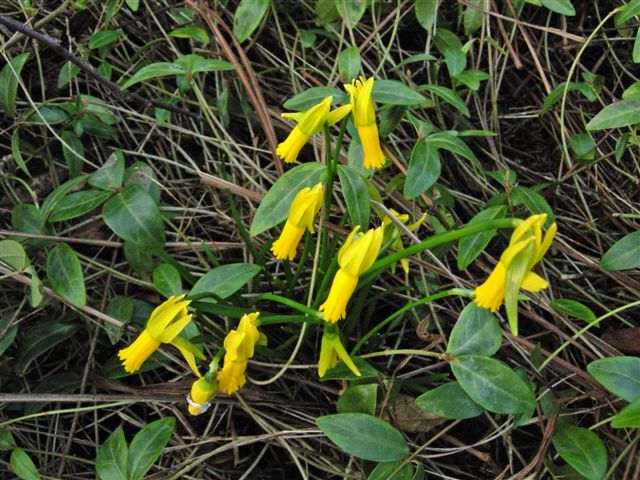
The cyclamen-flowered daffodil (Narcissus cyclamineus) is a small, wild daffodil from damp meadows and stream banks in north-west Spain and Portugal. It grows only 15–20 cm tall and flowers as early as February–March. The nodding yellow flowers have a long, narrow trumpet and petals swept sharply back, so they look like a cyclamen. Gardeners love it because it flowers so early, tolerates slightly acid, moist soil and slowly naturalises in a good spot. It is the parent of many early miniature daffodils, such as ‘February Gold’ and ‘Tête-à-tête’.
Caution: All parts are poisonous, especially the bulb: never mistake the bulbs for onions and keep them away from children and pets. The sap can irritate the skin, so wear gloves when picking and planting. Put cut daffodils in a vase on their own: their sap shortens the life of other flowers.
Light
Sun or partial shade
preferably some sun
Moisture
Normal to wet
must not dry out
Legal basis
Sand or loam
acid to neutral
Hardiness
Fully hardy
down to -20 °C
Size
0.2 m
tall, 0.1 m wide
Flowering
February–March
| Height | 0.2 m |
|---|---|
| Native to Belgium | No, planted |
| Poisonous to people and pets | Yes, take care with children and pets |
| Flowering | February–March |
Identify
Cyclamen-flowered daffodil: how do you recognise it?
- Habit
- Small plants 15–20 cm tall and about 10 cm wide.
- Leaves
- Narrow, grassy and bright green; they die back in late spring.
- Flower
- Nodding flower with a long, narrow trumpet with a frilled rim and sharply reflexed petals, in February–March.
- Colour
- Golden yellow all over; in the hybrids also white, cream or with an orange trumpet.
- Bulb
- A small, round bulb that forms offsets and also self-seeds.
Flowering: February–March · Plants: September–October
In your garden
Why grow it?
- One of the earliest daffodils, already in February–March.
- Graceful, nodding flowers with swept-back petals, quite unlike an ordinary daffodil.
- It grows in places that stay moist in spring, where many other bulbs rot.
- It slowly naturalises in grass, under shrubs and beside a pond.
- Small and dainty: ideal at the front of the border, in a rock garden or in a pot.
Cyclamen-flowered daffodil: where does it grow best?
- Sun or partial shade, for example under deciduous shrubs that are still bare in spring.
- Sandy or loamy soil, slightly acid to neutral, preferably rich in humus.
- Moist to damp: the soil must stay moist in spring. In summer it can be drier.
- Plant the bulbs 5–10 cm apart, in groups of at least ten.
- Light
- Sun and partial shade
- Soil type
- Sand or loam
- Acidity
- Acid or neutral
- Moisture
- Normal or wet
- Size
- 0.2 m tall, 0.1 m wide
- Hardiness
- Hardy (to -20 °C)
Goes well with
- Crocuses: They flower at the same time and add purple, white and yellow.
- Snowdrops: White next to yellow, in the same early, moist soil.
- Lungwort: Blue and pink flowers and spotted leaves in partial shade.
- Ferns: Their fronds fill the space as the daffodils die back.
- Hellebore: Flowers in February–March in the same partial shade.
Maintenance
Cyclamen-flowered daffodil: when and how to plant it?
Plant in September–October.
- Plant in September–October, so the bulbs make roots before winter.
- Dig a hole 5–8 cm deep; in poor sandy soil mix in some leaf mould.
- Set the bulbs pointed end up, 5–10 cm apart.
- In grass: lift a piece of turf, plant the bulbs underneath and put the turf back.
- Cover with soil, firm lightly and water if the soil is dry.
Care
- Water
- Make sure the soil does not dry out in spring; in pots, water regularly while it is growing.
- Feeding
- Not needed. A layer of leaf mould in autumn keeps the soil rich in humus.
- Leaves
- Leave the leaves for at least six weeks after flowering, until they turn yellow.
- Mowing
- Only mow grass with daffodils once the leaves have died back, usually from June.
- Deadheading
- Cut off spent flowers if you do not want seed, or leave them if it may naturalise.
Tip: It likes slightly acid soil that stays moist in spring. Plant it in grass or beside a pond and leave the leaves until they turn yellow: it will slowly naturalise.
Cyclamen-flowered daffodil: when to prune it?
When: No pruning is needed. Let the leaves die back naturally after flowering.
How:
- Cut off spent flowers if you do not want seed; leave the stem and leaves.
- Let the seed pods ripen if you want it to self-seed and naturalise.
- Only remove the leaves when they are completely yellow; mow the grass after that.
Caution: Do not cut or mow the leaves too early: the bulb will then not flower next year.
Propagation
- Offsets
- Lift crowded clumps when the leaves have died back, in June, or in September. Separate the bulbs and replant them straight away.
- Seed
- Sow fresh seed in summer in a pot outdoors. Seedlings take a few years to flower. In a spot it likes, it also self-seeds.
Cyclamen-flowered daffodil: how does it get through the winter?
Hardy to −20 °C.
- Hardy to about −20 °C: in Belgium there is nothing to do.
- The early flowers cope with light frost and a little snow.
- In a pot: stand the pot against a wall or wrap it in hard frost.
Diseases and pests
- Narcissus fly: The larva hollows out the bulb; the plant then only makes a few thin leaves. Throw away soft bulbs and firm the soil well once the leaves have died back.
- Slugs: They sometimes nibble flowers and young leaves. Pick them off in the evening.
- Basal rot: Soft, brown bulbs in cold, wet, heavy soil. Plant in humus-rich but free-draining soil.
- No flowers: Usually leaves cut off too early, a spring that was too dry or crowded clumps. Leave the leaves, water in spring and divide crowded clumps.
Through the year
- January: The first shoots appear.
- February: Flowering.
- March: Flowering. Keep the soil moist.
- April: Remove spent flowers or let the seed ripen. Leave the leaves.
- May: The leaves turn yellow.
- June: Mow the grass. Divide crowded clumps.
- September: Plant bulbs.
- October: Plant bulbs. Add leaf mould.
Use
Edible and useful
Not edible. All parts of daffodils are poisonous, especially the bulbs: they are regularly mistaken for onions or shallots, and the leaves for leeks or wild garlic. So never store the bulbs with the vegetables in the kitchen or cellar. The sap from the stems irritates the skin and makes other flowers in a vase wilt sooner. Also poisonous to dogs and cats. If any is swallowed, call a poison centre (in Belgium 070 245 245) or your doctor at once.
You and this species
Did you know?
- The species name cyclamineus means ‘like a cyclamen’: the swept-back petals recall a cyclamen flower.
- In the official classification of daffodils, the hybrids of this species form a group of their own, the Cyclamineus daffodils.
- Many well-known miniature daffodils, such as ‘February Gold’, ‘Jetfire’ and ‘Tête-à-tête’, have this species as a parent.