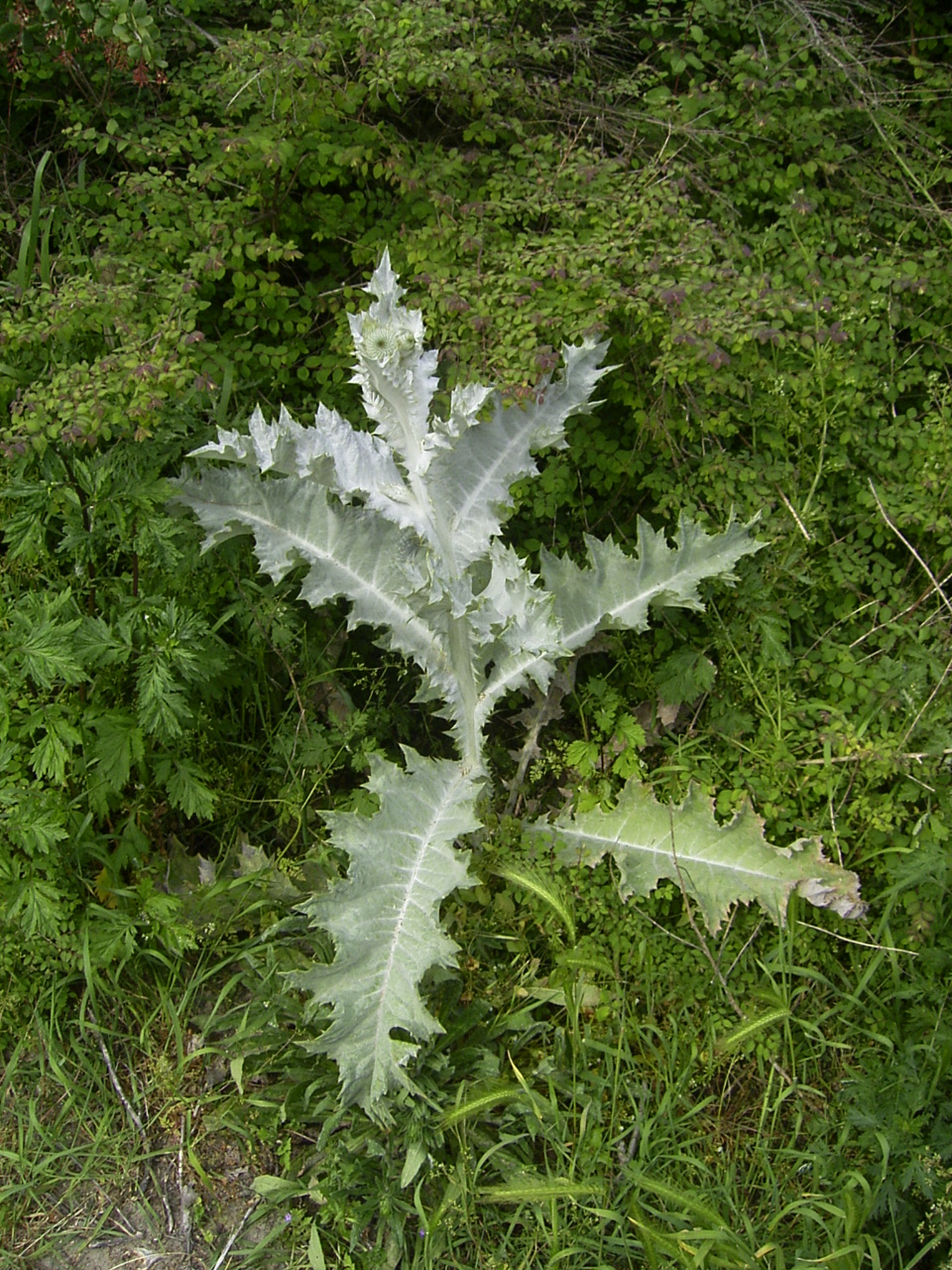
Photo: Wikimedia Commons, CC BY-SA 3.0 · source

Annual · Asteraceae
Scotch thistle
Onopordum acanthium
In other languages: Wegdistel (Nederlands) · Chardon aux ânes (Français)
Scotch thistle, also called cotton thistle, is an imposing biennial thistle from Europe and western Asia. In the first year it forms a large, silver-grey, spiny rosette of leaves; in the second a branched, winged stem of about 2 m rises, carrying purple thistle flowers of 4–5 cm in July and August. The whole plant is covered with white, woolly hairs that give it a silvery sheen. It likes a dry, sunny spot, is very drought-tolerant and attracts bees, butterflies and goldfinches. It self-seeds readily, so give it room.
Caution: The whole plant is spiny: wear thick gloves and long sleeves and do not plant it next to a path or where children play. It self-seeds freely and can quickly take over a corner or a natural meadow; cut off the flower heads before the seed ripens if you want to avoid that.
Light
Full sun
warm and bright
Moisture
Dry
tolerates drought
Legal basis
Sand, loam or clay
neutral to chalky
Hardiness
Fully hardy
down to -20 °C
Size
2 m
tall, 1 m wide
Flowering
July–August
| Height | 2 m |
|---|---|
| Native to Belgium | No, planted |
| Good for bees, butterflies and birds | Yes, for bees, butterflies and birds |
| Poisonous to people and pets | Not known to be poisonous |
| Flowering | July–August |
Identify
Scotch thistle: how do you recognise it?
- Habit
- Biennial. A large leaf rosette in the first year; in the second a branched, upright stem about 2 m tall and 1 m wide.
- Foliage
- Large, deeply cut, spiny-toothed, grey-green to silver-grey because of woolly hairs.
- Stem
- Winged with spiny edges, white-hairy; sturdy and branched.
- Flower
- Purple thistle heads of 4–5 cm with a spiny, globular involucre. July and August.
- Roots
- A deep taproot; the plant dislikes transplanting, so sow in place.
Flowering: July–August · Sowing: April–May and September
In your garden
Why grow it?
- A striking, silver-grey structural plant of about 2 m, with purple thistle flowers in its second year in July and August.
- Bees and butterflies visit the flowers; later birds such as goldfinches eat the seeds.
- Very drought-tolerant and suited to sunny, dry, poor soil.
- The silver-grey foliage catches the eye even in winter and early spring.
- Little work: no watering, no fertiliser, no pruning.
Scotch thistle: where does it grow best?
- Full sun for good growth, silver colour and flowering.
- Well-drained sandy, loamy or clay soil, neutral to chalky; poor soil is fine.
- Dry; it dislikes wet feet and is very drought-tolerant.
- Allow at least 1 m per plant and place it at the back, where nobody brushes against the spines.
- Light
- Sun
- Soil type
- Sand, loam or clay
- Acidity
- Neutral or chalky
- Moisture
- Dry
- Size
- 2 m tall, 1 m wide
- Hardiness
- Hardy (to -20 °C)
Goes well with
- Sea holly: Another silver-grey, spiny structural plant for dry soil.
- Ornamental grasses: Soft stems that soften the spiny structure.
- Viper’s bugloss: Blue flowers in the same dry, sunny corner.
- Evening primrose: Yellow flowers that open in the evening and attract moths.
- Wild marjoram: Low and aromatic; fills in the base and attracts bees and butterflies.
Maintenance
Scotch thistle: when and how to plant it?
- Sow in April–May, or in September, directly where it is to grow; avoid transplanting seedlings and rosettes.
- Rake the soil fine and sow on the surface, about 1 cm deep; firm it down.
- Keep the soil moist until the seed germinates after 2–3 weeks.
- Thin to at least 1 m between plants; the rosettes grow nearly 1 m wide.
- In the first year it forms only a rosette; the stem and flowers follow the year after.
Care
- Water
- Only water seedlings at the start. After that it looks after itself, even in dry summers.
- Feeding
- Not needed; rich soil gives floppy, over-tall plants.
- Support
- Usually unnecessary; in a windy spot a strong stake can help.
- Deadheading
- Cut off spent heads before the seed ripens if you do not want self-seeding.
- Clearing
- Remove the dead stems after flowering or in winter. Wear thick gloves.
Tip: An impressive silver-grey thistle of 2 m for a dry, sunny spot. Sow in place and give it room; cut off spent flowers if you do not want seedlings.
Scotch thistle: when to prune it?
When: It is not pruned; you remove spent flower heads and afterwards the stem, wearing thick gloves.
How:
- Cut off spent flower heads before the seed ripens if you do not want seedlings.
- Leave a few if you want to feed birds and accept self-sown plants.
- Cut the stem at the base after flowering or in winter.
- Pull up unwanted seedlings while young; it is easiest then.
Caution: The whole plant is spiny: wear thick gloves and long sleeves. It self-seeds freely and can quickly take over a corner or a natural meadow.
Propagation
- Sowing
- In April–May or in September in place, about 1 cm deep. Germination after 2–3 weeks.
- Self-sowing
- Let a few flower heads ripen; seedlings come up on their own and form a rosette the year after.
Scotch thistle: how does it get through the winter?
Hardy to −20 °C.
- Fully hardy, down to about −20 °C: no protection needed in Belgian winters, even as a rosette.
- Leave the stems with seed heads standing: they feed birds.
- In a pot it is too big and too deep-rooted; sow it in open ground instead.
Diseases and pests
- Excessive self-seeding: It self-seeds a lot. Cut off flower heads before they ripen or pull up seedlings.
- Powdery mildew: White powder on the leaves in warm, humid periods. Give plants space and remove affected leaves.
- Aphids: Sometimes on young shoots and buds. Rinse them off with water or let ladybirds do the work.
- Slugs: Young seedlings and rosettes are sometimes nibbled. Search for them in the evening or lay a ring of coarse sand.
Through the year
- February: Remove last year’s dead stems.
- April: Sow in the final position.
- May: Sow. Thin seedlings to 1 m.
- June: In the second year the stems grow strongly. Support if needed.
- July: Second-year plants flower.
- August: Flowering. Cut spent heads to limit self-seeding.
- September: Sow or collect seed. Leave heads for the birds.
- October: Rosettes stay in place. Remove stems.
Use
Good for wildlife
- Bees
- Nectar and pollen for honeybees and wild bees.
- Butterflies
- Nectar for butterflies.
- Birds
- Berries, seeds or insects as food, or a place to nest.
You and this species
Did you know?
- The English name Scotch thistle refers to Scotland, where a thistle is the national emblem; which thistle species it originally was is still disputed.
- In its first year the plant forms only a rosette, often more than half a metre wide; it flowers in the second year only.
- The seeds feed seed-eating birds such as goldfinches.