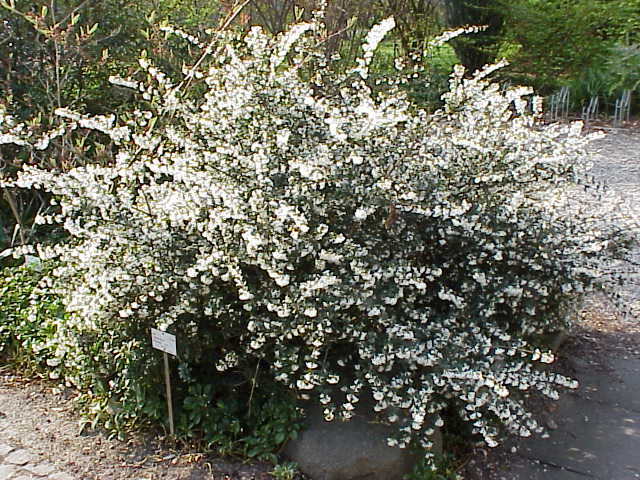
Photo: Kurt Stüber [1], CC BY-SA 3.0 · source

Shrub · Oleaceae
Delavay osmanthus
Osmanthus delavayi
In other languages: Osmanthus (Nederlands) · Osmanthe de Delavay (Français)
Delavay osmanthus (Osmanthus delavayi) comes from the mountains of Yunnan and Sichuan in south-west China. It is an evergreen shrub with gracefully arching branches and small, glossy, dark green, finely toothed leaves. In March–April it is covered in small white, tubular flowers with a sweet, jasmine-like scent. Small blue-black fruits sometimes follow the flowers. It grows slowly to about 2 m tall and 2.5 m wide. That makes it a lovely specimen, a fragrant hedge or a plant for beside the front door, where you can enjoy the scent of the flowers.
Light
Sun or partial shade
preferably some sun
Moisture
Normal
no wet feet
Legal basis
Sand, loam or clay
any pH
Hardiness
down to -15 °C
protect young plants
Size
2 m
tall, 2.5 m wide
Flowering
March–April
| Pruning months | April–May |
|---|---|
| Height | 2 m |
| Native to Belgium | No, planted |
| Good for bees, butterflies and birds | Yes, for bees |
| Poisonous to people and pets | Not known to be poisonous |
| Flowering | March–April |
Identify
Delavay osmanthus: how do you recognise it?
- Habit
- Slow-growing, evergreen shrub about 2 m tall and 2.5 m wide, with gracefully arching branches.
- Foliage
- Small, 2–3 cm, oval, glossy dark green and finely toothed, in opposite pairs on the stem.
- Flowers
- Small white, tubular flowers about 1 cm long in clusters, in March–April.
- Scent
- Sweet and strong, like jasmine; you can smell it from a distance.
- Fruit
- Small, oval, blue-black drupes in autumn, not every year.
Flowering: March–April · Plants: April–May and September–October · Pruning: April–May
In your garden
Why grow it?
- Fragrant flowers in March–April, when little else is in bloom: a welcome food source for early bees.
- Evergreen, with fine, glossy foliage that looks good all year.
- Graceful, arching habit; it grows slowly and needs little pruning.
- Lovely as a clipped or informal hedge, or as a specimen in a border.
- Grows in sun and part shade and in many soil types, including chalky soil.
- A fragrant plant beside the front door, a terrace or a seating area.
Delavay osmanthus: where does it grow best?
- Sun or part shade; it flowers best in the sun.
- Well-drained, humus-rich soil: sand, loam or clay, acid to chalky.
- Normally moist; it tolerates short dry spells, but not wet feet.
- Sheltered from cold, drying wind and late spring frosts, which can damage the flowers.
- Allow 2–2.5 m per shrub; for a hedge, plant at 80–100 cm.
- Light
- Sun and partial shade
- Soil type
- Sand, loam or clay
- Acidity
- Not fussy
- Moisture
- Normal
- Size
- 2 m tall, 2.5 m wide
- Hardiness
- Hardy (to -15 °C)
Goes well with
- Witch hazel: Flowers as early as winter and brings colour before the osmanthus opens.
- Hellebore: Flowers at the same time and enjoys the part shade at the foot of the shrub.
- Skimmia: Evergreen with pretty buds and red berries, in the same part shade.
- Barrenwort: Delicate spring flowers as ground cover under the shrub.
Maintenance
Delavay osmanthus: when and how to plant it?
Plant in April–May and September–October.
- Plant in April–May or in September–October, when the soil is neither frozen nor waterlogged.
- Dig a hole twice as wide as the root ball and mix in a few spadefuls of compost.
- Set the plant at the same depth as in its pot and firm the soil well.
- Leave 2–2.5 m between shrubs; in a hedge, 80–100 cm.
- Water thoroughly straight away, even if it is raining.
- Spread a layer of leaf mould or bark around the base, without covering the stem.
Care
- Water
- In the first year, water weekly in dry weather. After that, give a good soaking now and then in long dry spells.
- Feeding
- Compost or organic fertiliser for shrubs in April. Do not feed after July.
- Mulching
- A layer of leaf mould or bark in spring keeps the soil cool and moist.
- In a pot
- It also grows in a large pot with a good drainage hole; water more often and feed monthly during the growing season.
Tip: Plant it sheltered and prune only after flowering, in April–May: it flowers on last year’s wood. Put it near the front door or a seating area to enjoy the scent.
Delavay osmanthus: when to prune it?
Pruning months: April–May.
When: Straight after flowering, in April–May. It rarely needs pruning.
How:
- Cut dead, weak and crossing branches back to a healthy side shoot.
- As a hedge, trim it once a year after flowering with secateurs or hedge shears.
- To keep it smaller, shorten it after flowering in small steps, not drastically all at once.
Caution: Do not prune in late summer or autumn: you would cut off the flower buds for the following spring.
Propagation
- Cuttings
- From July to September: semi-ripe cuttings of 8–10 cm with a small heel of old wood, in a mix of sand and potting compost under plastic. They root slowly; overwinter them frost-free.
- Layering
- In spring, bend a low branch down, pin it and cover it with soil; separate it after a year or longer.
Delavay osmanthus: how does it get through the winter?
Hardy to −15 °C: protect young plants.
- Hardy down to about −15 °C: usually safe in Flanders, especially in a sheltered spot.
- In hard winters the leaf edges may turn brown or flower buds may freeze; a sheltered position and a layer of mulch help.
- In a pot, stand it against a warm wall and wrap the pot in hessian so the roots do not freeze.
Diseases and pests
- Frost and wind damage: Brown leaf edges or dried-out flower buds after a cold winter. Wait until after flowering to cut anything out: it often recovers.
- Yellow leaves: Yellowing can come from wet, compacted or poor soil. Improve drainage and apply compost or organic fertiliser.
- Scale insects: Small brown scales on stems and leaves, sometimes with sticky honeydew. Wipe them off with a soft brush and soapy water.
- Poor flowering: Too much shade or pruning too late, which removed the buds. Give it more sun and prune only after flowering.
Through the year
- March: Flowering begins: enjoy the scent. Check for dead wood.
- April: Flowering. Plant. Apply compost or organic fertiliser.
- May: Prune after flowering. Plant.
- June: Water in dry weather, especially young plants.
- July: Take semi-ripe cuttings.
- August: Take cuttings. Water in dry weather.
- September: Plant. Take cuttings.
- October: Plant. Mulch.
- November: Protect young plants from frost.
Use
Good for wildlife
- Bees
- Nectar and pollen for honeybees and wild bees.
You and this species
Did you know?
- The name Osmanthus comes from the Greek osme (scent) and anthos (flower): literally ‘fragrant flower’.
- It belongs to the olive family (Oleaceae), like olive, lilac, jasmine and ash.
- It is named after Jean-Marie Delavay, a French missionary and plant collector who found it in Yunnan in the nineteenth century.