Photo: Kurt Stüber [1], CC BY-SA 3.0 · source

Shrub · Oleaceae
Burkwood osmanthus
Osmanthus × burkwoodii
In other languages: Osmanthus (Nederlands) · Osmanthe de Burkwood (Français)
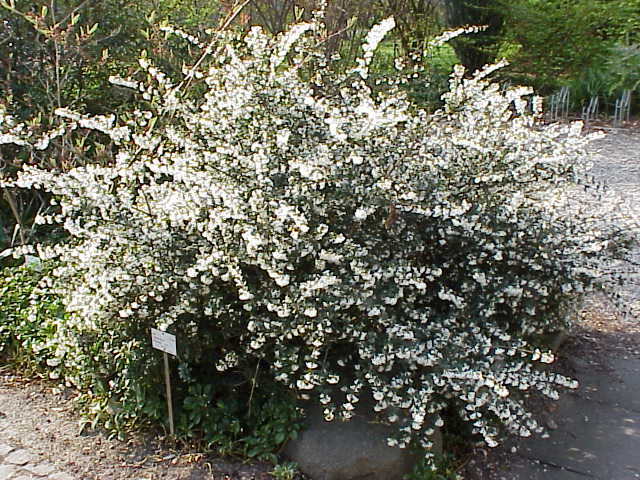
Burkwood osmanthus is an evergreen garden hybrid raised in England around 1930 by crossing a Chinese species with one from the Caucasus. It is a compact, dense shrub with small, dark green, leathery leaves. In April it is covered in white, tubular flowers with a sweet scent that you can smell from a distance on a mild day. It grows slowly to about 2.5 m high and wide and does well as a hedge, a specimen or a clipped ball, in sun or shade. Because it takes clipping so well, it is also a good alternative to box.
Light
Sun to shade
not fussy
Moisture
Normal
no wet feet
Legal basis
Sand, loam or clay
any pH
Hardiness
Fully hardy
down to -20 °C
Size
2.5 m
tall, 2.5 m wide
Flowering
April–May
| Pruning months | May |
|---|---|
| Height | 2.5 m |
| Native to Belgium | No, planted |
| Good for bees, butterflies and birds | Yes, for bees |
| Poisonous to people and pets | Not known to be poisonous |
| Flowering | April–May |
Identify
Burkwood osmanthus: how do you recognise it?
- Habit
- Compact, rounded, dense shrub 2–2.5 m high and as wide; slow-growing.
- Leaves
- Small, oval, 2–4 cm, leathery and glossy dark green with a finely toothed edge, in opposite pairs.
- Flowers
- White, tubular flowers of about 1 cm, in clusters in the leaf axils, in April–May.
- Scent
- Sweet and powerful, especially on mild, still days.
Flowering: April–May · Plants: April–May and September–October · Pruning: May
In your garden
Why grow it?
- Strongly scented white flowers in April, one of the sweetest-smelling spring shrubs.
- Evergreen and dense: a handsome hedge or topiary shape all year round.
- Bees find nectar in it in spring.
- Grows in sun, partial shade and shade.
- Slow-growing: one trim a year is enough.
- Takes clipping well and is an alternative to box.
Burkwood osmanthus: where does it grow best?
- Sun, partial shade or shade; it flowers most freely in sun.
- Any well-drained soil: sand, loam or clay, acid to chalky.
- Moist but not wet; avoid soil that stays wet for long.
- Sheltered from cold, dry east winds, which can scorch the leaves.
- For a hedge, 2–3 plants per metre; as a specimen, allow 2–2.5 m of space.
- Light
- Sun, partial shade and shade
- Soil type
- Sand, loam or clay
- Acidity
- Not fussy
- Moisture
- Normal
- Size
- 2.5 m tall, 2.5 m wide
- Hardiness
- Hardy (to -20 °C)
Goes well with
- Tulips: Colour in front of the dark green shrub while it is in flower.
- Lenten rose: Flowers earlier, in the same partial shade.
- Ferns: A fresh underplanting in the shade.
- Hydrangea: Takes over the flowering in summer.
Maintenance
Burkwood osmanthus: when and how to plant it?
Plant in April–May and September–October.
- Plant in April–May or September–October.
- Dig a hole twice as wide as the root ball and mix in compost.
- For a hedge: dig a trench and plant 35–50 cm apart.
- Set the plant at the same depth as it was in the pot and firm the soil well.
- Water in generously straight away, then weekly in dry spells during the first year.
- Spread a mulch of leaf mould around the base.
Care
- Watering
- Weekly in dry spells during the first year. Even in a dry winter an evergreen shrub sometimes needs water.
- Feeding
- Some compost or organic feed in April.
- Mulching
- A layer of leaf mould in spring keeps the soil cool and moist.
- In a pot
- It can stay in a large pot for years. Water regularly and repot every 3 years into fresh potting compost.
Tip: Plant it by a path, a seating area or the front door: you will smell the flowers every time you walk past in April.
Burkwood osmanthus: when to prune it?
Pruning months: May.
When: Straight after flowering, in May. It flowers on the previous year’s wood, so pruning later costs flowers.
How:
- Trim the shrub or hedge into shape with secateurs or a hedge trimmer; the small leaves tolerate a hedge trimmer well.
- Remove dead and crossing branches.
- An overgrown shrub tolerates hard pruning; it shoots again slowly but reliably.
- Keep a hedge slightly wider at the bottom than at the top.
Caution: Do not prune in autumn or winter: you would remove the flower buds for the following spring.
Propagation
- Semi-ripe cuttings
- In July–August: cuttings of 10 cm, lower leaves removed, in moist cutting compost under plastic or in a cold frame. They root slowly but reliably.
- Layering
- In spring, pin a low branch into the soil; sever and transplant it after a year.
Burkwood osmanthus: how does it get through the winter?
Hardy to −20 °C.
- Hardy to about −20 °C: no problem in most Belgian winters.
- In hard winters, cold, dry east winds can scorch the leaves; a sheltered spot helps.
- In a pot: stand it against a wall and wrap the pot in hessian.
- During a long, dry frosty spell, water on a frost-free day.
Diseases and pests
- Scale insects: Small brown scales on the leaves and stems, sometimes with sticky leaves. Remove them with a soft brush and a little soapy water.
- Brown leaves: Caused by cold winds or hard frost. Cut them off after flowering; the shrub will shoot again.
- Few flowers: Caused by pruning at the wrong time or by deep shade. Prune only straight after flowering.
- Root rot: Yellow leaves and a sickly plant in wet soil. Ensure good drainage.
Through the year
- April: Scented flowers. Planting. Spread compost.
- May: End of flowering. Prune straight after flowering. Planting.
- June: Water young plants in dry spells.
- July: Take semi-ripe cuttings.
- August: Take cuttings. Water in dry spells.
- September: Planting.
- October: Planting.
- December: Rest. An evergreen hedge in the winter garden.
Use
Good for wildlife
- Bees
- Nectar and pollen for honeybees and wild bees.
You and this species
Did you know?
- The name Osmanthus comes from the Greek words osme (scent) and anthos (flower): a scented flower.
- It is named after the English Burkwood nursery, where it was raised. It was first called × Osmarea burkwoodii, because one of its parents was then placed in the genus Phillyrea.
- It belongs to the same family as the olive, privet and jasmine.