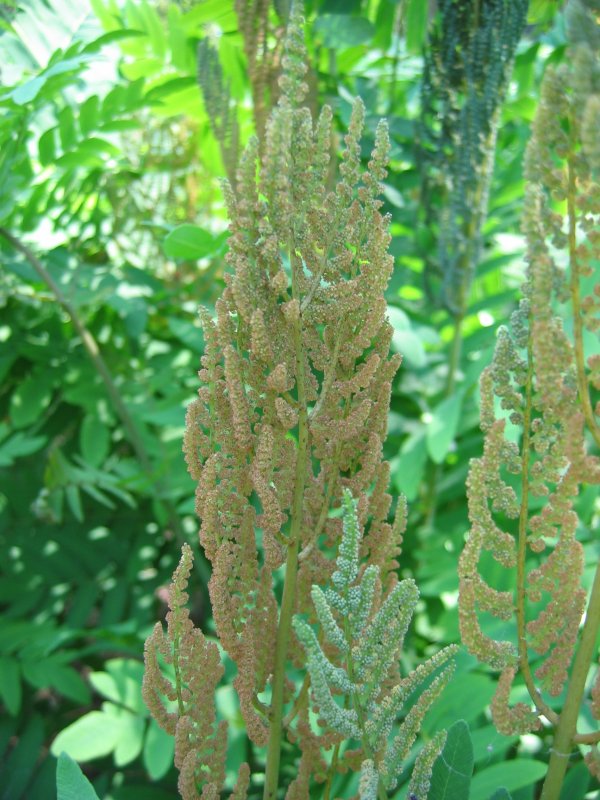
Photo: Kristian Peters -- Fabelfroh 11:15, 18 September 2006 (UTC), CC BY-SA 3.0 · source

Fern · Osmundaceae
Royal fern
Osmunda regalis
In other languages: Koningsvaren (Nederlands) · Osmonde royale (Français)
Royal fern is the largest native fern in Belgium. In the wild it grows in wet, acid swamp woodland, around pools and in boggy areas, where it has become rare. It forms a broad clump of large, twice-divided fronds up to 1.5 m tall and wide, with oblong, untoothed leaflets that look very different from those of most ferns. In early summer some fronds carry rusty brown spore clusters at their tips that look like flowers. In autumn the foliage turns golden yellow to coppery brown. Gardeners love its stately shape at the pond edge; ‘Purpurascens’, with purple-red young fronds, is a well-known form.
Light
Sun to shade
not fussy
Moisture
Normal to wet
must not dry out
Legal basis
Sand, loam or peat
acid to neutral
Hardiness
Fully hardy
down to -30 °C
Size
1.5 m
tall, 1.5 m wide
| Pruning months | March |
|---|---|
| Height | 1.5 m |
| Native to Belgium | Yes |
| Poisonous to people and pets | Not known to be poisonous |
Identify
Royal fern: how do you recognise it?
- Habit
- Broad, upright clump 1–1.5 m tall and as wide; old plants grow even larger.
- Fronds
- Twice divided, with oblong, untoothed leaflets. Pinkish to coppery when young, fresh green in summer, golden yellow to coppery brown in autumn.
- Spores
- Some fronds carry clusters of spore cases at the tip, green at first and later rusty brown, which look like flowers.
- Young croziers
- In April–May croziers covered in rusty brown hairs appear.
- Rhizome
- Thick, fibrous and slow-growing; on old plants a sturdy, knobbly base.
Plants: March–May and September–October · Pruning: March
In your garden
Why grow it?
- A large, stately fern with an almost tropical effect at the pond edge.
- Beautiful autumn colour, from golden yellow to coppery brown.
- The rusty brown spore clusters at the frond tips look like flowers.
- Native and rare in the wild: a valuable plant for a wildlife garden.
- Copes with wet soil and, with its feet in water, even full sun.
- Lives a very long time and needs little upkeep.
Royal fern: where does it grow best?
- Partial or full shade; with permanently wet feet it also copes with full sun.
- Acid to neutral, humus-rich soil: sand, loam or peat. It dislikes lime.
- Moist to wet soil that must never dry out. Ideal at a pond edge or in a bog garden.
- Allow 1–1.5 m of space per plant: it grows large.
- Light
- Sun, partial shade and shade
- Soil type
- Sand, loam or peat
- Acidity
- Acid or neutral
- Moisture
- Normal or wet
- Size
- 1.5 m tall, 1.5 m wide
- Hardiness
- Hardy (to -30 °C)
Goes well with
- Yellow flag: Yellow flowers in May–June at the same wet pond edge.
- Marsh marigold: Golden yellow spring flowers in wet soil, before the fern is fully grown.
- Purple loosestrife: Purple-pink spikes in summer on wet soil.
- Meadowsweet: Creamy, scented flower heads in the same wet spot.
Maintenance
Royal fern: when and how to plant it?
Plant in March–May and September–October.
- Plant from March to May or in September–October. Buy nursery-grown plants and never take plants from the wild.
- Dig a generous hole and mix in plenty of leaf mould or composted conifer bark.
- Set the plant at the same depth as in the pot: the crown must stay just above the soil.
- Keep 1–1.5 m from other plants.
- Water generously straight away, preferably with rainwater, and keep the soil moist at all times.
- Mulch with leaf mould or pine needles to keep the soil acid and moist.
Care
- Watering
- Keep the soil moist to wet at all times. In dry spells use rainwater, as tap water often contains lime.
- Feeding
- A layer of leaf mould in spring is enough. No lime or limy fertiliser.
- Mulching
- Spread leaf mould or pine needles around the plant every spring.
- Old fronds
- Leave the coloured fronds standing in winter and cut them off in March.
- Patience
- Young plants grow slowly; it only becomes really large after a few years.
Tip: Keep the soil acid and always moist: water with rainwater in dry spells and mulch with leaf mould. At a pond edge with wet feet it even copes with sun.
Royal fern: when to prune it?
Pruning months: March.
When: In March, before the new croziers unfurl. In winter the old fronds protect the crown.
How:
- Cut the dead fronds off at the base.
- Watch out for the croziers already waiting in the crown: do not cut into them.
- No other pruning is needed; the spore clusters can simply stay.
- Put the old fronds on the compost heap or use them as mulch under shrubs.
Propagation
- Spores
- The green spores stay viable for only a short time. Sow them in June, as soon as they ripen, on moist, sterile compost under glass and keep everything wet. A job for the patient.
- Division
- Only for large, old clumps with several crowns, in March–April. The root mass is tough: use a sharp spade or a saw and keep the pieces well watered.
Royal fern: how does it get through the winter?
Hardy to −30 °C.
- Fully hardy, to about −30 °C: no protection is needed in Belgium.
- In autumn the fronds turn golden yellow to coppery brown and then die back.
- Leave the old fronds until March to protect the crown.
- In a pot: choose a large pot, keep the soil wet and stand the pot in a sheltered spot.
Diseases and pests
- Brown fronds in summer: Caused by drought, or by sun on soil that is too dry. Water generously with rainwater and mulch.
- Yellow fronds: On chalky soil or when watered with limy tap water. Use rainwater and acid leaf mould.
- Late frost damage: Frozen young croziers turn brown. Cut them off; the plant regrows.
- Slow growth: Normal in young plants. Patience, constantly moist soil and acid compost are the secret.
Through the year
- January: Rest. Leave the old fronds.
- February: Rest. The old fronds protect the crown.
- March: Cut off old fronds. Plant or divide.
- April: The croziers unfurl. Mulch with leaf mould.
- May: Plant. Keep the soil wet.
- June: The spore clusters ripen. Sow spores straight away.
- July: Water with rainwater in dry spells.
- August: Keep the soil moist.
- September: Plant.
- October: Golden yellow to coppery brown autumn colour. Plant.
- November: The fronds die back. Leave them standing.
You and this species
Did you know?
- Royal fern belongs to a very old family: fossils of related ferns are more than 180 million years old.
- Its fibrous roots were once used as a potting medium for orchids, under the name osmunda fibre.
- In English it is also called flowering fern, because the spore clusters look like flowers.