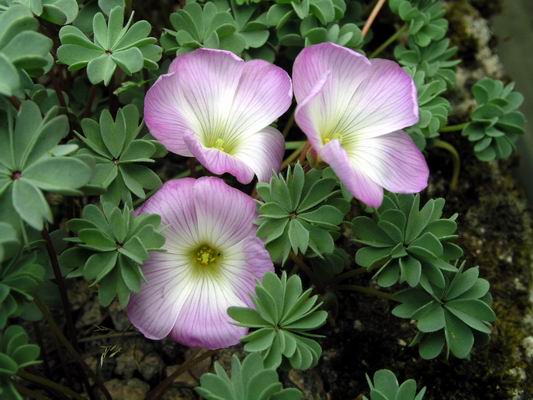
Photo: Ian Young, from www.srgc.org.uk, CC BY-SA 3.0 · source

Bulb or tuber · Oxalidaceae
Oxalis adenophylla
Oxalis adenophylla comes from the Andes of Chile and Argentina, where it grows in open, stony places. It is a small, low plant about 8 cm tall, with a compact tuft of blue-grey, pleated leaves shaped like a fan. In May and June, lilac-pink flowers with darker veins appear on short stalks above the foliage. It grows from a scaly tuber, slowly forms a neat clump and does not spread aggressively. Hardy to about −20 °C, it is perfect for a rock garden, a stone trough or a pot, as long as the soil is free-draining and sunny.
Caution: The plant contains oxalic acid and is poisonous if eaten. Children, cats and dogs are at risk: do not eat it.
Light
Full sun
warm and bright
Moisture
Dry to normal
no wet feet
Legal basis
Sand or loam
neutral to chalky
Hardiness
Fully hardy
down to -20 °C
Size
0.08 m
tall, 0.15 m wide
Flowering
May–June
| Height | 0.08 m |
|---|---|
| Native to Belgium | No, planted |
| Poisonous to people and pets | Yes, take care with children and pets |
| Flowering | May–June |
Identify
Oxalis adenophylla: how do you recognise it?
- Habit
- Low, compact clump about 8 cm tall and 15 cm wide.
- Leaves
- Blue-grey, pleated like a fan, with many small leaflets; the leaves disappear in winter.
- Flower
- Lilac-pink flowers with darker veins, on short stalks above the leaves, in May–June.
- Tuber
- Scaly tuber covered in brown, fibrous remains of old leaves; it sits just below the surface.
- Rest
- In winter the leaves die back; the tuber rests underground and starts growing again in spring.
Flowering: May–June · Plants: September–October
In your garden
Why grow it?
- Decorative blue-grey, pleated foliage that looks good even without flowers.
- Lilac-pink flowers with fine veins in May and June.
- Small and compact: ideal for a rock garden, a trough or a pot.
- Slowly forms a neat clump and does not run wild.
- Hardy and long-lived in a sunny, free-draining spot.
Oxalis adenophylla: where does it grow best?
- Full sun; in shade it hardly flowers.
- Lean, very free-draining soil with plenty of sand and grit, neutral to chalky.
- Dry to normal: especially in winter the soil must not stay wet.
- Plant in a rock garden, a stone trough or a pot, 10–15 cm apart.
- Light
- Sun
- Soil type
- Sand or loam
- Acidity
- Neutral or chalky
- Moisture
- Dry or normal
- Size
- 0.08 m tall, 0.15 m wide
- Hardiness
- Hardy (to -20 °C)
Goes well with
- Saxifrage: Another rock garden plant that suits the same dry, sunny corner.
- Stonecrop: A succulent that tolerates drought and flowers later in the season.
- Aubretia: Flowers earlier and covers the stones with purple blooms.
- Pinks: A low, flowering plant that goes well with the blue-grey foliage.
Maintenance
Oxalis adenophylla: when and how to plant it?
Plant in September–October.
- Plant in September or October, while the soil is not yet frozen.
- Mix the soil with plenty of coarse sand or fine grit so water drains away quickly.
- Set the tubers 3–5 cm deep, top side up.
- Leave 10–15 cm between tubers.
- Water a little after planting.
- Spread a thin layer of gravel or grit around the plant: it keeps the leaves clean and the crown dry.
Care
- Water
- Keep lightly moist in spring while it is growing. Little water in summer and winter; in a pot, water sparingly in dry weather.
- Feeding
- Hardly needed: lean soil is better. A little compost at planting if you like.
- Gravel layer
- Keep a thin layer of gravel or grit around the plant to keep the crown dry and clean.
- Tidying
- In autumn or late spring, remove the dead leaves.
- Dividing
- Divide the clump every few years, when flowering declines.
Tip: Plant it in a rock garden or trough with plenty of grit in the soil. It does not run wild, but it does want a free-draining, sunny spot.
Oxalis adenophylla: when to prune it?
When: No pruning is needed. Just remove dead leaves and, if you like, spent flowers.
How:
- Remove withered leaves in autumn or late spring.
- Cut off the spent flower stalks if you do not like them; this is not essential.
- Leave the leaves in place in summer as long as they are green.
Propagation
- Division
- In September–October, as the leaves die back: lift the clump carefully, divide the tubers and replant them straight away, 3–5 cm deep.
- Seed
- Sow fresh seed in spring in a tray of sandy seed compost. Seedlings take a few years to flower.
Oxalis adenophylla: how does it get through the winter?
Hardy to −20 °C.
- Hardy to about −20 °C: the tuber survives Belgian winters outdoors.
- Wet soil is the biggest danger: provide good drainage and, if needed, a thin layer of grit or a small cover in persistent rain.
- In a pot: put it in a sheltered spot against a wall, on pot feet, and do not let it stand full of water.
Diseases and pests
- Tuber rot: The tuber is soft and mouldy, because of soil that is too wet. Use a very free-draining mix and remove affected tubers.
- No flowers: Leaves appear but no flowers. The cause is usually too little sun or soil that is too wet. Move it to a sunnier, drier spot.
- Slugs: Holes in young leaves in spring. Collect them in the evening with a torch.
- Being smothered: Larger neighbours grow over the small plant. Keep its surroundings open and weed-free.
Through the year
- February: Clear away dead leaves.
- March: Leaves come up.
- April: Leaves grow; keep lightly moist.
- May: Flowering begins.
- June: Full flower, then cut off spent stalks.
- July: Keep dry; check the gravel layer.
- September: Plant or divide.
- October: Plant. Put pots in a sheltered spot.
- November: Keep pots dry and sheltered.
Use
Edible and useful
Not edible. The leaves and stems of these wood sorrels taste refreshingly sour, like sorrel, from the oxalic acid they contain, but do not eat them: larger amounts are harmful, as oxalic acid binds calcium and can strain the kidneys, especially in people prone to kidney stones. Cats, dogs, rabbits and rodents that eat a lot of it may drool, vomit and become weak: keep the pot or plant out of their reach. Do not let children nibble it, and the small tubers in the soil are not for eating. If any is swallowed, call a poison centre (in Belgium 070 245 245) or your doctor at once.
You and this species
Did you know?
- The name Oxalis comes from Greek and means ‘sour’: the leaves of many species taste sour because of the oxalic acid.
- It grows naturally in the Andes of Chile and Argentina, in open, stony places.
- Like many other Oxalis, its flowers and leaves close in dull weather and at night.