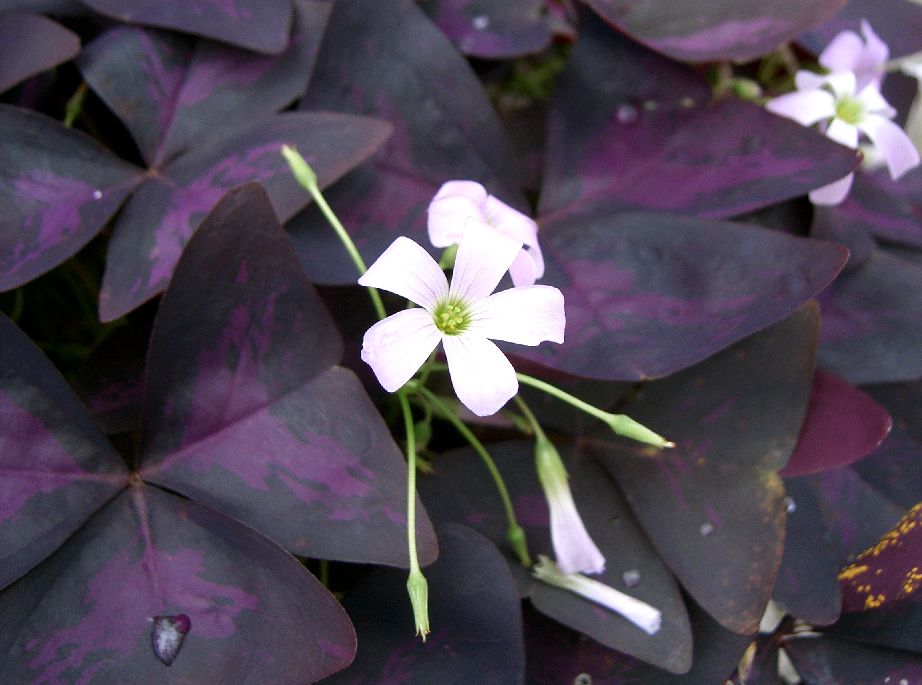
Photo: KENPEI, CC BY-SA 3.0 · source

Houseplant · Oxalidaceae
Purple shamrock
Oxalis triangularis
In other languages: Oxalis (Nederlands) · Faux trèfle pourpre (Français)
Purple shamrock is a small herbaceous plant from South America, including Brazil, grown here as a houseplant and as a summer plant for pots. It grows from small, scaly tubers and forms a dense clump of leaves, each made up of three triangular leaflets, like a butterfly or a clover leaf. The usual form has deep purple leaves with a lighter mark in the centre; there is also a green form. From April to October, clusters of pale pink to white, funnel-shaped flowers appear above the leaves. Growers love it because the leaflets fold up in the evening and in bright sun, so the plant moves a little all day long.
Caution: The leaves and stalks contain oxalic acid, like sorrel. Eating larger amounts is harmful to cats, dogs, rabbits and rodents, and to children. Keep the pot out of their reach.
Light
Sun or partial shade
preferably some sun
Moisture
Normal
no wet feet
Legal basis
Potting soil
Hardiness
Houseplant
min. 5 °C
Size
0.3 m
tall, 0.3 m wide
Flowering
April–October
| Height | 0.3 m |
|---|---|
| Poisonous to people and pets | Yes, take care with children and pets |
| Flowering | April–October |
Identify
Purple shamrock: how do you recognise it?
- Habit
- Dense, rounded clump 20–30 cm tall and wide, growing from small, scaly tubers.
- Leaves
- Three-part, on long, thin stalks; each leaflet is triangular, 2–4 cm, deep purple with a lighter purple or pink mark.
- Flowers
- Funnel-shaped flowers of 1–2 cm with five petals, pale pink to white, in loose clusters above the leaves, from April to October.
- Movement
- The leaflets fold up like an umbrella in the evening, in dull weather and in bright sun.
- Tubers
- Small, elongated, scaly tubers of 1–2 cm that multiply quickly.
Flowering: April–October · Plants: March–April
In your garden
Why grow it?
- Striking purple leaves that give colour all through the growing season, indoors and out.
- Flowers for a long time, from April to October, with dainty pink to white blooms.
- The leaflets close in the evening and open again in the morning: a living show.
- Fits on a windowsill, but also in a pot or container on the patio from mid-May to September.
- Tough: it survives a dormant spell as tubers and then simply shoots again.
- Multiplies by itself: after a few years you can divide the clump and give pieces away.
Purple shamrock: where does it grow best?
- Bright light to partial shade: an east- or west-facing window is ideal. Some morning or evening sun gives the deepest purple; fierce midday sun through glass makes the leaves flop.
- In too dark a spot you get long, floppy stalks and few flowers.
- Room temperature is fine, a slightly cooler spot of 15–21 °C even better; below 5 °C it suffers damage.
- Outdoors from mid-May to September in a pot in a sheltered, bright spot out of fierce midday sun.
- Open, free-draining compost: wet feet make the tubers rot.
- Light
- Sunny or bright, out of direct sun
- Potting soil
- Multi-purpose compost or airy, humus-rich compost
- Acidity
- Acid or neutral
- Watering
- Moderately
- Size
- 0.3 m tall, 0.3 m wide
- Temperature
- Minimum 5 °C
Goes well with
- Coral bells: Lime-green or silver leaves as a contrast to the dark purple in a pot or container.
- Coleus: Equally colourful leaves for the same bright spot out of fierce sun.
- Ferns: Fine green fronds as a calm backdrop for the purple butterfly leaves.
- Busy Lizzie: Flowers all summer in partial shade, in a pot next to the shamrock.
Maintenance
Purple shamrock: when and how to plant it?
Plant in March–April.
- Plant or repot in March or April, when the tubers start into growth again.
- Choose a wide, fairly shallow pot with a drainage hole: a 12–15 cm pot takes 8–10 tubers.
- Use open houseplant compost mixed with some perlite or coarse sand.
- Plant the tubers 2–3 cm deep, lying flat or with the narrow end up, a few centimetres apart.
- Water moderately and keep the compost lightly moist; the first leaves appear after two to three weeks.
Care
- Watering
- Water when the top centimetre is dry and never leave the compost soggy for long. More in summer and while flowering, almost nothing when dormant.
- Feeding
- From April to September, liquid feed for flowering houseplants every two to three weeks, at half strength.
- Deadheading
- Cut spent flower stalks off at the base or gently pull them out, so new ones follow.
- Turning
- The leaves grow towards the light: turn the pot a quarter turn now and then for a rounded clump.
- Dormancy
- After months of growth it may go dormant: the leaves flop and die back. Let them die down, cut them off, give hardly any water and put the pot somewhere cool. It shoots again after a few weeks to two months.
- Repotting
- Every one to two years in spring, when the pot is full of tubers.
Tip: If the clump has flopped or gone limp, cut all the leaves off just above the compost. Within a few weeks a new, compact clump of deep purple leaves grows back.
Purple shamrock: when to prune it?
When: Pruning is not needed. You only remove spent flower stalks and yellowed leaves, and the dead foliage after a dormant spell.
How:
- Cut spent flower stalks and yellow leaves off at the base, or gently pull them out.
- If the clump has flopped and gone limp, cut all the leaves off just above the compost: within a few weeks new, compact foliage grows.
- During dormancy, let the leaves die back completely before you cut them off.
Propagation
- Division
- In March–April when repotting: take the clump out of the pot, shake off the compost and share the tubers among new pots. Each tuber grows into a new plant.
- Single tubers
- During dormancy the tubers are easy to separate. Store them dry and cool and plant them 2–3 cm deep in fresh compost when they start to shoot again.
Purple shamrock: how does it get through the winter?
- Not hardy: below 5 °C it suffers damage. Bring pots that stood outside back indoors in September, before the first cold nights.
- Indoors it may keep growing in a bright, cool spot or go dormant in winter; both are normal.
- When dormant: little or no water and a cool spot at 10–15 °C until it shoots again.
- If it keeps growing, water less, do not feed and give it as much light as possible.
Diseases and pests
- Long, floppy stalks: Too little light or too warm. Move it somewhere brighter and cooler, and cut the whole clump back so it regrows compactly.
- Tuber rot: A limp, yellow plant and soft, brown tubers in wet compost. Repot the healthy tubers in fresh, open compost and water less.
- Spider mite: Fine yellow speckles and webbing, especially in warm, dry air. Rinse under the shower and move it somewhere a little cooler.
- Aphids and mealybug: Green aphids or white fluff on stalks and leaves. Rinse off with water or wipe away with a damp cloth.
- Rust: Orange, powdery spots on the undersides of the leaves. Cut off affected leaves and keep the foliage dry when watering.
Through the year
- January: Dormant or slow growth. Little water, no feed.
- February: Dormant or slow growth. Keep cool and bright.
- March: Repot or replant the tubers. Water moderately.
- April: Growth and first flowers. Start feeding. Divide clumps.
- May: Flowering. After mid-May the pot can go outside.
- June: Flowering. Cut off spent flower stalks.
- July: Flowering. Regular water and feed. Keep out of fierce midday sun.
- August: Flowering. Cut a floppy clump right back.
- September: Flowering. Bring pots indoors before the cold nights.
- October: Last flowers. Less water, stop feeding.
- November: Possible dormancy: let the leaves die back, hardly any water.
- December: Dormant or slow growth. Keep cool and bright.
Use
Edible and useful
Not edible. The leaves and stems of these wood sorrels taste refreshingly sour, like sorrel, from the oxalic acid they contain, but do not eat them: larger amounts are harmful, as oxalic acid binds calcium and can strain the kidneys, especially in people prone to kidney stones. Cats, dogs, rabbits and rodents that eat a lot of it may drool, vomit and become weak: keep the pot or plant out of their reach. Do not let children nibble it, and the small tubers in the soil are not for eating. If any is swallowed, call a poison centre (in Belgium 070 245 245) or your doctor at once.
You and this species
Did you know?
- The name Oxalis comes from the Greek oxys, ‘sour’: the leaves taste sour because of the oxalic acid.
- The folding of the leaflets in the evening is a sleep movement, controlled by small swellings at the base of each leaflet.
- A relative grows in our woods: the native wood sorrel, with small white flowers in April and May.