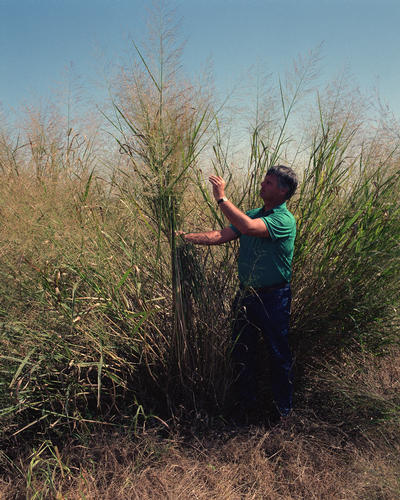
Photo: Warren Gretz, DOE/NREL, Public domain · source

Ornamental grass · Poaceae
Switchgrass
Panicum virgatum
In other languages: Vingergras (Nederlands) · Panic érigé (Français)
Switchgrass comes from the prairies of North America, where it forms vast grasslands together with other tall grasses. It makes an upright clump of narrow leaves, above which airy, see-through flower heads float from August to October. In autumn the foliage turns yellow, orange or red, depending on the cultivar. Gardeners value it because it copes with drought, stands up well and looks good all winter. Well-known cultivars are ‘Shenandoah’, with red foliage, ‘Heavy Metal’ and ‘Prairie Sky’, with blue-grey leaves, and the columnar ‘Northwind’.
Light
Full sun
warm and bright
Moisture
Dry to wet
not fussy
Legal basis
Sand, loam or clay
any pH
Hardiness
Fully hardy
down to -30 °C
Size
1.2 m
tall, 0.6 m wide
Flowering
August–October
| Pruning months | March |
|---|---|
| Height | 1.2 m |
| Native to Belgium | No, planted |
| Good for bees, butterflies and birds | Yes, for birds |
| Poisonous to people and pets | Not known to be poisonous |
| Flowering | August–October |
Identify
Switchgrass: how do you recognise it?
- Habit
- Dense, upright clump, 1–1.2 m tall in flower and about 60 cm wide. Spreads slowly.
- Leaves
- Narrow and linear, green to blue-grey; yellow, orange or red in autumn.
- Flowers
- Airy, widely branched panicles with tiny reddish to beige spikelets, from August to October.
- Seeds
- Small, shiny seeds that stay on the flower heads into winter.
- Roots
- Deep and strong, which is why it copes so well with drought.
Flowering: August–October · Plants: April–May · Pruning: March
In your garden
Why grow it?
- A sturdy, upright clump that gives structure deep into winter.
- Fine, airy flower heads from August to October that glow when backlit.
- Lovely autumn colour: yellow in the species, red in cultivars such as ‘Shenandoah’.
- Drought-tolerant thanks to deep roots, yet also copes with moist soil.
- The seeds feed birds in winter.
Switchgrass: where does it grow best?
- Full sun: in shade the clump falls open and colours less.
- Sandy, loamy or clay soil, acid to chalky: it is not fussy.
- Dry to moist soil; once established it tolerates drought well.
- Allow 50–60 cm between plants; lovely in a group or as a low, airy screen.
- Light
- Sun
- Soil type
- Sand, loam or clay
- Acidity
- Not fussy
- Moisture
- Dry to wet
- Size
- 1.2 m tall, 0.6 m wide
- Hardiness
- Hardy (to -30 °C)
Goes well with
- Purple coneflower: Pink flowers on sturdy stems, also loved by bees.
- Autumn aster: Violet-blue flowers in the same late season.
- Sedum: Flat, pink flower heads and fleshy leaves, also drought-tolerant.
- Globe thistle: Blue globes that stand out well against the airy flower heads.
- Russian sage: Silver-grey leaves and lavender-blue flowers for a sunny, dry spot.
Maintenance
Switchgrass: when and how to plant it?
Plant in April–May.
- Plant in April or May: switchgrass only grows once the soil warms up, and roots best then.
- Dig a hole twice as wide as the pot and loosen the bottom.
- Set the plant at the same depth as in the pot, with the crown just at soil level.
- Keep 50–60 cm between plants.
- Water thoroughly straight away and in dry spells during the first weeks.
- Mulch with gravel or a thin layer of compost if you like, keeping it away from the crown.
Care
- Watering
- In dry spells during the first year. After that only in long dry periods.
- Feeding
- Not needed. On rich soil or with lots of fertiliser it grows soft and flops.
- Leave standing
- Leave the clump all winter: the flower heads look lovely with frost and the seeds feed birds.
- Dividing
- Every four to five years, when the centre of the clump becomes bare, in spring.
Tip: Plant in spring and be patient: it is late to appear. Leave the flower heads all winter; cultivars such as ‘Shenandoah’ turn red in autumn and the seeds are winter food for birds.
Switchgrass: when to prune it?
Pruning months: March.
When: In March, before the new leaves appear. Not in autumn.
How:
- Cut the whole clump back to 10–15 cm above the ground.
- Tie the clump together with string first: you can then cut it in one go and clearing up is easy.
- Use sharp hedge shears or secateurs.
- Compost the dry leaves or use them as mulch.
Caution: Don’t cut back too late in spring: if the new shoots are already tall, you will cut off their tips.
Propagation
- Division
- In April–May, as the new leaves appear: slice pieces off the clump with a sharp spade and replant at once. This keeps cultivars true.
Switchgrass: how does it get through the winter?
Hardy to −30 °C.
- Fully hardy, to about −30 °C: no protection needed in Belgium.
- Leave the clump standing: the flower heads and coloured foliage give structure and the seeds feed birds.
- In a pot it also survives normal winters; wrap the pot in hessian in severe frost.
Diseases and pests
- Late start: In April the clump still looks dead. Switchgrass only starts growing once the soil is warm, often in May. Be patient.
- Flopping: Too much shade, too rich a soil or too much water makes the clump weak. A sunny spot on poor soil helps.
- Bare centre: Old clumps die out in the middle. Dividing in spring rejuvenates the plant.
- Rust: Orange-brown pustules on the leaves, especially in damp weather in late summer. Cut off affected leaves and give the plant space and air.
Through the year
- January: Leave the flower heads for the birds.
- February: Winter structure. Leave standing.
- March: Cut back to 10–15 cm.
- April: Plant. Divide if the centre is bare.
- May: New leaves appear. Plant or divide.
- June: Growth. Water young plants in dry spells.
- July: Foliage in full growth.
- August: The first flower heads appear.
- September: Flowering. The flower heads glow when backlit.
- October: Flowering and autumn colour.
- November: Leave standing; the seeds ripen.
- December: The seeds feed birds. Frost on the flower heads.
Use
Good for wildlife
- Birds
- Berries, seeds or insects as food, or a place to nest.
You and this species
Did you know?
- Switchgrass is one of the typical grasses of the North American tallgrass prairie, growing wild from Canada to Mexico.
- It is a warmth-loving grass (a so-called C4 plant): it only grows strongly when it is warm. That is why it starts so late.
- In the United States it is researched and grown as an energy crop for biofuel.