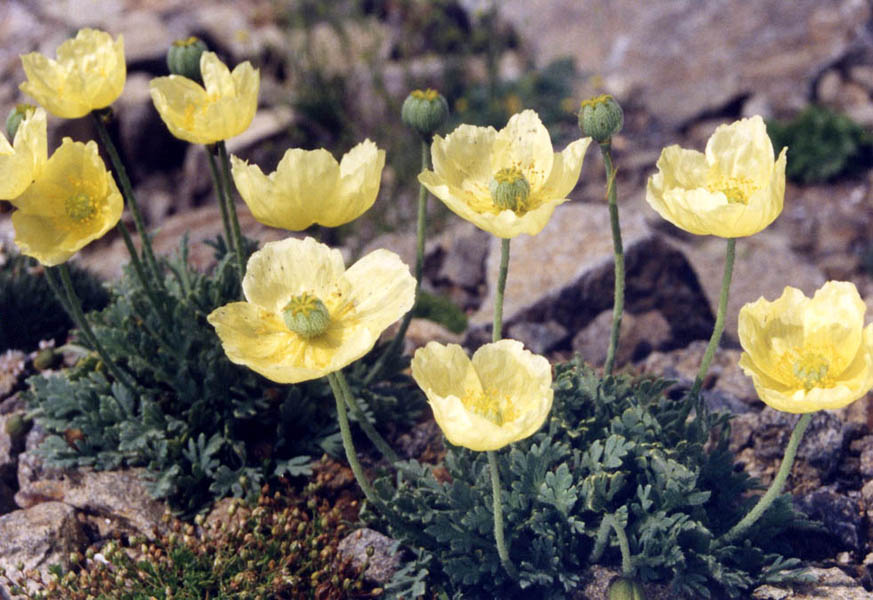
Photo: Ghislain118 (AD) http://www.fleurs-des-montagnes.net, CC BY-SA 3.0 · source

Annual · Papaveraceae
Iceland poppy
Papaver nudicaule
In other languages: IJslandse papaver (Nederlands) · Pavot d’Islande (Français)
Iceland poppy comes from cold northern regions and mountains of the northern hemisphere. It is a short-lived perennial that in the garden is usually grown as a biennial or annual. From a low rosette of cut, grey-green leaves rise long, leafless, hairy stems carrying cups of 5–7 cm in yellow, orange, white, pink and red. The silky, paper-thin petals look like silk. It flowers from May to August, is fully hardy and makes an excellent cut flower. Bees visit the flowers.
Caution: All parts of the plant, especially the milky sap and the unripe capsules, are poisonous if eaten. Children, cats, dogs and grazing animals are at risk; the sap can also irritate the skin. Wear gloves when cutting and keep flowers in the vase out of reach of small children and pets.
Light
Full sun
warm and bright
Moisture
Dry to normal
no wet feet
Legal basis
Sand or loam
any pH
Hardiness
down to -15 °C
protect young plants
Size
0.4 m
tall, 0.2 m wide
Flowering
May–August
| Height | 0.4 m |
|---|---|
| Native to Belgium | No, planted |
| Good for bees, butterflies and birds | Yes, for bees |
| Poisonous to people and pets | Yes, take care with children and pets |
| Flowering | May–August |
Identify
Iceland poppy: how do you recognise it?
- Habit
- Short-lived perennial, usually grown as a biennial or annual; 30–40 cm tall and 20 cm wide.
- Foliage
- A low rosette of cut, grey-green leaves; hairy.
- Flower
- Cups of 5–7 cm with four to six paper-thin petals, on long, leafless, hairy stems. May to August.
- Colour
- Yellow, orange, white, pink, red and mixed shades.
- Fruit
- A small capsule with a lid and pores from which the seed is shaken.
Flowering: May–August · Sowing: February–March and May–June · Plants: April–May and September
In your garden
Why grow it?
- Silky, colourful cups from May to August on slender, leafless stems.
- A popular cut flower, provided you treat the stems the right way.
- Bees readily visit the flowers and collect pollen.
- Fully hardy and suited to dry, sunny places.
- Compact: ideal at the front of a border, in a rock garden or in containers.
Iceland poppy: where does it grow best?
- Full sun or light partial shade; it flowers best in sun.
- Well-drained soil: sand or loam, acid to chalky; no wet ground.
- Dry to moderately moist; it dislikes wet feet, especially in winter.
- Space 20–25 cm apart; at the front of the border or in a rock garden.
- Light
- Sun
- Soil type
- Sand or loam
- Acidity
- Not fussy
- Moisture
- Dry or normal
- Size
- 0.4 m tall, 0.2 m wide
- Hardiness
- Hardy (to -15 °C)
Goes well with
- Lavender: Sun-loving and aromatic; together a colourful dry border.
- Ornamental grasses: Soft stems that show off the colourful cups.
- Stonecrop: A low, sturdy plant for the same dry spot.
- Larkspur: Blue spikes that contrast with orange and yellow poppies.
Maintenance
Iceland poppy: when and how to plant it?
Plant in April–May and September.
- Sow in February–March indoors (light germinator) or in May–June outdoors, in a seedbed or small pots.
- Sow on the surface and do not cover the very fine seed; firm in and keep moist at about 10–15 °C. Germination takes 2–3 weeks.
- Thin the seedlings or prick them out into pots; disturb them as little as possible, since the roots are sensitive.
- Plant out in April–May, or in September for flowers the following year, 20–25 cm apart.
- Water in at planting and keep the soil slightly moist for the first few weeks.
Care
- Water
- Keep young plants slightly moist. After that, water only in prolonged drought.
- Feeding
- Not needed; feed gives lots of leaf and few flowers.
- Deadheading
- Cut off spent flowers to prolong flowering. Leave a few if you want seed.
- Cutting
- Pick stems when the bud is just splitting and the colour shows. Sear the stem end briefly in boiling water or a flame; the flowers last longer.
- Mulching
- A thin layer of grit or sand keeps the crown dry; no thick organic mulch.
Tip: It is usually grown as a biennial: sow in June and plant out in September where it is to flower. For the vase, pick in bud and briefly sear the stem end.
Iceland poppy: when to prune it?
When: It is not pruned; you cut off spent flowers and, after flowering, the dead stems.
How:
- Cut off spent flowers with their stem before the capsule forms; this prolongs flowering.
- Let a few capsules ripen if you want to collect seed or allow self-sowing.
- Cut dead stems and leaves in autumn or late winter.
- Keep the white sap off your skin and eyes: wear gloves if you have a lot to cut.
Caution: The milky sap can irritate the skin: wear gloves and wash your hands afterwards.
Propagation
- Sowing
- In February–March indoors or in May–June outdoors. Sow on the surface without covering; germination at about 10–15 °C after 2–3 weeks.
- Self-sowing
- Let a few capsules ripen; seedlings come up on their own and flower the following year.
Iceland poppy: how does it get through the winter?
Hardy to −15 °C: protect young plants.
- Fully hardy, down to about −15 °C: no protection needed in Belgian winters, but well-drained soil.
- Wet winters are more dangerous than frost: ensure good drainage.
- In a pot: put it against a wall or in a dry spot and water sparingly.
Diseases and pests
- Root rot: The plant declines in wet soil. Choose a well-drained spot or mix grit into the soil.
- Downy mildew: Yellow patches with a greyish fuzz under the leaves in damp weather. Remove affected leaves and space plants.
- Aphids: On buds and young shoots. Rinse them off with water or let ladybirds do the work.
- Slugs: Young seedlings are soon eaten. Search for them in the evening or lay a ring of coarse sand or crushed shells.
Through the year
- February: Sow indoors.
- March: Sow. Prick out seedlings.
- April: Plant out pot-raised plants.
- May: Flowering begins. Sow or plant outdoors.
- June: Flowering. Sow outdoors for flowers next year. Cut in bud.
- July: Flowering. Remove spent flowers.
- August: Last flowers. Collect seed if wanted.
- September: Plant for flowers next spring.
- October: Clear the plants or let them self-seed.
Use
Edible and useful
Not edible. All parts of these poppies are poisonous, especially the milky sap and the unripe seed heads: they contain alkaloids that cause nausea, vomiting, stomach ache and drowsiness if swallowed, in children as well as in dogs, cats and grazing livestock. They are not opium poppies: the poppy seed from the bakery comes from the opium poppy (Papaver somniferum), and the seed of these poppies is not eaten. Do not make tea from the flowers or seed heads, and hang dried arrangements with seed heads out of children’s reach. The sap can irritate the skin: wear gloves when cutting flowers for the vase, and keep the vase out of reach of small children and cats. If any is swallowed, call a poison centre (in Belgium 070 245 245) or your doctor at once.
Good for wildlife
- Bees
- Nectar and pollen for honeybees and wild bees.
You and this species
Did you know?
- The species name nudicaule means ‘with a naked stem’ and refers to the leafless flower stalks.
- The buds first hang downwards and straighten just before opening, as in most poppies.
- The capsule has small pores under a lid and scatters the seed in the wind, like a pepper pot.