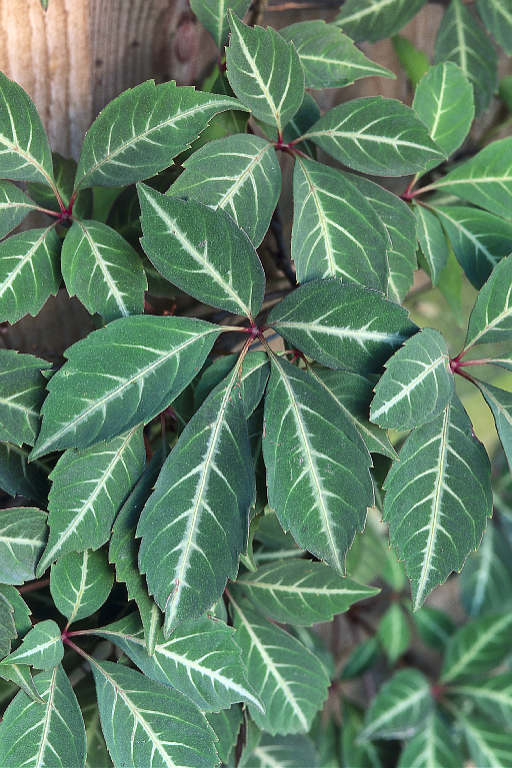
Photo: Rachida Boutboul, CC0 · source

Climber · Vitaceae
Chinese Virginia creeper
Parthenocissus henryana
In other languages: Chinese wingerd (Nederlands) · Vigne vierge de Chine (Français)
Chinese Virginia creeper is a deciduous climber from central China, related to the common Virginia creeper but far less rampant. It climbs to about 8 m using tendrils that end in sticky pads, so it scales a wall without wires or trellis. Its velvety, hand-shaped leaves are dark green to bronze-green with striking silvery-white veins, turning a fiery red in autumn. Gardeners choose it for a wall in partial shade, where the silver markings show up best. It looks elegant throughout the growing season and needs little work.
Light
Sun to shade
not fussy
Moisture
Normal
no wet feet
Legal basis
Sand, loam or clay
any pH
Hardiness
Fully hardy
down to -20 °C
Size
8 m
tall, 6 m wide
| Pruning months | November–December |
|---|---|
| Height | 8 m |
| Native to Belgium | No, planted |
| Good for bees, butterflies and birds | Yes, for bees and birds |
| Poisonous to people and pets | Not known to be poisonous |
Identify
Chinese Virginia creeper: how do you recognise it?
- Habit
- Deciduous, self-clinging climber, up to 8 m tall and 6 m wide.
- Leaves
- Palmately compound, usually of five leaflets 4–10 cm long. Velvety dark green to bronze-green with silvery-white veins, often purplish underneath.
- Autumn colour
- Fiery red to purple-red in October, then the leaves fall.
- Tendrils
- Branched tendrils with small sticky pads that cling firmly to stone and wood.
- Flowers and fruit
- Small greenish flowers in summer, barely visible but loved by bees. In warm summers small blue-black berries follow.
Plants: March–April and October–November · Pruning: November–December
In your garden
Why grow it?
- The most beautiful leaves of all the Virginia creepers: velvety green with silvery-white veins, fiery red in autumn.
- Less rampant than common Virginia creeper, so easier to keep in check on a house wall.
- Self-clinging: once established it needs no wires or trellis.
- Ideal for a north-, east- or west-facing wall, where many climbers do less well.
- The inconspicuous flowers attract bees; in warm summers small blue-black berries follow for the birds.
Chinese Virginia creeper: where does it grow best?
- Partial shade is ideal: that is where the silver veins look best. It also grows in shade; in full sun only if the soil stays moist.
- Humus-rich soil that does not dry out: sand, loam or clay, acid to chalky.
- Moist; the foot of a wall dries out quickly, so water more there.
- Against a wall, fence or pergola; it struggles to cling to a smooth, freshly painted wall.
- One plant easily covers 4–6 m of wall. Plant 30–40 cm out from the wall.
- Light
- Sun, partial shade and shade
- Soil type
- Sand, loam or clay
- Acidity
- Not fussy
- Moisture
- Normal
- Size
- 8 m tall, 6 m wide
- Hardiness
- Hardy (to -20 °C)
Goes well with
- Climbing hydrangea: White flowers in summer on the same shady wall.
- Clematis: Flowers among the velvety leaves.
- Hosta: Large leaves at the base, in the same partial shade.
- Ferns: Keep the base cool and green.
- Japanese anemone: Flowers in September–October, as the leaves start to turn red.
Maintenance
Chinese Virginia creeper: when and how to plant it?
Plant in March–April and October–November.
- Plant in March–April or October–November, when the soil is neither frozen nor waterlogged.
- Dig a hole twice as wide as the rootball, 30–40 cm from the wall, and mix in some compost.
- Set the plant at the same depth as in the pot, leaning slightly towards the wall.
- Guide the shoots to the wall with a few canes or strings and tie them loosely until the pads cling.
- Firm in and water thoroughly straight away.
- Mulch the base with compost or leaf mould to keep the roots cool and moist.
Care
- Watering
- Regularly in dry weather for the first two years, especially against a wall. An established plant needs little water.
- Feeding
- In March, a layer of compost or a little organic fertiliser around the base is enough.
- Mulching
- A layer of compost or leaf mould every spring keeps the base cool.
- Support
- In the first year, canes or strings help until the sticky pads take hold; after that it climbs on its own.
- Leaves
- Leave fallen autumn leaves at the base as a natural mulch.
Tip: Plant it against a wall in partial shade: that is where you get the best silver veins. In the first year, tie the shoots in loosely until the sticky pads take hold.
Chinese Virginia creeper: when to prune it?
Pruning months: November–December.
When: In early winter, in November–December, when it is bare and you can see the shoots clearly. Otherwise it hardly needs pruning.
How:
- Cut shoots out of gutters, off roof tiles and away from windows and doors. Keep 30–50 cm clear.
- Shorten shoots that are too long or hanging loose back to a bud or side shoot.
- Remove dead and damaged shoots.
- Do not pull shoots off the wall; cut them free so you do not damage the brickwork.
Caution: Do not prune in spring: the plant is then full of sap and the cuts can bleed for a long time.
Propagation
- Softwood cuttings
- In June–July: cuttings of young shoots with two or three nodes, lower leaves removed, in moist cutting compost under plastic, in good light but out of direct sun.
- Layering
- In spring, pin a long shoot to the ground and cover a node with soil. Sever it after a year and replant it.
Chinese Virginia creeper: how does it get through the winter?
Hardy to −20 °C.
- Hardy to about −20 °C: an established plant needs no protection in Belgium.
- Mulch the base of young plants in autumn for extra protection.
- In winter it is bare: only the network of shoots stays on the wall.
- In a large container: stand it against a wall and wrap the container in hessian.
Diseases and pests
- Scorched leaves: In strong sun the leaf edges turn brown and the silver veins fade. Choose a spot in partial shade or water more.
- Will not cling: Young shoots fall away from the wall. Tie them in for the first year; a smooth or freshly painted wall is difficult.
- Aphids: On young shoot tips in spring. Hose them off; ladybirds do the rest.
- Powdery mildew: White powder on the leaves, especially when the base is dry. Water enough and mulch.
Through the year
- March: Planting. Compost and mulch around the base.
- April: Planting. Guide new shoots to the wall and tie them in loosely.
- May: The leaves unfold, bronze-green with silver veins. Watch for aphids.
- June: Take softwood cuttings. Water in dry weather.
- July: Cuttings can still be taken. Water at the foot of the wall.
- September: In warm years, berries for the birds. Autumn colour begins.
- October: Fiery red autumn colour. Planting. Mulch the base of young plants.
- November: Planting. Prune after leaf fall: clear gutters and windows.
- December: Prune if still needed. Resting.
Use
Good for wildlife
- Bees
- Nectar and pollen for honeybees and wild bees.
- Birds
- Berries, seeds or insects as food, or a place to nest.
You and this species
Did you know?
- It is named after Augustine Henry, the Irish plant collector who worked in China; Lonicera henryi also bears his name.
- Parthenocissus literally means ‘virgin ivy’, from the Greek parthenos (virgin) and kissos (ivy), echoing the French name vigne vierge.
- The sticky pads cling so firmly that they often stay stuck to the wall when a shoot is pulled away.