Photo: Wikimedia Commons, CC BY-SA 3.0 · source

Annual · Geraniaceae
Zonal geranium
Pelargonium × hortorum
In other languages: Staande geranium (Nederlands) · Géranium zonal (Français)
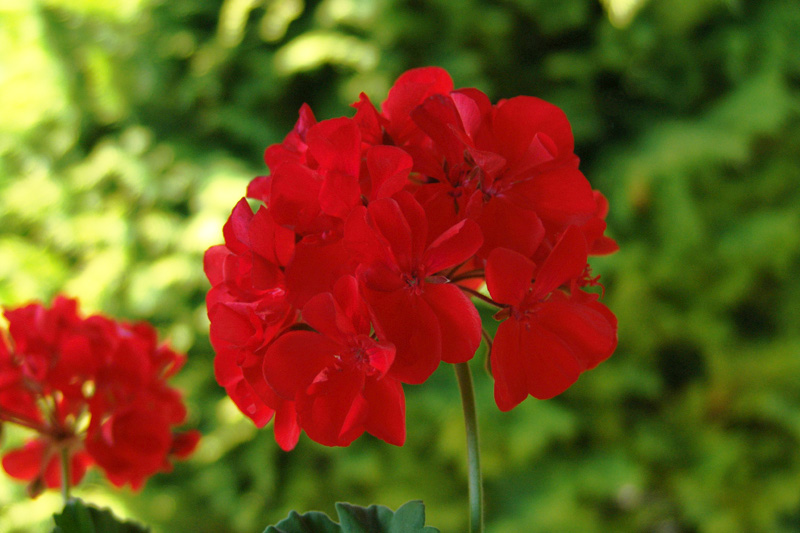
The zonal geranium is the classic balcony and patio plant. It descends from wild species from South Africa and flowers from May to October with rounded heads of red, pink, salmon, lilac or white flowers. The round, softly hairy leaves often carry a dark, horseshoe-shaped band, the ‘zone’ that gives the group its name. It copes well with drought and heat and needs little work. It is often sold as an annual, but with light, frost-free overwintering it lasts for years.
Caution: The leaves are mildly toxic to cats and dogs. Keep the plants out of their reach if they nibble them.
Light
Full sun
warm and bright
Moisture
Dry to normal
no wet feet
Legal basis
Sand, loam or clay
neutral to chalky
Hardiness
down to 2 °C
protect in harsh winters
Size
0.4 m
tall, 0.35 m wide
Flowering
May–October
| Pruning months | February–March and October |
|---|---|
| Height | 0.4 m |
| Native to Belgium | No, planted |
| Poisonous to people and pets | Yes, take care with children and pets |
| Flowering | May–October |
Identify
Zonal geranium: how do you recognise it?
- Habit
- Upright, branching plant 30–40 cm tall and about 35 cm wide, with fleshy stems that turn woody over the years.
- Leaves
- Round to kidney-shaped and softly hairy, often with a dark horseshoe-shaped band; they smell spicy when rubbed.
- Flower
- Rounded heads of single or double flowers on long stalks above the leaves, from May to October.
- Colour
- Red, pink, salmon, orange, lilac, purple and white, sometimes bicoloured.
- Roots
- Fine roots that dislike wet feet; it flowers best in a pot that is not too large.
Flowering: May–October · Sowing: January–February · Plants: May–June · Pruning: February–March and October
In your garden
Why grow it?
- Flowers for five months, from May to October.
- Tolerates drought and heat: ideal for sunny balconies, windowsills and containers that sometimes get forgotten.
- Easy to root from cuttings: a few cuttings in late summer give you new plants for free.
- Lasts for years if you overwinter it in a light, frost-free place.
- The leaves are decorative too, with a dark zone or variegated pattern in some varieties.
Zonal geranium: where does it grow best?
- Full sun; in shade it makes lots of leaves and few flowers.
- Well-drained soil or potting compost, neutral to chalky. Sand, loam and clay are fine, as long as water drains away.
- Rather dry than wet: let the soil dry out a little between waterings.
- A spot somewhat sheltered from heavy rain keeps the flowers looking better.
- Allow 25–30 cm between plants; a 20–25 cm pot holds one plant.
- Light
- Sun
- Soil type
- Sand, loam or clay
- Acidity
- Neutral or chalky
- Moisture
- Dry or normal
- Size
- 0.4 m tall, 0.35 m wide
- Hardiness
- Frost tender: plant out after the last frost (mid-May)
Goes well with
- Verbena: Trails over the edge of the container and likes the same sun.
- Petunia: Flowers just as long and fills the container with colour.
- Lobelia: Small blue flowers as a contrast to red geraniums.
- Lavender: Loves sun and drought just as much; lovely together in large pots.
- Silver ragwort: Silver-grey leaves that calm the bright colours.
Maintenance
Zonal geranium: when and how to plant it?
Plant in May–June.
- Plant out after the ‘Ice Saints’, in mid-May, once there is no more night frost.
- Choose a pot or trough with drainage holes, so excess water can escape.
- Fill with free-draining potting compost, if you like with a little added sand or perlite.
- Set the plant at the same depth as in its nursery pot and firm the compost.
- Space plants 25–30 cm apart.
- Water in, then let the compost dry out a little before watering again.
Care
- Watering
- Let the soil dry out a little between waterings: too much water is worse than too little. On hot days, do check small pots daily.
- Feeding
- From June to September, a flowering-plant fertiliser in the watering can every week.
- Deadheading
- Cut or snap off faded flower heads, stalk and all, and it will keep flowering.
- Repotting
- Repot overwintered plants in March in fresh compost, in a pot only slightly larger.
- Yellow leaves
- Remove yellow and dead leaves: they attract mould.
Tip: Choose a pot that is not too big: a geranium with slightly cramped roots flowers more freely than one in a large pot full of wet compost.
Zonal geranium: when to prune it?
Pruning months: February–March and October.
When: Prune in October, before bringing the plants in, and again in February–March, before new growth starts. Pinch out young seedlings and cuttings in March.
How:
- On young plants, pinch out the tips of the stems: they branch and become bushier.
- In October, shorten all stems by a third and remove flowers and buds.
- In February–March, cut back further to 10–15 cm, just above a leaf or bud.
- Remove thin, weak and diseased stems completely.
Caution: Do not prune in full summer flower: you lose weeks of blooms. Removing faded flower heads is enough.
Propagation
- Tip cuttings
- In August–September, take tips 8–10 cm long with a few leaves. Remove the lower leaves, let the cutting dry for an hour and insert it in sandy cuttings compost, with no plastic cover, or it will rot. It roots in three to four weeks.
- Seed
- In January–February indoors at 20–24 °C, barely covering the seed. Prick out the seedlings when they have two true leaves; they flower in summer.
- Spring cuttings
- You can also take cuttings from overwintered plants in March; they flower the same summer.
Zonal geranium: how does it get through the winter?
Hardy to 2 °C: protect in harsh winters.
- Not hardy: bring it in before the first frost, usually in October.
- Ideal is a light, cool, frost-free place at 5–10 °C, such as a cold greenhouse, a cool stairwell or a garage with a window.
- In winter give very little water, just enough to stop the stems shrivelling, and no fertiliser.
- No light, cool place? Then take cuttings in late summer and overwinter only those on a cool windowsill.
Diseases and pests
- Blackleg: The base of the stem turns black, often on cuttings and in cold, wet weather. Water less, use fresh compost and throw away affected plants.
- Grey mould: Grey fluff on flowers and leaves, especially in autumn and during overwintering. Remove dead leaves and provide fresh air.
- Rust: Rings of brown, powdery pustules on the undersides of the leaves. Cut off affected leaves and keep the foliage dry.
- Whitefly and aphids: Tiny white flies or green aphids on the undersides of the leaves. Spray them off with water or hang up yellow sticky traps.
- Red leaves: Red leaf edges caused by cold nights in spring or autumn, or by a lack of nutrients. Move it somewhere warmer or feed it.
Through the year
- January: Sow indoors at 20–24 °C. Give overwintered plants very little water.
- February: Sow. Cut overwintered plants back to 10–15 cm.
- March: Finish pruning, repot and take cuttings. Pinch out young plants. More light and water.
- April: Put plants outside on mild days to harden off. Pot up seedlings.
- May: After mid-May, plant out in the sun.
- June: Flowering. Feed weekly and remove faded flower heads.
- July: Full flower. Do not overwater.
- August: Flowering. Take tip cuttings.
- September: Take cuttings. Feed less.
- October: Shorten by a third and bring indoors before the first frost.
- November: Overwinter light and cool at 5–10 °C, almost dry.
Use
Edible and useful
Not edible. Zonal and ivy-leaved geraniums are mildly poisonous, especially to cats and dogs: chewing the leaves or flowers causes vomiting, drooling and lethargy, and brushing against them often sometimes irritates the skin. Horses can be affected too. They are not scented geraniums: the leaves that give cakes or tea a rose or lemon scent come from other pelargoniums, and these are not used in the kitchen. Hang window boxes and hanging baskets out of reach of cats, do not let children chew the leaves, and wear gloves if you have sensitive skin. If any is swallowed, call a poison centre (in Belgium 070 245 245) or your doctor at once.
You and this species
Did you know?
- Despite the name, it is not a true geranium. Pelargonium comes from the Greek word for stork, Geranium from the word for crane: both refer to the beak-shaped seed pods.
- Its wild ancestors, Pelargonium zonale and Pelargonium inquinans, came to Europe from the Cape in the early 18th century.
- In the past, gardeners overwintered geraniums bare-rooted and upside down in a cool, frost-free cellar; in spring they simply started growing again.