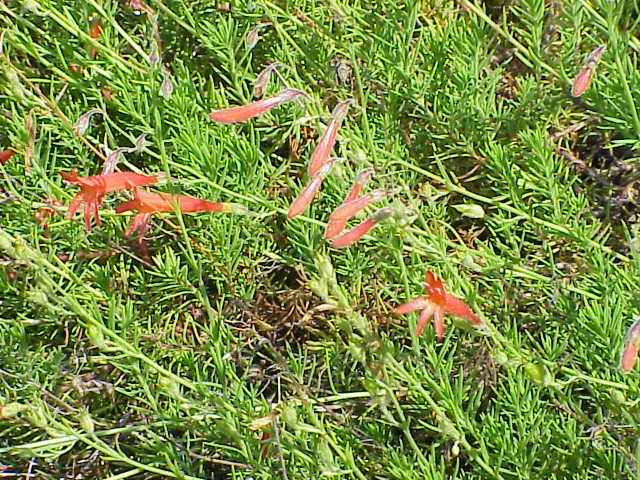
Photo: Kurt Stüber [1], CC BY-SA 3.0 · source

Perennial · Plantaginaceae
Pineleaf penstemon
Penstemon pinifolius
In other languages: Slangenkop (Nederlands) · Penstémon à feuilles de pin (Français)
Penstemon pinifolius, the pineleaf penstemon, grows wild on dry, rocky slopes in the south-western United States and northern Mexico. It is a low, evergreen subshrub of 20–30 cm with fine, needle-like leaves that look like pine needles. From June to August it carries spikes of narrow tubular flowers in fiery red to orange. Yellow-flowered forms also exist, such as ‘Mersea Yellow’. It is perfect for the rock garden, a gravel bed or the edge of a sunny border, provided the soil drains very well.
Light
Full sun
warm and bright
Moisture
Dry
tolerates drought
Legal basis
Sand or loam
any pH
Hardiness
Fully hardy
down to -20 °C
Size
0.3 m
tall, 0.4 m wide
Flowering
June–August
| Pruning months | April and August |
|---|---|
| Height | 0.3 m |
| Native to Belgium | No, planted |
| Good for bees, butterflies and birds | Yes, for bees |
| Poisonous to people and pets | Not known to be poisonous |
| Flowering | June–August |
Identify
Pineleaf penstemon: how do you recognise it?
- Habit
- Low, dense subshrub 20–30 cm high and about 40 cm wide, with a woody base.
- Foliage
- Needle-like, 1–3 cm long, bright to dark green, in tufts along the stems; evergreen.
- Flower
- Narrow tubular flowers of 2.5–3 cm in loose spikes at the stem tips, from June to August.
- Colour
- Fiery red to orange-red; yellow cultivars also exist.
- Roots
- Fine and fibrous: it needs free-draining, lean soil.
Flowering: June–August · Plants: April–May · Pruning: April and August
In your garden
Why grow it?
- Fine, evergreen needle-like foliage that stays attractive all year, even in winter.
- Flowers from June to August with bright orange-red tubular blooms in full sun.
- Bees and bumblebees visit the flowers.
- Drought-tolerant: excellent for a gravel garden, rock garden or sunny wall.
- Stays small and tidy: suits small gardens, containers and front gardens.
Pineleaf penstemon: where does it grow best?
- Full sun: the more sun, the richer the flowering.
- Very free-draining, poor sandy or loamy soil, acid to chalky. Heavy clay is unsuitable.
- Fairly dry: it tolerates drought very well but not wet feet.
- Allow 30–40 cm between plants. A raised bed or rock garden is ideal.
- Light
- Sun
- Soil type
- Sand or loam
- Acidity
- Not fussy
- Moisture
- Dry
- Size
- 0.3 m tall, 0.4 m wide
- Hardiness
- Hardy (to -20 °C)
Goes well with
- Stonecrop: Low, fleshy plants in the same dry, sunny soil.
- Thyme: A fragrant ground cover that tolerates the same lean soil.
- Blue fescue: Blue-grey tufts that stand out nicely against the orange-red flowers.
- Houseleek: Rosettes in the same sunny, lean spot, ideal in a rock garden.
Maintenance
Pineleaf penstemon: when and how to plant it?
Plant in April–May.
- Plant in April–May, when the worst of the frost is over and the soil is warming up.
- Mix the soil with a third fine grit or coarse sand; for heavy soil, make a raised planting bed.
- Plant at the same depth as in the pot, preferably slightly raised so water runs away.
- Keep 30–40 cm between plants and firm the soil.
- Water in once generously after planting, then only during long dry spells.
- Spread a layer of gravel around the plant instead of organic mulch, which holds moisture.
Care
- Water
- Rarely once established. It tolerates drought better than wet soil.
- Feeding
- Hardly needed. Rich soil gives lots of leaves and few flowers.
- Mulching
- Use gravel or grit, not compost or bark: they keep the base damp.
- Deadheading
- Cut off faded spikes after flowering to keep the plant tidy.
- Support
- Not needed; it stays low and compact.
- Pots
- Does well in a pot with plenty of sand and grit in the compost; provide drainage holes.
Tip: Give it gravel rather than compost: this subshrub wants poor, dry soil without wet feet. Plant it slightly raised in a rock garden or on a small mound.
Pineleaf penstemon: when to prune it?
Pruning months: April and August.
When: Lightly in April and after flowering in August.
How:
- In April, cut off dead and brown tips back to where the stem is green.
- After flowering, in August, cut faded spikes back to just above the foliage.
- Do not cut into old, bare wood: it regrows badly.
- Trim lightly every year to keep the plant dense and compact.
Caution: Never cut into old, leafless wood: it often does not shoot again.
Propagation
- Cuttings
- In July–August: take 5–8 cm cuttings from semi-ripe shoots, remove the lower leaves and insert them in sandy compost. They root within a few weeks; overwinter them frost-free.
- Seed
- In spring or autumn in a tray of sandy compost. Sow thinly, barely cover the seed and keep the tray outdoors. Germination is slow and uneven.
Pineleaf penstemon: how does it get through the winter?
Hardy to −20 °C.
- Hardy down to about −20 °C: in Belgium it survives most winters.
- The foliage stays green. Wet soil is more dangerous than frost: make sure drainage is good.
- In a wet winter, a small glass or plastic cover above the plant keeps off rain.
- In a pot: stand it against a sheltered wall and keep the pot dry.
Diseases and pests
- Root rot: Limp, yellow or brown foliage in wet soil. Improve drainage with grit, plant higher or move it to a drier spot.
- Becoming woody: Old plants turn bare and woody at the base. Trim lightly every year and replace old plants in time with cuttings.
- Few flowers: Too much shade or soil too rich. Give it full sun and lean soil.
- Aphids: Rarely, on young shoots. Rinse off with water.
Through the year
- April: Plant. Cut off dead wood and brown tips.
- May: Plant. Wait for the last frosts.
- June: Flowering begins.
- July: Flowering. Take cuttings.
- August: Cut off faded spikes. Take cuttings.
- September: Check the planting spot. Make sure drainage is good.
- October: Improve the spot with grit.
- November: Provide a small cover in wet winters.
- December: Rest. Do not water.
Use
Good for wildlife
- Bees
- Nectar and pollen for honeybees and wild bees.
You and this species
Did you know?
- Pinifolius is Latin for ‘with pine leaves’, after its needle-like leaflets.
- In the wild it grows on rocky, dry slopes in the south-western United States and northern Mexico.
- In its homeland, tubular flowers like these are often visited by hummingbirds.