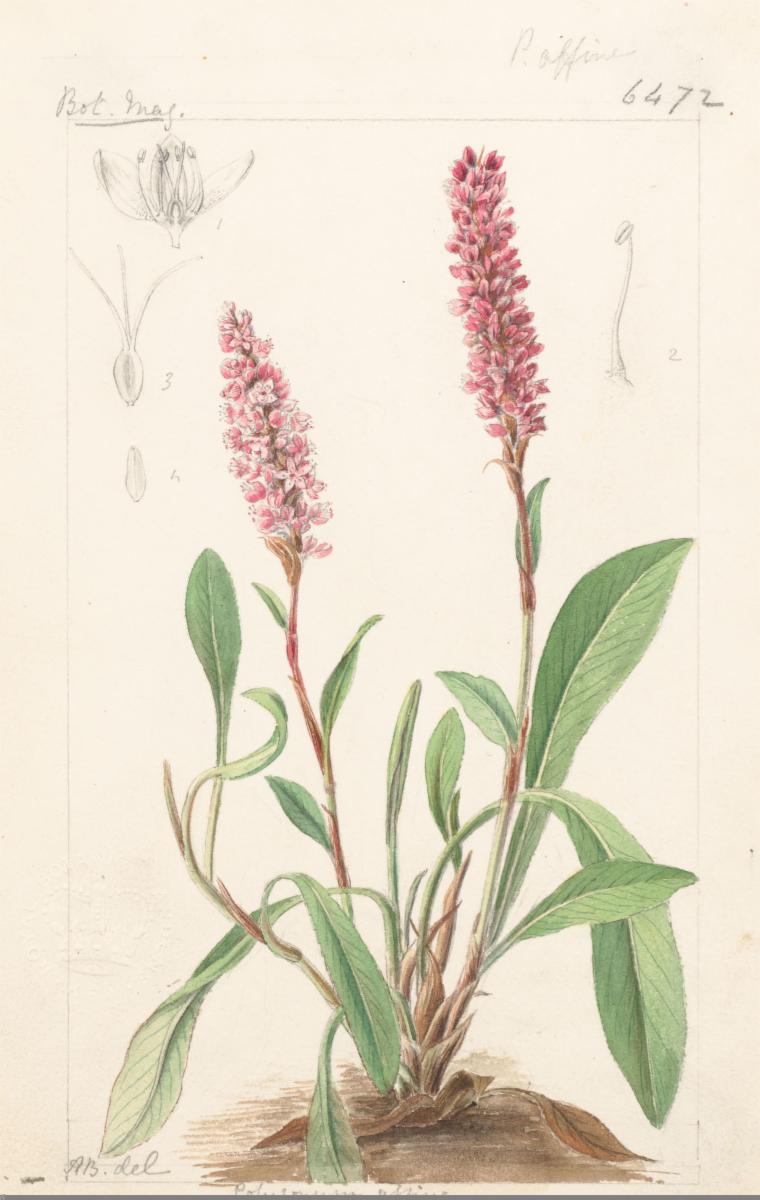
Photo: Ann Barnard, Public domain · source

Perennial · Polygonaceae
Himalayan knotweed
Persicaria affinis
In other languages: Duizendknoop (Nederlands) · Renouée affine (Français)
Himalayan knotweed comes from the mountains of the Himalaya and is used in gardens mainly as a low, dense ground cover. It forms a mat of narrow, lance-shaped leaves about 20 cm high and up to 60 cm wide. From July to October it carries upright, thick spikes of small pink flowers, which slowly deepen to darker pink and red. In autumn the foliage turns bronze-red. Well-known cultivars include ‘Superba’ and ‘Darjeeling Red’. It is also known as Polygonum affine and Bistorta affinis.
Caution: It spreads by creeping rootstocks and can take up a lot of space over the years. Give it room or cut the edges every spring.
Light
Sun or partial shade
preferably some sun
Moisture
Normal
no wet feet
Legal basis
Sand, loam or clay
any pH
Hardiness
Fully hardy
down to -25 °C
Size
0.2 m
tall, 0.6 m wide
Flowering
July–October
| Pruning months | March |
|---|---|
| Height | 0.2 m |
| Native to Belgium | No, planted |
| Good for bees, butterflies and birds | Yes, for bees |
| Poisonous to people and pets | Not known to be poisonous |
| Flowering | July–October |
Identify
Himalayan knotweed: how do you recognise it?
- Habit
- Low, creeping perennial about 20 cm high and 60 cm wide, forming mats by creeping rootstocks.
- Foliage
- Narrow, lance-shaped, 5–15 cm, dark green and glossy; bronze-red in autumn, partly evergreen in mild winters.
- Flower
- Thick, upright spikes of 5–8 cm made up of small flowers, from July to October.
- Colour
- First bright pink, then deeper pink to red as the flower ages.
- Roots
- Creeping, branching rootstocks with which the plant gradually forms a carpet.
Flowering: July–October · Plants: March–May and September–October · Pruning: March
In your garden
Why grow it?
- A dense, low-maintenance ground cover that suppresses weeds.
- Long flowering from July to October with pink spikes that turn red.
- Bees visit the flowers when little else is in bloom.
- Lovely autumn colour: the foliage turns bronze-red.
- Suits sun or partial shade, along paths, over low walls and in rock gardens.
Himalayan knotweed: where does it grow best?
- Sun or partial shade; in full sun it needs more water.
- Ordinary garden soil: sand, loam or clay, acid to chalky. Humus-rich soil is ideal.
- Normally moist; in dry weather the leaf edges turn brown.
- Allow 30–40 cm spacing for a quickly dense carpet, or 50–60 cm for slower growth.
- Light
- Sun and partial shade
- Soil type
- Sand, loam or clay
- Acidity
- Not fussy
- Moisture
- Normal
- Size
- 0.2 m tall, 0.6 m wide
- Hardiness
- Hardy (to -25 °C)
Goes well with
- Lady’s mantle: Soft yellow-green flowers and leaves contrast nicely with the pink spikes.
- Cranesbill: Blue or pink flowers in the same sunny to partly shaded spot.
- Ornamental grasses: Airy stems above the low, dense carpet.
- Japanese anemone: Flowers at the same time, in white and pink shades.
Maintenance
Himalayan knotweed: when and how to plant it?
Plant in March–May and September–October.
- Plant in March–May or September–October, when the soil is neither frozen nor too wet.
- Dig a hole big enough for the root ball and work some compost into the bottom.
- Set the plant at the same depth as in the pot and firm the soil.
- Keep 30–40 cm between plants; the carpet closes in two to three years.
- Water in at once and keep the soil moist during the first season.
- Lay a thin layer of compost or bark between the plants to suppress weeds until they meet.
Care
- Water
- In the first year weekly in dry weather. After that, only in long dry spells, especially in sunny spots.
- Feeding
- In spring a spadeful of compost or a little organic fertiliser.
- Mulching
- A thin layer of compost in spring keeps the soil cool and moist.
- Deadheading
- Not needed: the spikes stay attractive. Cut them off if they look untidy.
- Dividing
- Divide the plant every 3–4 years when the centre goes bare, and replant the healthy pieces.
- Containing
- Keep the carpet in check by cutting the edges with a spade in spring.
Tip: Plant it in partial shade or where the soil does not dry out: in full sun the leaf edges scorch. Cut the edges every spring to keep the carpet within bounds.
Himalayan knotweed: when to prune it?
Pruning months: March.
When: In March, before the new shoots start to grow.
How:
- Cut off dead foliage and dried spikes, and trim the carpet down to a few centimetres above the ground.
- After flowering you can cut off faded spikes if you want a tidy mat.
- Cut the edges with a spade to limit spreading.
- Remove bare or dried-out patches and replant healthy pieces there.
Propagation
- Division
- In March–April or September–October: lift a clump, divide it with a spade or knife into pieces with roots and replant at once, 30–40 cm apart.
- Cuttings
- In June–July: take 8–10 cm tip cuttings or pieces of rooted stem. Pot them up in compost and keep them moist until rooted.
Himalayan knotweed: how does it get through the winter?
Hardy to −25 °C.
- Hardy down to about −25 °C: no protection is needed in Belgium.
- The foliage turns bronze-red and partly stays in place in mild winters; in hard winters it dies back.
- In a pot or container: stand it against a wall and do not let the roots dry out.
Diseases and pests
- Brown leaf edges: Mostly in dry weather or full sun. Water, mulch the soil and plant it in partial shade instead.
- Bare centre: Old plants go bare in the middle. Divide them and replant the healthy pieces.
- Spreading too far: It spreads by rootstocks. Cut the edges and pull out unwanted runners.
- Aphids: On young shoots in spring. Rinse off with water or let the ladybirds do the work.
Through the year
- March: Cut back to a few centimetres. Add compost. Plant or divide.
- April: Plant or divide. Cut the edges.
- May: Plant. Mulch.
- June: Take cuttings. Water in dry weather.
- July: Flowering begins. Water in dry weather.
- August: Full flower. Bees on the flowers.
- September: Flowering. Plant or move.
- October: Bronze-red autumn colour. Plant.
- November: Rest. Leave the foliage.
- December: Rest.
Use
Good for wildlife
- Bees
- Nectar and pollen for honeybees and wild bees.
You and this species
Did you know?
- Persicaria comes from the Latin ‘persica’ (peach), after the peach-like leaves of some species.
- It was long called Polygonum affine and is also sold under the name Bistorta affinis.
- Knotweeds are related to buckwheat and rhubarb: they belong to the same family, the Polygonaceae.