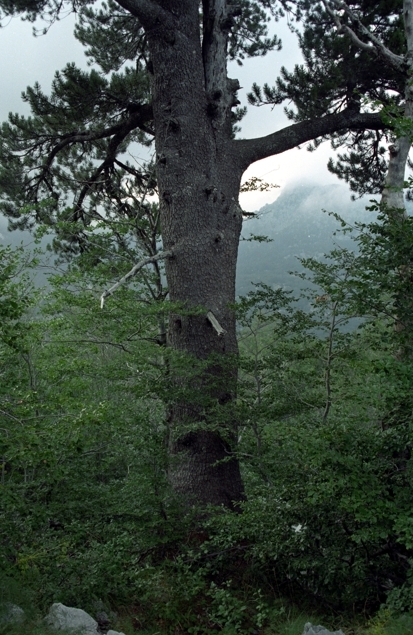
Photo: Wikimedia Commons, CC BY-SA 3.0 · source

Tree · Pinaceae
Bosnian pine
Pinus heldreichii
In other languages: Bosnische den (Nederlands) · Pin de Bosnie (Français)
The Bosnian pine grows naturally on chalky mountain slopes in the Balkans and in southern Italy, often on rocky, dry and windy sites. It is a compact, slow-growing evergreen pine with a dense, conical to egg-shaped crown, stiff dark green needles and pale grey bark that breaks into small, angular plates on older trees. The young cones are a striking blue-purple and ripen to brown. It is very tough: it tolerates lime, drought and wind and looks good even in cold winters. For small gardens there are compact selections such as ‘Smidtii’ and ‘Compact Gem’.
Light
Full sun
warm and bright
Moisture
Dry to normal
no wet feet
Legal basis
Sand, loam or clay
any pH
Hardiness
Fully hardy
down to -30 °C
Size
15 m
tall, 6 m wide
| Height | 15 m |
|---|---|
| Native to Belgium | No, planted |
| Poisonous to people and pets | Not known to be poisonous |
Identify
Bosnian pine: how do you recognise it?
- Habit
- Slow-growing evergreen tree about 15 m tall and 6 m wide (taller in the wild), with a dense, conical to egg-shaped crown.
- Needles
- Two per bundle, 7–10 cm, stiff and sharp, dark green and packed close along the twigs.
- Bark
- Pale grey to almost white; on older trees it breaks into small, angular plates.
- Cones
- Egg-shaped, 5–9 cm; blue-purple when young, later brown.
- Roots
- A strong root system that anchors itself even in rocky soil.
Plants: April–May and September–October
In your garden
Why grow it?
- Tolerates lime, dry soil and wind: a rare pine for chalky gardens.
- A compact, dense, regular crown of stiff, dark green needles.
- Striking pale bark and blue-purple young cones.
- Evergreen and fully hardy, to about −30 °C.
- Low maintenance: no pruning needed, and there are compact selections for small gardens.
Bosnian pine: where does it grow best?
- Full sun: in shade it becomes thin and bare.
- Well-drained soil: sand, loam or clay, acid to chalky. It tolerates lime very well, but not wet feet.
- Dry to normally moist; once established it is drought tolerant.
- Tolerates wind and an open, exposed spot.
- Allow 6 m width; for compact selections 1–2 m.
- Light
- Sun
- Soil type
- Sand, loam or clay
- Acidity
- Not fussy
- Moisture
- Dry or normal
- Size
- 15 m tall, 6 m wide
- Hardiness
- Hardy (to -30 °C)
Goes well with
- Lavender: Likes the same sunny, well-drained, chalky soil and scents the summer.
- Stonecrop: Sturdy and drought tolerant as underplanting in a sunny spot.
- Ornamental sage: Purple flower spikes in summer, on the same dry, sunny soil.
- Blue fescue: Blue-grey tufts that match the dark green needles.
Maintenance
Bosnian pine: when and how to plant it?
Plant in April–May and September–October.
- Plant in April–May or in September–October, when the soil is neither frozen nor waterlogged.
- Dig a hole twice as wide as the root ball and just as deep. Loosen the sides so the roots can grow out easily. In heavy soil, mix some coarse sand or grit into the excavated soil.
- Set the plant at the same depth as in its pot or root ball: the root collar stays at soil level. On heavy clay, plant slightly raised.
- Give it 5–6 m from buildings and other trees, or choose a compact selection where space is limited.
- Water generously straight away, even if it is raining.
- Spread a layer of gravel or bark mulch around the base, keeping it clear of the trunk.
Care
- Water
- For the first two years, water generously every week in dry spells. After that it looks after itself, even in dry summers.
- Feeding
- Not needed: it is used to poor soil.
- Mulching
- A layer of gravel or bark suppresses weeds; keep it clear of the trunk.
- Stake
- A young tree in a windy spot gets a stake for two to three years.
- Checking
- In spring, look for brown, crooked shoots; in summer, for woolly tufts and aphids.
Tip: Plant it in a sunny, well-drained spot and then leave it alone: wet feet are its worst enemy and pruning is unnecessary. On heavy clay, plant it slightly raised.
Bosnian pine: when to prune it?
When: It does not need pruning: it takes on its compact shape by itself. Only remove dead, damaged or diseased branches if necessary.
How:
- Cut dead or damaged branches back to the trunk or a side branch.
- Remove a double leader and leave one strong leader.
- Remove affected shoots in dry weather, back into healthy wood, and put them in the household waste.
Caution: Never cut into bare wood without needles: a pine will not regrow from it.
Propagation
- Seed
- For the species: collect the cones in autumn, let them dry and shake out the seeds. Sow them in spring in pots outdoors, after a cold period over winter. Seedlings grow slowly.
- Grafting
- Compact selections such as ‘Smidtii’ are grafted by nurseries; seedlings do not come true to the parent plant.
Bosnian pine: how does it get through the winter?
Hardy to −30 °C.
- Fully hardy, to about −30 °C: no protection is needed.
- Wet feet are more dangerous than frost in winter: make sure water drains away well.
- In a pot: put the pot in a sheltered spot and wrap it in hessian so the roots do not freeze. Water in dry, frost-free weather.
Diseases and pests
- Wet feet: Yellow needles and poor growth in heavy, wet or compacted soil. Plant in a well-drained or slightly raised spot.
- Aphids: White woolly tufts or grey aphids on twigs and needles, sometimes with sticky honeydew. Spray them off with a strong jet of water; ladybirds help.
- Needle drop: Old needles turn yellow or brown after a few years and fall in autumn. This is normal; only worry if branches go bare or many needles die on the outside.
- Shoot dieback: New shoots turn brown and bend in spring. Cut affected shoots back into healthy wood in dry weather and avoid drought stress in young trees.
Through the year
- March: Check for winter damage. Renew the mulch.
- April: Plant. New shoots appear. Watch for brown shoots.
- May: Plant. Apply mulch. Water young trees in dry weather.
- June: Water young trees in dry weather. Watch for aphids.
- July: Water young trees in dry weather.
- August: Water young trees in hot, dry weather.
- September: Plant. The cones turn brown.
- October: Plant. Needle drop is normal. Water new plantings.
- November: Move pots to a sheltered spot or wrap them against frost.
- December: Rest. Water pots in dry, frost-free weather.
You and this species
Did you know?
- In southern Italy it is called ‘pino loricato’, armoured pine, after its bark, which looks like armour made of plates. In the Pollino mountains there are specimens more than 1000 years old.
- It used to be called Pinus leucodermis; leucodermis means ‘white skin’ and refers to the pale grey bark.
- The species name honours Theodor von Heldreich, a German botanist who worked in Greece.