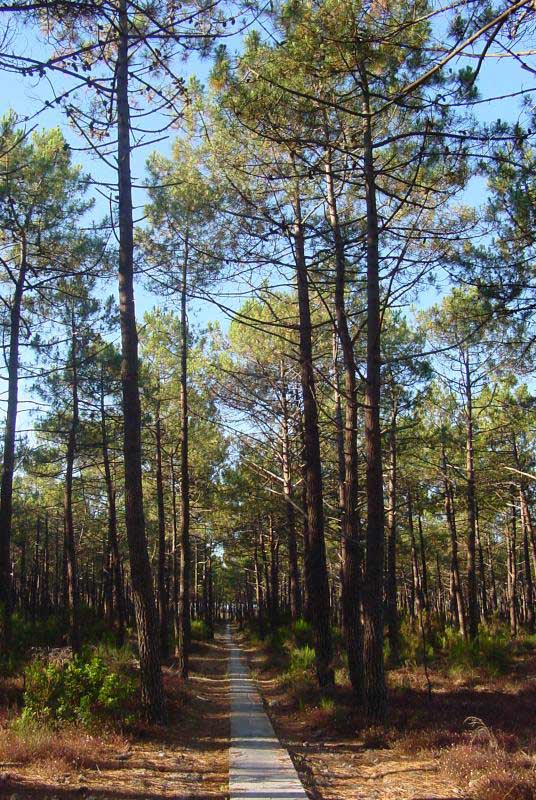
Photo: Patrick Verdier, Free On Line Photos, Copyrighted free use · source

Tree · Pinaceae
Maritime pine
Pinus pinaster
In other languages: Zeeden (Nederlands) · Pin maritime (Français)
The maritime pine grows naturally along the coasts of the western Mediterranean and the Atlantic coast of Portugal, Spain and France. It is a fast-growing pine with long, stiff needles in pairs and large, glossy brown cones. Young trees have a conical crown; with age the tree becomes more open and irregular, with a bare trunk and a broad top. The thick, deeply fissured, reddish-brown bark is handsome. It is made for poor, acid sandy soil, drought and coastal wind, but tolerates neither lime nor wet ground. It is too large for an ordinary garden: this is a tree for roomy plots.
Light
Full sun
warm and bright
Moisture
Dry
tolerates drought
Legal basis
Sand
acid to neutral
Hardiness
down to -15 °C
protect young plants
Size
25 m
tall, 10 m wide
| Height | 25 m |
|---|---|
| Native to Belgium | No, planted |
| Poisonous to people and pets | Not known to be poisonous |
Identify
Maritime pine: how do you recognise it?
- Habit
- Fast-growing pine up to about 25 m tall and 10 m wide, conical when young, later with a bare trunk and a broad, open crown.
- Needles
- Two per bundle, 10–25 cm long, stiff, sharply pointed and grey-green to dark green.
- Cones
- Large, conical cones of 8–22 cm, glossy reddish-brown, often in whorls around the branch.
- Bark
- Thick, deeply fissured and reddish-brown to dark grey; impressive on old trees.
- Roots
- A deep taproot: it transplants badly, so plant it young and straight into its final spot.
Plants: April–May and September–October
In your garden
Why grow it?
- Grows well on poor, dry sandy soil where few other trees survive.
- Tolerates wind and drought, so useful as a windbreak in coastal and sandy areas.
- Evergreen, with long needles, large cones and a handsome, deeply fissured bark.
- Fast-growing: within a few years it gives a green, Mediterranean look.
- Birds and squirrels like the seeds; the tree also shelters many insects.
Maritime pine: where does it grow best?
- Full sun: it is a true light-demander and grows poorly in shade.
- Poor, well-drained sandy soil, acid to neutral; it tolerates neither lime nor wet ground.
- Dry to moderately moist; once established it copes well with drought and sea wind.
- Allow at least 8–10 m of free space; do not plant it close to houses or boundaries.
- Light
- Sun
- Soil type
- Sand
- Acidity
- Acid or neutral
- Moisture
- Dry
- Size
- 25 m tall, 10 m wide
- Hardiness
- Hardy (to -15 °C)
Goes well with
- Heather: Flowers on the same acid, poor sandy soil and forms a low, colourful layer beneath.
- Broom: Yellow flowers in May–June, enjoys the same dry sandy soil.
- Juniper: A sturdy, evergreen native shrub for dry sandy soil.
- Blue fescue: Blue tufts that go well with the long, grey-green needles.
Maintenance
Maritime pine: when and how to plant it?
Plant in April–May and September–October.
- Plant in April–May or in September–October, preferably a small container or rootballed plant (30–60 cm). Small specimens settle best.
- Dig a hole twice as wide as the rootball and just as deep. Loosen the sides with the spade.
- Set the pine at the same depth as in its pot, with the root collar level with the soil. Do not plant deeper.
- Backfill, firm lightly and give it a generous watering. Do not mix compost or fertiliser into the soil.
- Spread a little pine bark or wood chips around the base, not against the trunk, and water in dry weather in the first year.
Care
- Water
- In the first summer, water generously once a week in dry weather. After that it manages on rain.
- Feeding
- Not needed; it does best on poor sandy soil. Too much food gives soft, fast growth.
- Mulching
- A thin layer of pine bark or wood chips keeps the soil around young plants moister and weed-free.
- Needles and cones
- Old needles fall every year; they acidify the soil slightly and make a useful natural mulch. Heavy cones can cause damage when they fall.
- Protect young trees
- Protect the trunk from mowers and keep young trees free of grass and weeds.
Tip: Plant it young and choose the spot carefully: it loves sand, sun and drought, and dislikes being moved. Do not put it in chalky or clay soil.
Maritime pine: when to prune it?
When: It needs no pruning. Dead or damaged branches can be removed from winter to early spring.
How:
- Cut dead, broken or crossing branches back to the trunk.
- Always keep one continuous leader: never cut off the top.
- To raise the lower crown, remove low branches while they are still thin.
Caution: Never cut into bare, brown wood without needles or buds: a pine will not sprout again from it.
Propagation
- Seed
- Sow in spring (March–April) in deep pots or tubes, because of the taproot. Soak the seed in lukewarm water for a day first. Move young plants to their final spot early.
- Buying
- A young nursery plant of 30–60 cm is the easiest route and settles better than a large tree.
Maritime pine: how does it get through the winter?
Hardy to −15 °C: protect young plants.
- Hardy to about −15 °C: enough for most Flemish winters, especially on the coast and in sheltered sandy soil.
- In very severe winters young specimens may suffer brown needles or damage; plant it in a sheltered, sunny spot.
- In the first winters, give young trees some shelter with a windbreak of hessian or brushwood.
Diseases and pests
- Lime-induced chlorosis: Needles turn yellow, especially on chalky soil. Plant it only on acid to neutral soil; correcting it later is difficult.
- Wet feet: Yellow or brown needles and root rot on wet, heavy soil. Choose a dry, free-draining spot.
- Frost damage: Brown needles or dying tips after a severe winter. Wait until spring and only then cut away dead parts.
- Woolly aphids: White, woolly patches on shoots and needles. Wash them off with a jet of water or dab them with soapy water.
Through the year
- March: Check for winter damage. Remove dead branches.
- April: Plant. Mulch young trees.
- May: Plant. Water newly planted trees in dry weather.
- June: Water young trees in dry weather.
- July: Water young specimens. Watch for woolly aphids.
- August: Water during prolonged drought.
- September: Plant. Water regularly after planting.
- October: Plant. Prepare shelter for young trees.
- November: Put up shelter for young trees.
- December: Rest. Shake snow off the branches.
You and this species
Did you know?
- The vast Landes forest in south-west France consists largely of maritime pine, planted in the 19th century on former wet heathland and dunes.
- In the past, maritime pines were tapped for resin, from which turpentine and rosin were made.
- Its name refers to its natural home on the coast, where it is also used to stabilise dunes.