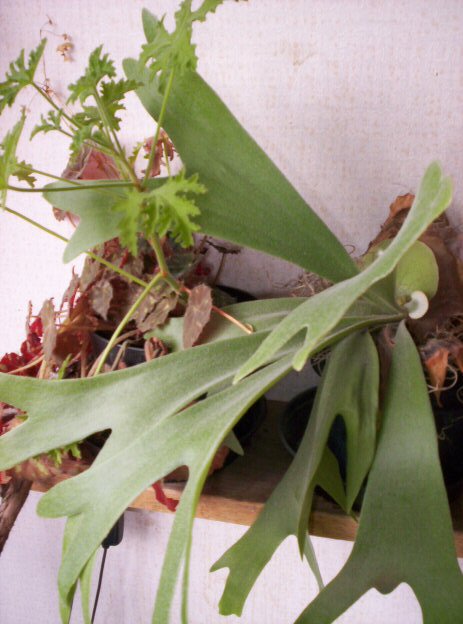
Photo: Känsterle at Dutch Wikipedia, Public domain · source

Houseplant · Polypodiaceae
Staghorn fern
Platycerium bifurcatum
In other languages: Hertshoornvaren (Nederlands) · Corne d’élan (Français)
The staghorn fern comes from the rainforests and damp woodlands of eastern Australia and New Guinea, where it grows as an epiphyte on tree trunks and branches, without soil. It has two kinds of fronds: rounded shield fronds that press flat against their support and later turn brown and papery, and long, forked fronds that hang outwards like antlers. These antler fronds look grey-green because of a fine felty coating. Mounted on a board or in a hanging basket it is a living work of art on the wall. It is the easiest and most widely sold species in its genus.
Light
Partial shade
no harsh midday sun
Moisture
Normal
no wet feet
Legal basis
Potting soil
Hardiness
Houseplant
min. 10 °C
Size
0.8 m
tall, 0.8 m wide
| Height | 0.8 m |
|---|---|
| Poisonous to people and pets | Not known to be poisonous |
Identify
Staghorn fern: how do you recognise it?
- Habit
- Epiphytic fern with a rosette of hanging, forked fronds, 50–80 cm long and as wide.
- Shield fronds
- Round to kidney-shaped, fresh green at first, later brown and papery. They clasp the support, catch water and protect the roots.
- Antler fronds
- Long, leathery and forked two or three times, grey-green from a felt of star-shaped hairs; they hang down or angle outwards.
- Spores
- Brown, velvety patches on the undersides of the antler frond tips.
- Roots
- Short; they grow beneath the shield fronds and anchor the plant to its support.
Plants: April–May
In your garden
Why grow it?
- A striking, sculptural plant that you hang on the wall like a picture.
- Grows without compost: on a board, a piece of cork or in a hanging basket.
- Over the years it becomes an impressive plant half a metre or more across.
- Produces young plants around its edge that you can detach.
- Known to be non-toxic to cats and dogs.
Staghorn fern: where does it grow best?
- Bright light to partial shade, without direct midday sun: a light wall near an east- or west-facing window.
- Moderately warm: 15–24 °C, not below 10 °C.
- Fairly humid air: a light bathroom or kitchen is ideal. Not above a radiator.
- Give it room: the antler fronds reach 80 cm and need to hang freely.
- Some air movement is good, cold draughts are not.
- Light
- Bright, out of direct sun
- Potting soil
- Airy, humus-rich compost
- Acidity
- Acid
- Watering
- Moderately
- Size
- 0.8 m tall, 0.8 m wide
- Temperature
- Minimum 10 °C
Goes well with
- Air plants: Also grow without soil and fit beside it on a board or piece of wood on the wall.
- Moth orchid: Another epiphyte, for the same light spot without harsh sun in a humid bathroom.
- Boston fern: A trailing fern with fine fronds, contrasting with the bold antler fronds.
Maintenance
Staghorn fern: when and how to plant it?
Plant in April–May.
- Mount it in April–May, when it outgrows its pot or board.
- Choose a board of untreated wood, a piece of cork or a hanging basket, a little larger than the plant.
- Put a thick layer of moist sphagnum moss on the board and press the root ball onto it, with the shield fronds against the moss.
- Tie it in place with nylon thread or fishing line over the shield fronds, without squeezing the antler fronds. In time new shield fronds grow over the line.
- Soak the board straight away for a quarter of an hour in lukewarm rainwater and let it drain well before you hang it up.
- If you prefer a pot: use a shallow pot with an airy mix of bark, sphagnum and some orchid compost, not ordinary potting compost.
Care
- Watering
- Every 1–2 weeks, plunge the plant for a quarter of an hour in lukewarm rainwater until the moss is soaked, then let it drain well. Wait until the moss is almost dry before soaking again.
- Humidity
- In dry air you can mist the fronds with rainwater now and then.
- Feeding
- From April to September, houseplant feed at a quarter strength in the soaking water once a month.
- Felt coating
- Do not wipe the grey felt off the fronds or use leaf shine: it protects the plant from drying out.
- Shield fronds
- Leave the brown shield fronds in place: that is how they should be, and they protect the roots.
Tip: Lift the board before you soak it: if it still feels heavy, the moss is still wet and soaking can wait. That prevents rot at the base.
Staghorn fern: when to prune it?
When: It is not pruned. Just cut off a dead, completely brown antler frond now and then.
How:
- Cut dead, dried-up antler fronds off at the base without damaging the shield fronds.
- Always leave the brown shield fronds: they are a natural part of the plant.
- Touch the spore patches and the felt on the fronds as little as possible.
Caution: Never cut away the shield fronds and do not rub the felt off the fronds: both protect the plant.
Propagation
- Offsets
- Young plants appear around the edge. In April–May, cut one free with its roots and a piece of shield frond once it has a few antler fronds, and mount it on its own small board with sphagnum.
- Spores
- Also possible from spores, on a moist medium under glass, but it takes years: a job for patient enthusiasts.
Staghorn fern: how does it get through the winter?
- Indoors all year: it cannot take frost and dislikes temperatures below 10 °C.
- In winter soak it less often, about every 2–3 weeks, and give no feed.
- Hang it in a light spot, away from hot radiators and warm, dry air.
Diseases and pests
- Scale insects: Brown scales on the fronds and along the veins, sometimes with sticky honeydew. Remove them carefully with a cotton bud without rubbing off the felt.
- Black base: Black, soft patches at the base and on the shield fronds, caused by watering too often. Let the moss become almost dry between soakings.
- Limp, dried fronds: Too little water or too dry air. Soak it a little more often and hang it in a more humid room.
- Brown patches under frond tips: These are spore patches, not a disease. Simply leave them.
- Brown shield fronds: Normal: old shield fronds turn brown and papery. Do not remove them.
Through the year
- January: Soak every 2–3 weeks. No feed. Away from the radiator.
- March: Soak more often as the days lengthen.
- April: Mount, or move onto a larger board. Detach offsets. Monthly feed in the soaking water.
- May: Mount or detach offsets. Soak every 1–2 weeks.
- June: Soak every 1–2 weeks. Feed. Protect from harsh sun.
- July: In warm weather soak weekly. Watch for scale insects.
- August: Soak and feed.
- September: Last feed.
- October: Soak less often.
- December: Soak every 2–3 weeks. Light spot.
You and this species
Did you know?
- Platycerium means ‘flat horn’, after the shape of the antler fronds.
- In the wild the shield fronds catch fallen leaves and rainwater, which break down into the humus the plant lives on.
- The grey felt on the fronds is made up of tiny star-shaped hairs that protect the plant from drying out.