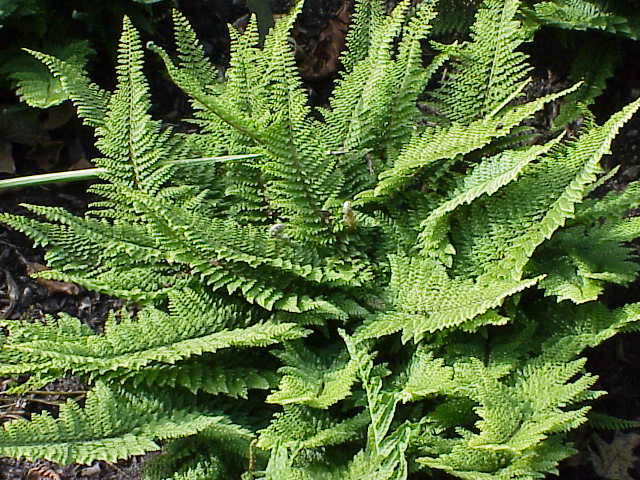
Photo: Kurt Stüber [1], CC BY-SA 3.0 · source

Fern · Dryopteridaceae
Soft shield fern
Polystichum setiferum
In other languages: Zachte naaldvaren (Nederlands) · Polystic à soies (Français)
The soft shield fern is an evergreen fern native to damp woods, banks and sunken lanes in western and southern Europe. It forms a broad, loose rosette of finely divided fronds that are soft to the touch, almost like lace. In spring, croziers covered in pale, silvery-brown scales appear in the centre and slowly unfurl. It is one of the finest ferns for a shade garden, in winter too, and it copes with lime and fairly dry shade better than many other ferns. Well-known forms are the Divisilobum Group, with even more finely cut fronds, and ‘Proliferum’, which forms small bulbils along the midrib.
Light
Partial shade or shade
tolerates little sun
Moisture
Normal
no wet feet
Legal basis
Sand, loam or clay
any pH
Hardiness
Fully hardy
down to -20 °C
Size
0.7 m
tall, 0.9 m wide
| Pruning months | March |
|---|---|
| Height | 0.7 m |
| Native to Belgium | Yes |
| Poisonous to people and pets | Not known to be poisonous |
Identify
Soft shield fern: how do you recognise it?
- Habit
- Broad, spreading rosette 60–70 cm tall and 80–90 cm wide. The fronds arch gracefully outwards.
- Fronds
- Twice divided, even more finely in some forms, soft and lace-like. Each leaflet has a short stalk and a fine, bristle-like tip.
- Stalk
- Covered in light brown scales. The young croziers are completely clothed in pale, silvery-brown scales.
- Spores
- Round clusters of spores under the leaflets in summer. Ferns do not flower.
- Bulbils
- In ‘Proliferum’ and similar forms, small buds grow along the midrib and turn into young ferns.
Plants: March–May and September–October · Pruning: March
In your garden
Why grow it?
- Evergreen: a fresh green presence in the shade garden, even in midwinter.
- Its fine, soft fronds add texture and soften hard edges and walls.
- Copes with lime and, once established, with fairly dry shade, for example under trees.
- Native and at home in a wildlife garden.
- Easy: one tidy-up in March and hardly any other work.
Soft shield fern: where does it grow best?
- Partial or full shade. Morning sun is fine, but strong midday sun scorches the fronds.
- Humus-rich, well-drained soil: sand, loam or clay, from acid to chalky.
- Normally moist. Once established it tolerates fairly dry shade, but not waterlogging.
- Allow 70–90 cm between plants: it grows wider than tall.
- Light
- Partial shade and shade
- Soil type
- Sand, loam or clay
- Acidity
- Not fussy
- Moisture
- Normal
- Size
- 0.7 m tall, 0.9 m wide
- Hardiness
- Hardy (to -20 °C)
Goes well with
- Hellebore: Flowers in winter beside the evergreen fronds.
- Epimedium: An evergreen ground cover for dry shade.
- Snowdrop: Small white flowers among the ferns in February.
- Wood anemone: A white carpet in spring.
- Hosta: Large leaves as a contrast to the fine, lacy fronds.
Maintenance
Soft shield fern: when and how to plant it?
Plant in March–May and September–October.
- Plant in March–May or September–October, when the soil is moist and not frozen.
- Dig a hole twice as wide as the pot and mix in leaf mould or compost.
- Set the crown level with the soil surface, never deeper, or it will rot.
- Space plants 70–90 cm apart so the fronds can spread freely.
- Water in well straight away and mulch with leaf mould.
Care
- Water
- Water in dry spells in the first year. After that it usually looks after itself, except in long dry periods.
- Feeding
- Not needed. A layer of leaf mould or compost in spring is enough.
- Mulching
- Leave autumn leaves around the plant or spread leaf mould in spring.
- Old fronds
- The fronds stay green all winter. Only cut them off in March.
Tip: If you need a fern for dry shade under trees, choose this one: once established it manages with little water. Do water it regularly in its first year, though, so it roots in well.
Soft shield fern: when to prune it?
Pruning months: March.
When: In March, just before the new croziers unfurl.
How:
- Cut last year’s fronds off at the base, just above the crown.
- This shows off the new, silvery-brown croziers and makes the plant look fresh again.
- Take care not to damage the young croziers in the centre.
- During the season, only cut off damaged or brown fronds.
Propagation
- Bulbils
- For forms with bulbils: in late summer or autumn, lay a frond bearing bulbils on a tray of moist cutting compost, pin it down and cover with glass or plastic. After a few months young ferns grow from it; pot them up separately.
- Division
- Older plants with several crowns can be divided in March–April. Each piece needs its own crown and roots.
- Spores
- Sowing spores on moist, sterile compost under glass is also possible, but takes a lot of patience.
Soft shield fern: how does it get through the winter?
Hardy to −20 °C.
- Hardy to about −20 °C and evergreen: no protection is needed in an ordinary Belgian winter.
- Leave the fronds all winter: they protect the crown and look lovely with frost on them.
- After hard frost the fronds may turn brown. The plant simply sprouts again in spring.
- Stand a pot against a wall, sheltered from hard frost and waterlogging.
Diseases and pests
- Crown rot: In wet, poorly drained soil the crown may rot. Plant a little higher or improve the drainage.
- Slugs: They sometimes nibble the young croziers. Pick them off in the evening.
- Brown fronds: After hard frost, drying wind or strong sun. Cut them off in March; the plant recovers.
- Vine weevil: The white larvae eat the roots, especially of plants in pots. If the plant suddenly wilts, check the roots and use nematodes if needed.
Through the year
- January: Rest. The fronds stay green.
- March: Cut away old fronds. Plant or divide.
- April: New croziers unfurl. Watch for slugs.
- May: Plant. Mulch with leaf mould.
- July: Water in long dry spells.
- August: Spores ripen.
- September: Plant. Pin down fronds with bulbils.
- October: Plant. Leave autumn leaves around the base.
- December: The evergreen fronds brighten the shade garden.
You and this species
Did you know?
- The Latin name setiferum means bristle-bearing, after the fine, soft tip on each leaflet.
- Polystichum comes from the Greek polys, many, and stichos, row, after the rows of spore clusters on the fronds.
- In the 19th century Britain went through a real fern craze. Many of the unusual forms of this fern were found and collected at that time.