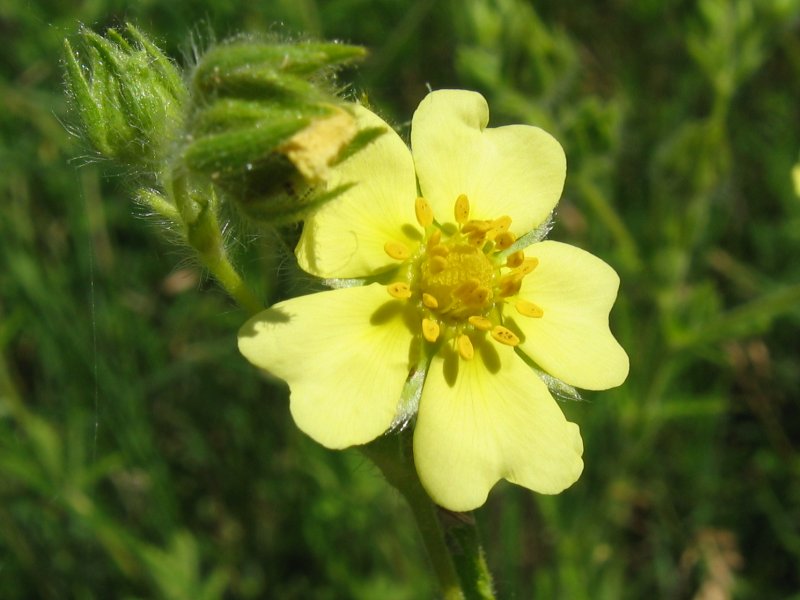
Photo: Kristian Peters -- Fabelfroh 09:06, 1 November 2006 (UTC), CC BY-SA 3.0 · source

Perennial · Rosaceae
Sulphur cinquefoil
Potentilla recta
In other languages: Rechte ganzerik (Nederlands) · Potentille dressée (Français)
Sulphur cinquefoil occurs naturally in Europe and western Asia, on dry grassland, roadside verges and sunny slopes. It forms a sturdy, upright clump of about 50 cm with hairy, palmate leaves of five to seven narrow leaflets. From June to August it carries flat, loose clusters of pale yellow flowers. A well-known cultivar is ‘Warrenii’. It needs little: sun, lean soil and dryness. Be warned, though: it seeds itself freely and can run wild, so cut off the spent flowers.
Caution: Seeds itself freely and can run wild. In North America it is an invasive weed in many places. Cut off spent flowers before the seed ripens, weed out seedlings early and do not plant it near a nature reserve.
Light
Full sun
warm and bright
Moisture
Dry
tolerates drought
Legal basis
Sand or loam
any pH
Hardiness
Fully hardy
down to -30 °C
Size
0.5 m
tall, 0.4 m wide
Flowering
June–August
| Pruning months | March and July |
|---|---|
| Height | 0.5 m |
| Native to Belgium | No, planted |
| Good for bees, butterflies and birds | Yes, for bees |
| Poisonous to people and pets | Not known to be poisonous |
| Flowering | June–August |
Identify
Sulphur cinquefoil: how do you recognise it?
- Habit
- Sturdy, upright clump about 50 cm high and 40 cm wide, with straight, hairy stems.
- Leaves
- Palmate with five to seven narrow, toothed leaflets, hairy and green to grey-green.
- Flower
- Saucer-shaped, five-petalled flowers of about 2 cm in flat, loose clusters, pale yellow, from June to August.
- Seed
- Plenty of small seeds, so it seeds itself freely.
- Roots
- Sturdy, woody rootstock that goes deep, which makes it very drought-tolerant.
Flowering: June–August · Plants: March–May and September–October · Pruning: March and July
In your garden
Why grow it?
- Flowers from June to August with pale yellow blooms in a flat cluster.
- Very drought-tolerant: a good choice for sunny, lean soil and the gravel garden.
- Bees readily visit the flowers.
- Sturdy, upright clump that needs little support on poor soil.
- Fully hardy (to about −30 °C) and little work.
Sulphur cinquefoil: where does it grow best?
- Full sun for the sturdiest growth and the richest flowering.
- Lean, well-drained soil: sand or loam, acid to chalky. On rich soil it turns floppy and seeds itself even more.
- Dry: it loves a dry spot and hardly needs any water.
- Suits a gravel garden, a dry border or a naturalistic garden; better not to put it next to a nature reserve.
- Allow 30–40 cm per plant.
- Light
- Sun
- Soil type
- Sand or loam
- Acidity
- Not fussy
- Moisture
- Dry
- Size
- 0.5 m tall, 0.4 m wide
- Hardiness
- Hardy (to -30 °C)
Goes well with
- Sage: Purple-blue spikes beside the soft yellow, in the same sun and dry soil.
- Globe thistle: Blue globes and an open, sturdy structure.
- Lavender: Purple and grey foliage in the same sun and dry soil.
- Feather grass: An airy grass that softens the stiff stems.
Maintenance
Sulphur cinquefoil: when and how to plant it?
Plant in March–May and September–October.
- Plant in March–May or in September–October, when the soil is neither frozen nor waterlogged.
- Use lean soil; no compost is needed. Mix heavy clay with coarse sand or grit for better drainage.
- Dig a hole as deep as the pot and set the plant at the same depth as in its pot.
- Space plants 30–40 cm apart.
- Water straight away, then only in dry weather until it is established.
- Spread a thin layer of fine gravel around the plant instead of compost.
Care
- Watering
- Only in the first year in dry weather. After that it almost always looks after itself.
- Feeding
- Not needed. On rich soil it turns floppy and seeds itself more.
- Mulching
- A thin layer of fine gravel is fine; compost is not needed.
- Spent flowers
- Cut the stems off before the seed ripens. This is the most important job.
- Support
- Usually not needed. On rich soil or in part shade it can flop.
Tip: Cut off spent stems before the seed ripens, otherwise it seeds itself freely. It does best in full sun on lean, dry soil.
Sulphur cinquefoil: when to prune it?
Pruning months: March and July.
When: In March to clear old stems, and in July–August after flowering.
How:
- After flowering, cut the spent stems back to the foliage before the seed ripens.
- In March, cut last year’s dead stems down to just above the ground.
- Weed out seedlings early, while they are still small.
Caution: Do not throw cut flowers with seed on a cold compost heap or into the countryside: the seed can germinate.
Propagation
- Division
- In March–April or in September, every three to four years: lift the clump, divide it into pieces with roots and leaves and replant straight away.
- Sowing
- Sow in autumn or spring in a seed tray and barely cover the fine seed. Usually not needed, because the plant seeds itself.
Sulphur cinquefoil: how does it get through the winter?
Hardy to −30 °C.
- Fully hardy, to about −30 °C: no protection is needed in Belgium.
- The risk is not the cold but wet soil in winter. Make sure it drains well.
- In a pot: use free-draining, gritty soil and put the pot in shelter; do not let it stand in water.
Diseases and pests
- Too much self-seeding: It seeds itself freely and the seedlings can take over neighbours. Cut off the flowers before the seed ripens and weed out seedlings early.
- Flopping stems: On rich soil or in part shade it turns floppy. Do not feed, give more sun, or cut it back after flowering.
- Powdery mildew: White powder on the leaves in drought and poor airflow. Give it space and cut off affected parts.
- Rot in wet soil: The crown turns brown and soft in a wet winter. Provide well-drained soil.
Through the year
- March: Cut off old stems. Weed out seedlings. Plant or divide.
- April: Plant. Weed out seedlings.
- May: Plant.
- June: Flowering begins.
- July: Flowering. Cut off spent stems before the seed ripens.
- August: Last flowers. Cut off faded stems.
- September: Plant or divide.
- October: Plant.
- December: Rest.
Use
Good for wildlife
- Bees
- Nectar and pollen for honeybees and wild bees.
You and this species
Did you know?
- The species name recta means ‘straight’ and refers to the straight, sturdy stems.
- In the wild it grows on dry, sunny grassland, verges and slopes in Europe and western Asia.
- The palmate foliage has five to seven leaflets: this is the origin of the name cinquefoil, ‘five leaves’.