Photo: Wikimedia Commons, CC BY-SA 3.0 · source

Perennial · Primulaceae
Auricula
Primula auricula
In other languages: Aurikel (Nederlands) · Oreille d’ours (Français)
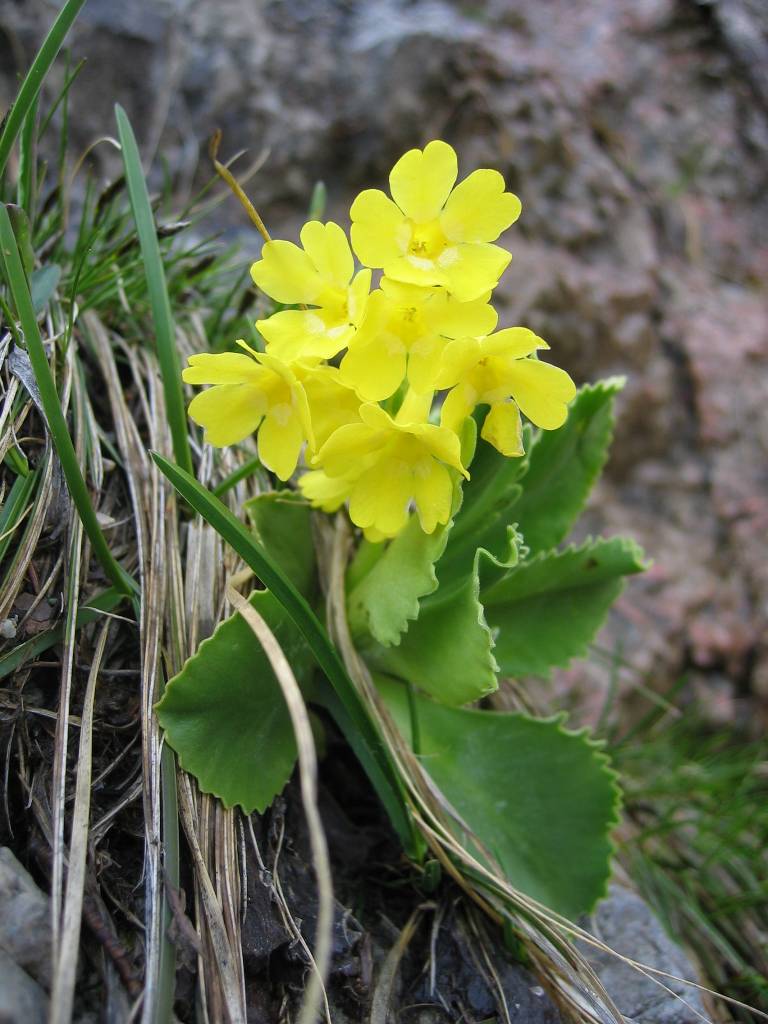
The auricula is a primula from the mountains of central Europe, such as the Alps, where it grows in crevices in limestone rock. It forms evergreen rosettes of thick, fleshy leaves, often covered in a white powdery coating. From March to May, sturdy stems carry heads of fragrant flowers with a striking pale eye. The wild species is yellow, but garden auriculas come in almost every colour, from claret and purple to brown and even green or grey. Since the seventeenth century they have been treasured collectors’ plants, in groups such as border, alpine, show and double auriculas.
Light
Sun or partial shade
preferably some sun
Moisture
Normal
no wet feet
Legal basis
Sand or loam
neutral to chalky
Hardiness
Fully hardy
down to -30 °C
Size
0.2 m
tall, 0.25 m wide
Flowering
March–May
| Height | 0.2 m |
|---|---|
| Native to Belgium | No, planted |
| Poisonous to people and pets | Not known to be poisonous |
| Flowering | March–May |
Identify
Auricula: how do you recognise it?
- Habit
- Low, evergreen rosette about 20 cm tall and 25 cm wide, on a short, thick rootstock.
- Leaves
- Thick, fleshy, oval to spoon-shaped and grey-green, often with a white powdery coating.
- Flower
- A head of several flowers on a sturdy stem, each with a pale or white eye in the centre.
- Colour
- Yellow in the wild; garden cultivars in red, purple, pink, brown, yellow and white. Show auriculas sometimes have a green, grey or white edge.
- Scent
- Sweet, stronger in some cultivars than in others.
- Roots
- Fleshy and prone to rot in wet soil.
Flowering: March–May · Plants: March–April and September
In your garden
Why grow it?
- Fragrant spring flowers from March to May, in an unusually rich range of colours.
- Evergreen rosettes of fleshy, often powdered leaves: attractive all year round.
- Compact: ideal for a rock garden, a trough, a low wall or a pot on the patio.
- A classic collectors’ plant with hundreds of cultivars, from simple border auriculas to refined show auriculas.
- Fully hardy: its greatest enemy is not frost but too much wet.
Auricula: where does it grow best?
- Sun or half shade; in summer preferably sheltered from fierce midday sun.
- Very free-draining sandy or loamy soil with added grit, neutral to chalky.
- Normally moist in the growing season, but never waterlogged: standing water rots the roots.
- Ideal in a rock garden, between stones, on a low wall or in a pot with grit.
- Plant 20–25 cm apart.
- Light
- Sun and partial shade
- Soil type
- Sand or loam
- Acidity
- Neutral or chalky
- Moisture
- Normal
- Size
- 0.2 m tall, 0.25 m wide
- Hardiness
- Hardy (to -30 °C)
Goes well with
- Houseleek: Another rock plant for a free-draining trough or a low wall.
- Mossy saxifrage: Cushions of small spring flowers between the rosettes.
- Grape hyacinth: Blue flower spikes at the same time, in a pot or rock garden.
- Dwarf iris: An early bulb that suits a trough topped with grit.
- Alpine pink: Grey leaves and scented flowers, also for chalky, free-draining soil.
Maintenance
Auricula: when and how to plant it?
Plant in March–April and September.
- Plant in March–April or in September.
- Mix the garden soil with coarse sand or fine grit; in a pot, use potting compost with a third grit or perlite, in a pot with a drainage hole.
- Set the plant at the same depth as it was in the pot: the rosette must not be buried.
- Leave 20–25 cm between plants.
- Water in, then let the soil dry out a little.
- Spread a thin layer of fine grit around the rosette: it keeps the neck dry and the leaves clean.
Care
- Water
- Moderate: keep it moist in the growing season, but let the top layer dry out between waterings. Do not water into the heart of the rosette.
- Feeding
- In spring a little compost or a half dose of organic fertiliser. Too much feeding makes it soft and prone to rot.
- Spent flowers
- Cut the flower stems off at the base unless you want to collect seed.
- Leaves
- Remove yellow and withered leaves regularly to prevent grey mould.
- Repotting
- In a pot, repot every year after flowering or in late August into fresh, free-draining compost. Trim off old, dead roots as you do so.
- Summer
- Stand pots in a cool spot in light shade in summer.
Tip: Stand pots of auriculas on a shelf against a wall, like an old-fashioned auricula theatre: you see and smell the flowers up close, and they stay dry.
Auricula: when to prune it?
When: It is not pruned. After flowering, in May, simply cut off the faded flower stems.
How:
- Cut the faded flower stems off at the base, unless you want to collect seed.
- Gently pull yellow or dead leaves away from the rosette.
- Touch the powdered leaves as little as possible: the coating rubs off easily.
Propagation
- Offsets
- After flowering or in August–September, detach the young side rosettes with a little root and pot them up in free-draining compost. Keep them in shade for a few weeks.
- Division
- Old clumps with several rosettes can be carefully pulled apart after flowering.
- Seed
- Seed gives plants that differ from the parent. It germinates best after a cold period.
Auricula: how does it get through the winter?
Hardy to −30 °C.
- Fully hardy, to about −30 °C: in the mountains it spends the winter under snow.
- The real danger is winter wet: in the ground, free-draining soil and a layer of grit around the neck help.
- In a pot: keep it sheltered from rain in winter, under an overhang or in a cold frame, but outside in the cold.
- Give pots very little water in winter.
Diseases and pests
- Vine weevil: The grubs eat the roots: the plant wobbles in the soil and wilts. Check the roots when repotting and use nematodes against the grubs.
- Root aphids: White, woolly tufts on the roots and a plant that grows poorly. Rinse the roots when repotting and pot up in fresh compost.
- Rot: A brown, soft heart or rotting neck caused by too much water. Ensure good drainage, water less and keep the heart dry.
- Grey mould: Grey fuzz on leaves and flowers in damp, still weather. Remove affected leaves and improve air flow.
Through the year
- January: Rest. Remove yellow leaves, keep pots dry.
- March: Flowering starts. Plant. Give a little compost.
- April: Full flower and scent. Shelter pots from rain to protect the flowers.
- May: Last flowers. Cut off faded stems. Repot after flowering.
- June: Move pots to a cool spot in light shade. Water moderately.
- August: Detach and pot up side rosettes. Refresh the compost in pots.
- September: Plant. Pot up young plants.
- November: Shelter pots from rain. Water very sparingly.
You and this species
Did you know?
- Auricula means ‘little ear’ and refers to the shape of the leaves, hence the old English name bear’s ears.
- In the eighteenth and nineteenth centuries, enthusiasts displayed their auriculas in an auricula theatre: an open wooden stand with shelves where the pots were arranged as if on a stage.
- The white powder on the leaves and flowers is called farina. Rain washes it off, which is why enthusiasts grow show auriculas under cover.