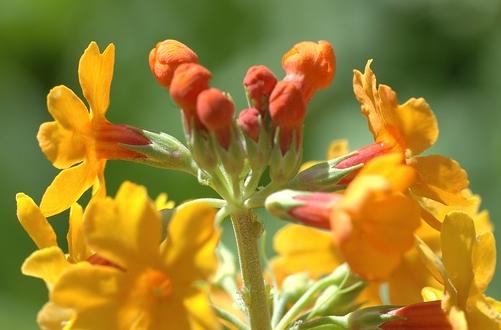
Photo: Jason L. Buberel, CC BY-SA 1.0 · source

Perennial · Primulaceae
Bulley's primrose
Primula bulleyana
In other languages: Etageprimula (Nederlands) · Primevère de Bulley (Français)
Bulley’s primrose comes from the mountains of Yunnan in south-west China and is named after the English plant enthusiast Arthur Bulley. From a rosette of long, fresh green leaves rise sturdy stems of 50–60 cm in June and July, carrying several tiers of orange flowers one above the other, like the arms of a candelabra. The buds are red and contrast nicely with the open flowers. It is a plant for wet soil beside a pond or stream, in half shade. Planted in small groups, it brings a warm colour to midsummer. It crosses easily with related candelabra primulas, so seedlings sometimes turn up in in-between shades.
Light
Partial shade or shade
tolerates little sun
Moisture
Moist to wet
must not dry out
Legal basis
Loam, clay or peat
acid to neutral
Hardiness
Fully hardy
down to -25 °C
Size
0.6 m
tall, 0.3 m wide
Flowering
June–July
| Height | 0.6 m |
|---|---|
| Native to Belgium | No, planted |
| Good for bees, butterflies and birds | Yes, for bees |
| Poisonous to people and pets | Not known to be poisonous |
| Flowering | June–July |
Identify
Bulley's primrose: how do you recognise it?
- Habit
- Clump-forming perennial 50–60 cm tall and about 30 cm wide, with a leaf rosette at the base and upright flower stems.
- Foliage
- Long, oval to lance-shaped leaves of 15–30 cm with a wavy edge, fresh green; they largely die back in winter.
- Flowers
- Each stem carries several tiers of small, five-petalled flowers of about 2 cm, in June and July.
- Colour
- Orange flowers opening from red buds. Related candelabra primulas and hybrids flower yellow, red or pink.
- Roots
- Fibrous and shallow: the plant needs constantly moist soil and soon suffers from drought.
Flowering: June–July · Plants: March–April and September–October
In your garden
Why grow it?
- Brings orange colour to the damp, shady corner of the garden where few other perennials flower well.
- Flowers in June and July, just when most spring primulas have finished.
- Bees and bumblebees visit the flowers.
- Hardy to about −25 °C and returns year after year.
- Self-seeds in moist soil, so a small group becomes a lovely colony within a few years.
- Beautiful at the edge of a pond, in a bog garden or along a stream.
Bulley's primrose: where does it grow best?
- Half shade or light shade; in full sun only if the soil stays wet all the time.
- Wet, humus-rich soil: loam, clay or peat, acid to neutral. Ideal for a bog garden or the edge of a pond.
- The soil must never dry out in summer: in dry ground it soon disappears.
- Sheltered from strong wind, which can snap the tall flower stems.
- Plant in groups of 5–7, 30–40 cm apart.
- Light
- Partial shade and shade
- Soil type
- Loam, clay or peat
- Acidity
- Acid or neutral
- Moisture
- Wet
- Size
- 0.6 m tall, 0.3 m wide
- Hardiness
- Hardy (to -25 °C)
Goes well with
- Marsh marigold: Yellow flowers in spring, in the same wet soil.
- Hosta: Large, calm foliage in the same half shade, a quiet backdrop for the orange flowers.
- Siberian iris: Flowers in June in blue and purple, a lovely contrast with orange.
- Astilbe: Pink and red plumes in the same damp, half-shaded spot.
- Ostrich fern: Fresh green, elegant fronds next to the primulas.
Maintenance
Bulley's primrose: when and how to plant it?
Plant in March–April and September–October.
- Plant in March–April or in September–October, when the soil is moist but not frozen.
- Dig a generous hole and mix in plenty of compost or leaf mould so that the soil holds moisture.
- Set the plant at the same depth as in its pot, with the centre of the rosette at soil level: do not bury it too deeply.
- Leave 30–40 cm between plants and put them in groups of 5–7.
- Water in generously straight away and keep the soil constantly moist in the first year.
- Spread a layer of leaf mould as mulch around the plants, without covering the crown.
Care
- Water
- Keep the soil moist at all times, especially while in flower. In an ordinary border water generously and regularly in dry weather; beside a pond or in a bog garden this is rarely necessary.
- Feeding
- A layer of compost or organic fertiliser in spring. No more is needed.
- Mulching
- A layer of leaf mould in spring and autumn keeps the soil cool and moist.
- Spent flowers
- Cut the stems down after flowering. Leave a few if you want seedlings.
- Tidying
- Remove dead leaves in February–March so the new rosettes get light.
- Slugs
- Watch for slugs in spring: they love the young leaves.
Tip: Give it the wettest spot you have, preferably beside a pond or stream. If you want it to spread, leave a few seed stems standing: in moist soil, seedlings appear by themselves.
Bulley's primrose: when to prune it?
When: It is hardly pruned. Cut off spent flower stems after flowering and remove dead leaves in February–March.
How:
- Cut spent flower stems down to the base, unless you want seed.
- Leave a few stems until the seed capsules are brown and dry if you want it to self-seed.
- Pull or cut off dead, brown leaves in February–March, taking care not to damage the centre of the rosette.
Propagation
- Seed
- Sow fresh seed in summer or in January–February in a tray of seed compost, without covering it: it germinates in light. Put the tray outside in the cold and keep it moist; seedlings appear in spring. Because of crossing with related primulas, they do not always resemble the parent plant.
- Division
- Divide older clumps after flowering, in August–September, or in early spring. Lift the plant, split it into pieces with roots and a bit of rosette, and replant them straight away in moist soil.
Bulley's primrose: how does it get through the winter?
Hardy to −25 °C.
- Fully hardy, to about −25 °C: no protection is needed in Belgian winters.
- The foliage largely dies back. Leave it in place until spring as protection for the rosettes.
- Wet soil in winter is not a problem; a dry summer is far more dangerous.
Diseases and pests
- Slugs: Holes in the young leaves in spring. Collect them in the evening and clear hiding places such as piles of dead leaves around the plant.
- Drought stress: Limp leaves with brown, dry edges. Water generously, lay a thick mulch and, if necessary, move it to a lower, damper spot.
- Vine weevil: The grubs eat the roots, especially in pots, and the plant suddenly wilts. Use nematodes against the grubs in autumn or spring.
- Aphids: On young flower stems in spring. Rinse them off with water or let ladybirds do the work.
Through the year
- February: Remove last year’s dead leaves.
- March: Plant or divide. Give compost. Watch for slugs.
- April: Plant. Apply mulch. Keep the soil moist.
- May: Keep the soil moist. Watch for slugs and aphids.
- June: Flowering begins. Water generously in dry weather.
- July: Full flower. Cut off spent stems or leave them for seed.
- August: Divide after flowering. Collect seed and sow.
- September: Plant or divide. Sow.
- October: Plant. Mulch with leaf mould.
Use
Good for wildlife
- Bees
- Nectar and pollen for honeybees and wild bees.
You and this species
Did you know?
- Arthur Bulley, after whom the species is named, funded the plant hunter George Forrest’s journeys to China, where Forrest collected many new plants, including primulas.
- The flowers stand in tiers one above the other, which is why these primulas are called candelabra primulas.
- It crosses readily with related species such as Primula beesiana and Primula pulverulenta, so garden seedlings can come in all kinds of shades.