Photo: Wikimedia Commons, CC BY-SA 3.0 · source

Fern · Onocleaceae
Ostrich fern
Matteuccia struthiopteris
In other languages: Struisvaren (Nederlands) · Fougère-à-l’autruche (Français)
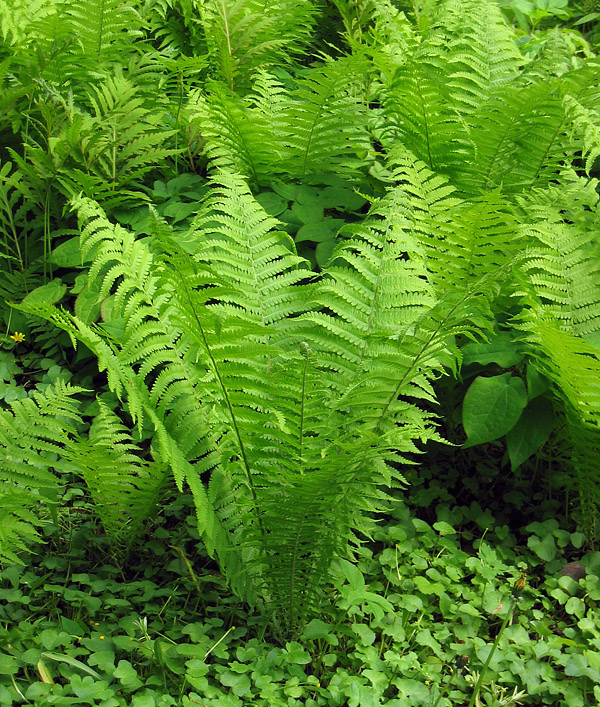
Ostrich fern grows wild in damp woods and along streams in central and northern Europe, Asia and North America. It forms elegant, regular shuttlecocks of pale green, feather-like fronds up to 1.2 m tall, which are reminiscent of ostrich plumes. In late summer short, stiff, dark brown fronds appear in the centre; they carry the spores and stand all winter. With underground runners it forms new shuttlecocks, so after a few years a fine group develops. Gardeners love its fresh, architectural effect in a damp shady corner or at the edge of a pond.
Light
Partial shade or shade
tolerates little sun
Moisture
Normal to wet
must not dry out
Legal basis
Any garden soil
acid to neutral
Hardiness
Fully hardy
down to -35 °C
Size
1.2 m
tall, 1 m wide
| Pruning months | March |
|---|---|
| Height | 1.2 m |
| Native to Belgium | No, planted |
| Poisonous to people and pets | Not known to be poisonous |
Identify
Ostrich fern: how do you recognise it?
- Habit
- Regular shuttlecock of fronds, up to 1.2 m tall and about 1 m wide. Forms new shuttlecocks with runners.
- Fronds
- Pale green, feather-like and finely cut, tapering towards the base. They die back in autumn.
- Fertile fronds
- Short, stiff, dark brown fronds of 30–60 cm in the centre of the shuttlecock, from late summer; they stand all winter.
- Young croziers
- In April dense green croziers appear and unfurl quickly.
- Runners
- Long underground runners, on which new plants appear some distance away.
Plants: March–May and September–October · Pruning: March
In your garden
Why grow it?
- One of the most elegant ferns: perfect, pale green shuttlecocks.
- The unfurling of the croziers in April is a spectacular spring moment.
- The brown fertile fronds stand all winter and look good in dried arrangements.
- Forms a group by itself with runners: ideal for filling a damp, shady corner.
- Very hardy and rarely ill.
Ostrich fern: where does it grow best?
- Partial or full shade; in sun the fronds scorch quickly.
- Sand, loam, clay or peat, acid to neutral and rich in humus.
- Moist to wet soil: it must never dry out. Ideal at a pond edge or along a stream.
- Sheltered from strong wind, which snaps the large fronds.
- Allow 80 cm–1 m between plants and give it room to spread.
- Light
- Partial shade and shade
- Soil type
- Sand, loam, clay or peat
- Acidity
- Acid or neutral
- Moisture
- Normal or wet
- Size
- 1.2 m tall, 1 m wide
- Hardiness
- Hardy (to -35 °C)
Goes well with
- Marsh marigold: Yellow flowers in spring at the pond edge, before the fern starts growing.
- Astilbe: Pink, red and white plumes on the same moist soil.
- Hosta: Large leaves next to the airy shuttlecocks.
- Siberian bugloss: Sky-blue flowers in April between the young croziers.
- Wood anemone: White spring flowers beneath the fern, before it unfurls its fronds.
Maintenance
Ostrich fern: when and how to plant it?
Plant in March–May and September–October.
- Plant from March to May or in September–October, when the soil is not frozen.
- Dig a hole twice as wide as the pot and mix in plenty of leaf mould.
- Set the plant at the same depth as in the pot: the crown must stay just above the soil.
- Keep 80 cm–1 m from other plants and expect it to spread.
- Water generously straight away and keep the soil moist throughout the first year.
- Mulch with leaf mould to keep the soil cool and moist.
Care
- Watering
- Keep the soil moist at all times; water regularly in dry summers, or the fronds turn brown.
- Feeding
- A layer of leaf mould or well-rotted compost in spring is enough.
- Mulching
- A layer of leaf mould every spring keeps the soil cool and moist.
- Runners
- Cut off unwanted runners with a spade and replant them elsewhere or give them away.
- Old fronds
- The green fronds die back in autumn; clear them away in March.
Tip: Give it a spot where the soil never dries out, such as a pond edge: the fronds then stay fresh until autumn. Leave the brown fertile fronds standing in winter; they are very decorative.
Ostrich fern: when to prune it?
Pruning months: March.
When: In March, before the new croziers unfurl. You can leave the brown fertile fronds all winter as decoration.
How:
- Cut the dead green fronds and the old fertile fronds off at the base.
- Watch out for the croziers already waiting in the crown: do not cut into them.
- In autumn, feel free to cut a few fertile fronds for a dried arrangement.
- Cut off runners that stray too far straight away.
Propagation
- Runners
- In March–April or in September: detach a young plant with roots from the runner and replant it elsewhere at once. The easiest method.
- Spores
- In late winter collect spores from the brown fertile fronds and sow them straight away on moist, sterile compost under glass or plastic. Keep everything moist; it takes months before tiny ferns appear.
Ostrich fern: how does it get through the winter?
Hardy to −35 °C.
- Very hardy, to about −35 °C: no protection is needed in Belgium.
- The green fronds die back in autumn; the brown fertile fronds stay standing and are a lovely winter feature.
- In a pot: stand the pot in a sheltered spot and keep the compost slightly moist.
Diseases and pests
- Brown fronds in summer: A sign of drought or too much sun. Water generously, mulch and move it to a shadier spot if needed.
- Runners in the wrong place: New plants sometimes appear some way from the parent. Cut them off or, in a small garden, install a root barrier.
- Late frost damage: Frozen croziers turn brown. The plant regrows; cut off the damaged fronds.
- Poor growth: On dry or poor soil it stays small. Mix compost into the soil and keep it moist.
Through the year
- January: Rest. Leave the fertile fronds.
- February: Rest. The fertile fronds decorate the garden.
- March: Cut off old fronds and fertile fronds. Plant or move runners.
- April: The croziers unfurl. Mulch with leaf mould.
- May: Plant. Water in dry spells.
- June: Keep the soil moist.
- July: Water in dry spells. Cut off runners.
- August: The fertile fronds appear in the centre.
- September: Plant or move runners.
- October: The green fronds die back. Cut fertile fronds for a dried arrangement.
- November: Leave the fertile fronds standing.
You and this species
Did you know?
- Struthiopteris comes from the Greek strouthion, ostrich, and pteris, fern: the fronds look like ostrich feathers.
- The genus name honours the Italian physicist Carlo Matteucci, who lived in the 19th century.
- Ostrich fern has two kinds of fronds: large green fronds that make food for the plant, and separate brown fronds that only carry spores.