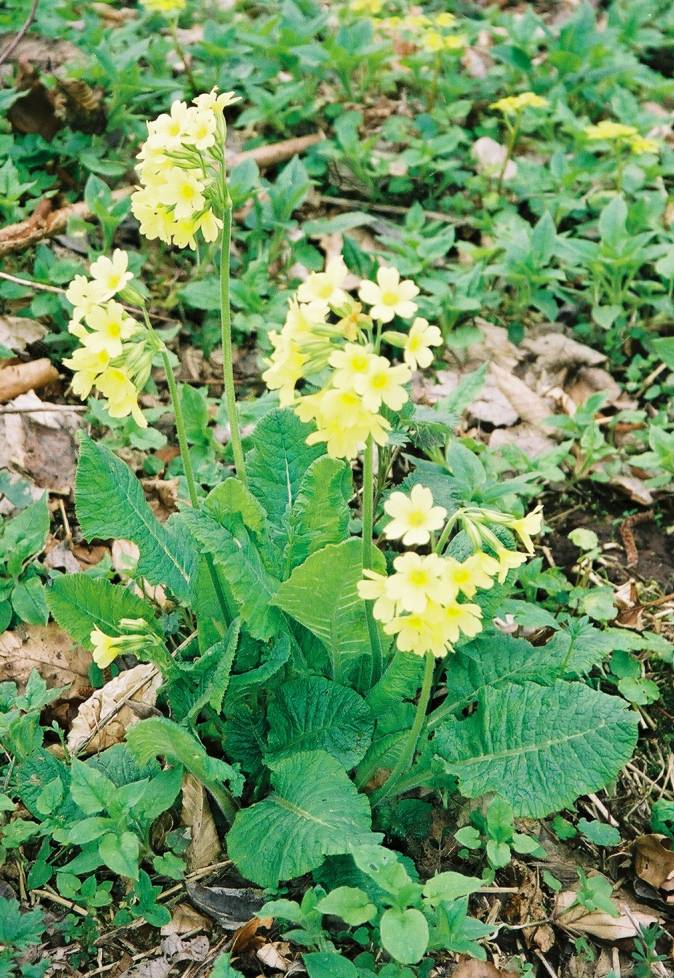
Photo: Wikimedia Commons, CC BY-SA 3.0 · source

Perennial · Primulaceae
Oxlip
Primula elatior
In other languages: Slanke sleutelbloem (Nederlands) · Primevère élevée (Français)
The oxlip is a native plant of damp deciduous woods and hay meadows across Europe, including Belgium, although it is not common in the wild. From a rosette of wrinkled leaves rise stems of 20–30 cm from March to May, carrying an umbel of pale yellow, flat flowers that lean to one side. It resembles the primrose and the cowslip, but can be told apart by its pale colour and narrow calyx. It is a sturdy, easy spring flower for half shade, especially under deciduous shrubs and trees. Bees and bumblebees find nectar on it early in the year.
Light
Partial shade or shade
tolerates little sun
Moisture
Normal to wet
must not dry out
Legal basis
Loam or clay
any pH
Hardiness
Fully hardy
down to -30 °C
Size
0.25 m
tall, 0.25 m wide
Flowering
March–May
| Height | 0.25 m |
|---|---|
| Native to Belgium | Yes |
| Good for bees, butterflies and birds | Yes, for bees |
| Poisonous to people and pets | Not known to be poisonous |
| Flowering | March–May |
Identify
Oxlip: how do you recognise it?
- Habit
- Clump-forming perennial about 25 cm tall and wide, with a leaf rosette at the base and slender flower stems that can reach 30 cm.
- Foliage
- Oval to long oval leaves of 5–20 cm, wrinkled and hairy, with the blade tapering abruptly into a winged stalk; fresh green.
- Flowers
- Umbel of 5–20 pale yellow flowers of about 2 cm, leaning to one side, from March to May.
- Calyx and colour
- Narrow, tubular calyx and a flat, pale sulphur-yellow corolla with an orange throat.
- Fruit
- A capsule holding small seeds, ripe in June; the seed germinates best when fresh.
- Roots
- Fibrous and shallow, with a short rootstock; it likes soil that does not dry out.
Flowering: March–May · Sowing: September–October · Plants: March–April and September–October
In your garden
Why grow it?
- Native plant that fits well in a naturalistic garden, a woodland edge or a half-shaded border.
- Flowers from March to May, when bees and bumblebees still find little food.
- Fully hardy to about −30 °C and faithful for many years.
- Self-seeds quietly in suitable soil and so forms a natural carpet by itself.
- Pale yellow flowers go beautifully with spring bulbs, lungworts and hellebores.
- Little work: no pruning, hardly any diseases.
Oxlip: where does it grow best?
- Half shade or light shade, for example under deciduous shrubs and trees: in spring there is still plenty of light there.
- Loam or clay, humus-rich and moisture-retentive; acid, neutral or chalky are all fine.
- The soil should stay moist in spring and must not dry out completely in summer.
- Does well in natural grassland or a wildflower meadow, provided the grass is not too tall and dense.
- Allow 20–25 cm between plants, in groups of 5–10 for a natural effect.
- Light
- Partial shade and shade
- Soil type
- Loam or clay
- Acidity
- Not fussy
- Moisture
- Normal or wet
- Size
- 0.25 m tall, 0.25 m wide
- Hardiness
- Hardy (to -30 °C)
Goes well with
- Wood anemone: Flowers at the same time in white, a natural spring picture under trees.
- Hellebore: Brings large flowers and sturdy foliage to the same half shade.
- Lungwort: Blue and pink flowers that open together with the oxlip.
- Snowdrop: Flowers just before the oxlip and makes an early spring garden.
- Male fern: Fresh green foliage that fills the space later in the year.
Maintenance
Oxlip: when and how to plant it?
Plant in March–April and September–October.
- Plant in March–April or in September–October, when the soil is moist but not frozen.
- Dig a hole as deep as the pot and twice as wide, and mix in some compost or leaf mould.
- Set the plant at the same depth as in its pot, with the centre of the rosette at soil level.
- Plant in groups of 5–10, 20–25 cm apart.
- Water in straight away and keep the soil moist through the first spring and summer.
- Spread a thin layer of leaf mould around the plants; fallen tree leaves make the best mulch.
Care
- Water
- Keep the soil moist in spring. Water now and then in dry summers, especially in the first year.
- Feeding
- Usually not needed. A thin layer of leaf mould or well-rotted compost in autumn is enough.
- Mulching
- Leave fallen tree leaves in place or spread leaf mould: it keeps the soil moist and feeds the soil.
- Spent flowers
- You can leave them: the plants will then self-seed. If you do not want that, cut them off after flowering.
- Tidying
- Remove dead leaves in February–March so the flowers can grow freely.
Tip: Plant it in small groups under deciduous shrubs or trees, where the soil stays moist in spring. Buy nursery-grown plants and never take specimens from the wild.
Oxlip: when to prune it?
When: It is not pruned. At most, cut off spent flower stems and remove dead leaves in February–March.
How:
- Cut spent flower stems down to the base if you do not want seedlings.
- Leave the stems until the seed capsules are ripe if you want it to spread.
- Remove dried or damaged leaves in February–March with scissors, without touching the centre of the rosette.
Propagation
- Seed
- Sow fresh seed outdoors in September–October in a tray of seed compost and do not cover it: it germinates in light. Put the tray outside in the cold and keep it moist; seedlings appear in spring and flower after 2–3 years.
- Division
- Divide older clumps after flowering, in May–June, or in September. Lift the plant, split it into pieces with roots and a bit of rosette, and replant them straight away in moist soil.
Oxlip: how does it get through the winter?
Hardy to −30 °C.
- Fully hardy, to about −30 °C: no protection is needed in Belgian winters.
- The foliage stays largely green in mild winters; leave it until spring.
- In a pot: choose a frost-proof pot, put it in a sheltered spot and do not let the soil dry out.
Diseases and pests
- Slugs: Holes in the young leaves and flower buds in spring. Collect them in the evening and clear hiding places.
- Vine weevil: The grubs eat the roots, especially in pots, and the plant suddenly wilts. Use nematodes against the grubs.
- Drought scorch: Limp, scorched leaves in a dry summer. Water, mulch and plant it where the soil stays moist.
- Leaf spot and rust: Brown or orange spots on the leaves. Cut off affected leaves and leave space and air between the plants.
Through the year
- February: Clear dead leaves.
- March: Flowering begins. Plant or divide. Watch for slugs.
- April: Full flower. Plant.
- May: Flowering ends. Divide if needed.
- June: Collect seed. Water in dry weather.
- July: Water in dry weather.
- September: Plant, divide and sow.
- October: Plant and sow. Leave fallen leaves as mulch.
Use
Good for wildlife
- Bees
- Nectar and pollen for honeybees and wild bees.
You and this species
Did you know?
- The Latin species name elatior means ‘taller’: the plant is taller than the primrose.
- In England the true oxlip grows almost only in ancient woods in the east of the country, in East Anglia, where it is rare.
- Its pale yellow, flat flowers with a narrow calyx tell it apart from the cowslip, which has deep yellow, cup-shaped flowers and an inflated calyx.