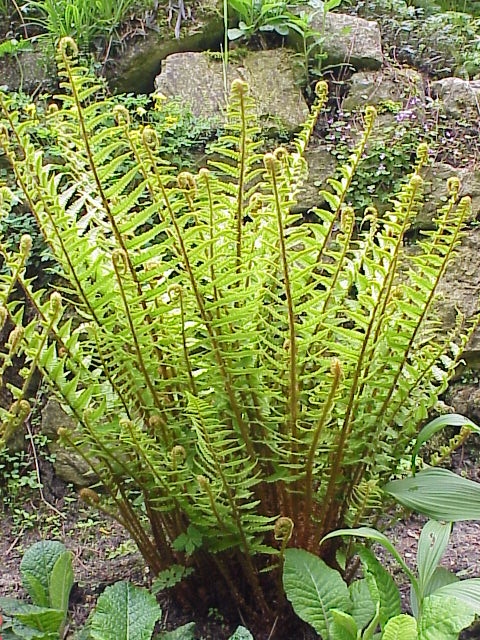
Photo: Wikimedia Commons, CC BY-SA 3.0 · source

Fern · Dryopteridaceae
Male fern
Dryopteris filix-mas
In other languages: Mannetjesvaren (Nederlands) · Fougère mâle (Français)
Male fern is one of the most common native ferns of our woods, hedgerows and shady banks. It forms a sturdy shuttlecock of large, fresh green, divided fronds up to 1 m long. In spring the young fronds unfurl from croziers covered in light brown scales, one of the loveliest moments in the shade garden. Gardeners value it for its toughness: it grows in shade and partial shade, even on fairly dry soil under trees. There are decorative forms, such as ‘Linearis Polydactyla’, with narrow, forked leaflets, and ‘Crispa Cristata’, with crisped, crested fronds.
Caution: All parts are poisonous, especially the rhizome. Do not let children or pets nibble it and never eat the young croziers of this fern. It is also poisonous to grazing animals such as horses, cattle and sheep.
Light
Partial shade or shade
tolerates little sun
Moisture
Dry to normal
no wet feet
Legal basis
Sand, loam or clay
any pH
Hardiness
Fully hardy
down to -30 °C
Size
1 m
tall, 1 m wide
| Pruning months | March |
|---|---|
| Height | 1 m |
| Native to Belgium | Yes |
| Poisonous to people and pets | Yes, take care with children and pets |
Identify
Male fern: how do you recognise it?
- Habit
- Sturdy shuttlecock of fronds, up to 1 m tall and as wide, from one or a few crowns.
- Fronds
- Large, lance-shaped and fresh green, divided into deeply cut leaflets. They die back in autumn.
- Young croziers
- In April–May the new fronds unfurl from croziers covered in light brown scales.
- Spores
- Under the fronds sit two rows of round spore clusters, each covered by a small kidney-shaped flap; ripe in summer.
- Rhizome
- Short, thick and upright, covered in brown scales. Poisonous.
Plants: March–May and September–October · Pruning: March
In your garden
Why grow it?
- One of the toughest ferns: it grows even in dry shade under trees, where little else succeeds.
- Native and valuable in a wildlife garden; the fronds give cover to small creatures.
- The unfurling of the young croziers in April and May is a spring highlight.
- Large, fresh green fronds that fill a shady corner all season.
- Little work: one tidy-up a year is enough.
Male fern: where does it grow best?
- Partial or full shade; in full sun the fronds scorch.
- Sand, loam or clay, acid to chalky: it is not fussy. Humus-rich soil gives the finest plants.
- Dry to normal soil; it copes with drought better than most ferns, but looks best if the soil does not dry out.
- Sheltered from strong wind, which snaps and dries the fronds.
- Allow 80 cm–1 m between plants.
- Light
- Partial shade and shade
- Soil type
- Sand, loam or clay
- Acidity
- Not fussy
- Moisture
- Dry or normal
- Size
- 1 m tall, 1 m wide
- Hardiness
- Hardy (to -30 °C)
Goes well with
- Wood anemone: Flowers in March–April, before the fern unfurls its fronds.
- Foxglove: Tall flower spikes above the fresh green fronds, in the same partial shade.
- Barrenwort: A low, tough ground cover for dry shade.
- Hosta: Large, undivided leaves as a contrast with the divided fronds.
- Snowdrop: Early flowers on bare soil, long before the fern starts growing.
Maintenance
Male fern: when and how to plant it?
Plant in March–May and September–October.
- Plant from March to May or in September–October, when the soil is not frozen or waterlogged.
- Dig a hole twice as wide as the pot and mix in leaf mould.
- Set the plant at the same depth as in the pot: the crown with the croziers must stay just above the soil.
- Keep 80 cm–1 m from other plants.
- Water generously straight away, even under trees, and in dry spells during the first year.
- Mulch with leaf mould or leave fallen autumn leaves around the plant.
Care
- Watering
- Regularly in the first year, especially under trees. After that only in long dry spells.
- Feeding
- Not needed. Leave fallen autumn leaves in place or add some leaf mould in spring.
- Mulching
- A layer of leaf mould or wood chips keeps the soil cool and moist.
- Old fronds
- Leave the dead fronds standing in winter and cut them off in March.
- Dividing
- Old plants with several crowns can be divided in spring.
Tip: Only cut off the old fronds in March, just before the new croziers unfurl; in winter they protect the crown. Under trees, water regularly in the first year; after that it copes even in dry shade.
Male fern: when to prune it?
Pruning months: March.
When: In March, just before the new croziers unfurl. In winter the old fronds protect the crown.
How:
- Cut the old, withered fronds off at the base, as close to the crown as possible.
- Watch out for the young croziers already waiting in the crown: do not cut into them.
- Fronds that are still green can stay until the new ones have unfurled.
- Use the old fronds as mulch under shrubs or put them on the compost heap.
Caution: Do not cut too late: once the croziers start unfurling, they are easily damaged.
Propagation
- Division
- In March–April: dig up an old plant with several crowns and cut it with a sharp spade or knife into pieces, each with a crown and roots. Replant at once and water.
- Spores
- In July–August: lay a frond with ripe spore clusters on paper and collect the spores. Sprinkle them on moist, sterile compost under glass or plastic. After a few months small green flat growths appear, and later the first tiny ferns. A job for the patient.
Male fern: how does it get through the winter?
Hardy to −30 °C.
- Fully hardy, to about −30 °C: no protection is needed in Belgium.
- The fronds die back in autumn; in sheltered spots they sometimes stay green into winter.
- Leave the old fronds until March: they protect the crown and give shelter to small creatures.
- In a pot: stand the pot in a sheltered spot and keep the compost slightly moist.
Diseases and pests
- Scorched fronds: Brown, dry fronds in summer from too much sun or drought. Water and move the fern to more shade if needed.
- Late frost damage: Frozen young croziers turn brown and limp. The plant makes new fronds; cut off the damaged ones.
- Snapped fronds: Caused by strong wind, children at play or pets. Cut them off; a sheltered spot prevents it.
- Brown dots under the fronds: These are the spore clusters, not a disease or pest. Nothing needs doing.
Through the year
- January: Rest. Leave the old fronds.
- February: Rest. The old fronds protect the crown.
- March: Cut off old fronds before the croziers unfurl. Plant or divide.
- April: The young croziers unfurl. Plant or divide. Mulch.
- May: Plant. Water in dry spells.
- June: The fronds are fully grown. Water young plants.
- July: The spores ripen. Collect spores.
- August: Water in long dry spells.
- September: Plant.
- October: Plant. Leave fallen leaves around the plant.
- November: The fronds die back. Leave them standing.
Use
Edible and useful
Not edible. All parts of male fern are poisonous, especially the rhizome; it was once used against tapeworm, sometimes causing serious poisoning. In some countries people eat the cooked young fiddleheads of other ferns, such as ostrich fern, but never eat those of this fern: ostrich fern fiddleheads have a smooth stem with a deep U-shaped groove on the inside and only a few thin, papery brown scales, whereas male fern fiddleheads are covered in pale brown scales. Do not eat fern fiddleheads unless you are sure which fern they come from. Also poisonous to pets and to grazing animals such as horses, cattle and sheep. If any is swallowed, call a poison centre (in Belgium 070 245 245) or your doctor at once.
You and this species
Did you know?
- The name male fern comes from an old folk belief: this sturdy fern was seen as the male partner of the more delicate lady fern.
- Ferns do not flower or set seed: they reproduce by spores, which form on the underside of the fronds.
- In the 19th century Britain was gripped by a real fern craze, in which enthusiasts collected all sorts of unusual forms of male fern.