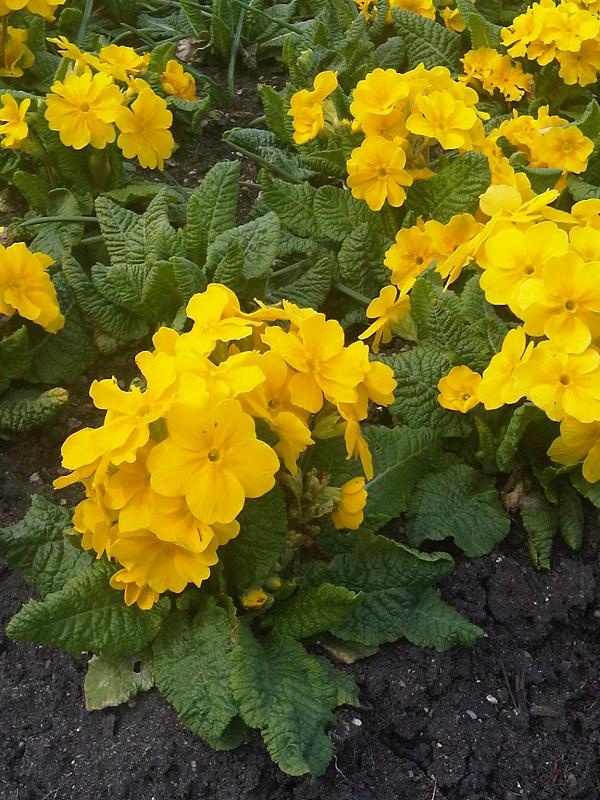
Photo: Emőke Dénes, CC BY-SA 4.0 · source

Perennial · Primulaceae
Polyanthus
Primula × polyantha
In other languages: Primula (Nederlands) · Primevère des jardins (Français)
Polyanthus is an old garden hybrid bred mainly from the primrose and the cowslip. It forms a rosette of crinkled, tongue-shaped leaves topped by a cluster of flowers on a single sturdy stem of 15–25 cm. From February it flowers in almost every colour, from white and yellow to orange, red, pink, purple and blue, usually with a yellow eye. That is why it is so popular in pots and window boxes by the front door and at the front of the border. A classic is the Gold-laced Group, with dark red to almost black flowers finely edged in gold.
Caution: Mildly poisonous: not edible, and the sap can irritate the skin of sensitive people. Wear gloves and keep children and pets away from the plant.
Light
Partial shade or shade
tolerates little sun
Moisture
Normal
no wet feet
Legal basis
Loam or clay
acid to neutral
Hardiness
Fully hardy
down to -20 °C
Size
0.25 m
tall, 0.25 m wide
Flowering
February–May
| Height | 0.25 m |
|---|---|
| Native to Belgium | No, planted |
| Good for bees, butterflies and birds | Yes, for bees |
| Poisonous to people and pets | Yes, take care with children and pets |
| Flowering | February–May |
Identify
Polyanthus: how do you recognise it?
- Habit
- A low rosette about 25 cm tall and wide.
- Leaves
- Tongue-shaped, crinkled and fresh green, with a slightly wavy edge.
- Flowers
- A cluster of flowers together on a single sturdy stem of 15–25 cm, from February to May.
- Colour
- Almost every colour, from white, yellow and orange to red, pink, purple and blue, usually with a yellow eye.
- Roots
- A short rhizome with many fine roots, just below the surface.
Flowering: February–May · Plants: February–April and September–October
In your garden
Why grow it?
- One of the first colourful flowers of the year, from February onwards.
- Flowers in almost every colour: ideal for pots, window boxes and the front of the border.
- After flowering you can plant it out in the garden: in partial shade it comes back every year.
- Early nectar for bumblebee queens and other early insects.
- Indoors in a cool spot it flowers for weeks as a pot plant.
Polyanthus: where does it grow best?
- Partial shade is ideal: spring sun is fine, fierce summer sun is not.
- Humus-rich loam or clay that holds moisture but drains well, acid to neutral.
- Soil that does not dry out in summer; avoid wet, heavy soil in winter.
- Space plants 20–25 cm apart.
- Light
- Partial shade and shade
- Soil type
- Loam or clay
- Acidity
- Acid or neutral
- Moisture
- Normal
- Size
- 0.25 m tall, 0.25 m wide
- Hardiness
- Hardy (to -20 °C)
Goes well with
- Forget-me-not: A blue haze around the colourful rosettes.
- Daffodil: Flowers at the same time, in pots and in the border.
- Grape hyacinth: Little blue spikes between the polyanthus.
- Ferns: Take over the spot in summer in partial shade.
- Hellebore: Another early flower for the same partial shade.
Maintenance
Polyanthus: when and how to plant it?
Plant in February–April and September–October.
- Plant in February–April or in September–October. Let plants bought in flower get used to the outdoors in a sheltered spot for a week first.
- Mix compost or leaf mould into the soil, especially on sandy soil.
- Set the rosette at the same depth as in the pot: the crown must stay above the soil, or it will rot.
- Space plants 20–25 cm apart.
- Water well and keep the soil lightly moist for the first few weeks.
- In a pot or window box: use potting compost with a little garden compost, in a container with a drainage hole.
Care
- Watering
- Keep the soil lightly moist, especially in pots, but avoid wet feet.
- Feeding
- In pots, a little liquid feed every two weeks during flowering; in the garden, compost in spring is enough.
- Spent flowers
- Cut off spent flower stems and remove yellow leaves; it then flowers for longer.
- Indoors
- As a pot plant indoors it flowers longest in a cool, bright spot at 10–15 °C.
- Dividing
- Divide old clumps every 2–3 years after flowering to keep them free-flowering.
Tip: Let a polyanthus bought in flower get used to the outdoors in a sheltered spot for a week, and plant it out in partial shade after flowering: it will then come back every year.
Polyanthus: when to prune it?
When: Pruning is not needed. During and after flowering, cut off spent flower stems.
How:
- Cut spent flower stems off at the base.
- Remove yellow, brown or nibbled leaves.
- Leave the healthy leaves after flowering: the plant needs them to build up strength for next year.
Propagation
- Division
- After flowering or in September: lift older clumps, pull them apart into pieces each with a rosette and its own roots, and replant them. Water well.
- Seed
- In summer, in a cool, shaded tray; the seed germinates best below 20 °C. Seed from your own plants gives mixed colours that rarely resemble the parents.
Polyanthus: how does it get through the winter?
Hardy to −20 °C.
- Hardy to about −20 °C: established plants in the garden need no protection.
- Plants sold in flower come from a heated greenhouse: let them acclimatise first and cover them with fleece in hard frost.
- In hard frost, move pots against a wall or into a cold, bright shed or porch.
- As a pot plant indoors: cool and bright, not next to a radiator.
Diseases and pests
- Slugs and snails: Holes in leaves and flowers. Pick them off in the evening.
- Vine weevil: Plants suddenly wilt and come loose: white grubs eat the roots, especially in pots. Apply nematodes in spring or late summer.
- Crown rot: The centre rots in wet, heavy soil or when planted too deep. Replant higher, in better-drained soil.
- Aphids: Small aphids in the centre and on the undersides of the leaves. Hose them off or let ladybirds do the work.
- Grey mould: Grey fluff on leaves and flowers, especially indoors or in damp weather. Remove affected parts and improve air flow.
Through the year
- February: Flowering begins. Fill pots and window boxes; protect from hard frost.
- March: Full flower. Remove spent flowers. Planting.
- April: Flowering. Plant out faded pot plants in partial shade in the garden.
- May: Last flowers. Divide after flowering.
- June: Water during dry spells.
- July: Sow in a cool, shaded tray.
- August: Water during dry spells. Apply nematodes against vine weevil grubs.
- September: Planting and dividing.
- October: Planting.
Use
Edible and useful
Not edible. These primroses are mildly poisonous: eating them can cause vomiting and stomach ache, in children as well as in dogs and cats, and the fine hairs on the leaves and stems can cause a rash in sensitive people. Do not confuse them with the cowslip (Primula veris), whose flowers you can use: these primroses are not eaten, not even the flowers. Wear gloves if you divide or move a lot of clumps, and wash your hands afterwards. Keep pots and troughs of primroses, which often stand on the table or windowsill, out of reach of small children and pets. If any is swallowed, call a poison centre (in Belgium 070 245 245) or your doctor at once.
Good for wildlife
- Bees
- Nectar and pollen for honeybees and wild bees.
You and this species
Did you know?
- The name Primula comes from the Latin primus, ‘the first’, because the plant flowers so early in the year.
- Polyanthus means ‘many-flowered’: unlike the primrose, the flowers are carried together in a cluster on one stem.
- Primulas have two flower forms, with a long or a short style. Charles Darwin studied this to understand how plants avoid self-pollination.