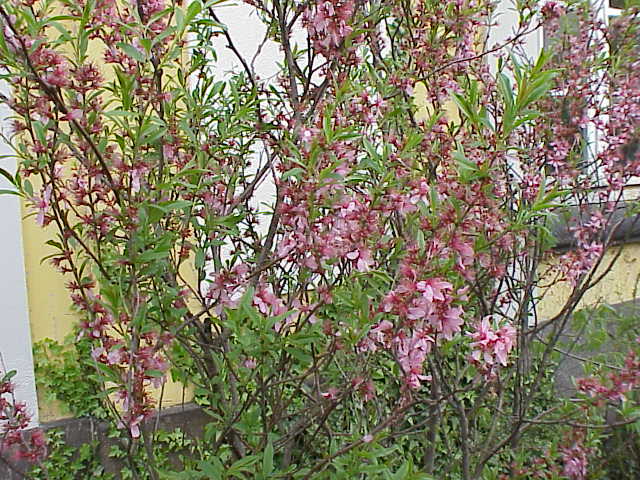
Photo: Kurt Stüber [1], CC BY-SA 3.0 · source

Shrub · Rosaceae
Dwarf Russian almond
Prunus tenella
In other languages: Dwergamandel (Nederlands) · Amandier nain (Français)
Dwarf Russian almond (Prunus tenella) is a low, densely branched shrub from south-eastern Europe and western Asia, which grows wild on dry steppes as far as Siberia. In April it is covered in bright pink, saucer-shaped little flowers, just as the narrow, glossy leaves appear. It grows to about 1 m tall and wide and produces suckers, so over the years it forms a dense, low clump. It is extremely hardy and drought-tolerant, and bees love the flowers. It suits a sunny border, a rock garden or a bank.
Caution: It produces suckers and can become a large clump. Do not plant it right next to a lawn or small border, and limit it by removing suckers every year or installing a root barrier. The kernels in the little fruits are bitter and not for eating.
Light
Full sun
warm and bright
Moisture
Dry to normal
no wet feet
Legal basis
Sand, loam or clay
any pH
Hardiness
Fully hardy
down to -35 °C
Size
1 m
tall, 1 m wide
Flowering
April
| Pruning months | April–May |
|---|---|
| Height | 1 m |
| Native to Belgium | No, planted |
| Good for bees, butterflies and birds | Yes, for bees |
| Poisonous to people and pets | Not known to be poisonous |
| Flowering | April |
Identify
Dwarf Russian almond: how do you recognise it?
- Habit
- Low, densely branched shrub about 1 m tall and wide, which produces suckers.
- Foliage
- Narrow and lance-shaped, a few centimetres long, glossy dark green with a slightly toothed edge.
- Flowers
- Bright pink, saucer-shaped flowers about 2 cm across, in April, close along the branches.
- Fruit
- Small, downy, almond-like fruits in summer; the kernel is bitter.
- Roots
- It forms underground suckers, with which it slowly builds a dense clump.
Flowering: April · Plants: March–April and October–November · Pruning: April–May
In your garden
Why grow it?
- A cloud of bright pink flowers in April, on a low shrub.
- Bees and other early insects find nectar and pollen there.
- Extremely hardy and drought-tolerant.
- Narrow, glossy leaves that stay fresh all summer.
- Low maintenance: grows in full sun and even in poor, dry soil.
- Thanks to its suckers it forms a dense, low clump that covers the ground, lovely on a bank.
Dwarf Russian almond: where does it grow best?
- Full sun; in shade it flowers less abundantly.
- Well-drained soil: sand, loam or clay, acid to chalky; poor, dry soil is no problem.
- Dry to normally moist; it tolerates drought, but not wet feet.
- Tolerates wind and frost, but the blossom can be damaged in April by late night frosts.
- Allow 80–100 cm per plant; allow for suckers and do not plant right next to a lawn.
- Light
- Sun
- Soil type
- Sand, loam or clay
- Acidity
- Not fussy
- Moisture
- Dry or normal
- Size
- 1 m tall, 1 m wide
- Hardiness
- Hardy (to -35 °C)
Goes well with
- Daffodils: Yellow flowers beneath the pink blossom, at the same time.
- Grape hyacinth: Blue flowers that go well with the pink.
- Lavender: Likes the same sun and dry soil; takes over later in summer.
- Ornamental grasses: Soft stems as a backdrop to the low shrub.
Maintenance
Dwarf Russian almond: when and how to plant it?
Plant in March–April and October–November.
- Plant in October–November or in March–April, when the soil is neither frozen nor waterlogged.
- Dig a hole twice as wide as the root ball and mix in a little compost.
- Set the plant at the same depth as in its pot and firm the soil well.
- Leave 80–100 cm between plants; for a group, plant three or five together.
- Water thoroughly straight away, then weekly in dry weather during the first year.
- Spread a layer of compost or bark around the plants; to limit suckers, install a root barrier.
Care
- Water
- In the first year, weekly in dry weather. After that it copes well with drought.
- Feeding
- A little compost or organic fertiliser in March. Do not overdo it: too much feeding gives soft growth and fewer flowers.
- Mulching
- A layer of compost or bark keeps the soil moist and suppresses weeds.
- Suckers
- In spring or autumn, remove unwanted suckers with a sharp spade.
Tip: Plant it in full sun and cut a few old branches right down to the ground after flowering: it stays compact and flowers abundantly. Remove unwanted suckers with a spade.
Dwarf Russian almond: when to prune it?
Pruning months: April–May.
When: Straight after flowering, in April–May.
How:
- Every 2–3 years, cut some of the oldest branches right down to the ground, to give new shoots room.
- Shorten the faded branches lightly, by about a third, for a compact shape.
- Remove dead, weak and damaged branches.
Caution: Do not prune in winter or before flowering: you would cut off the flower buds.
Propagation
- Suckers
- From October to March, dig out a rooted sucker with a spade and replant it elsewhere straight away.
- Seed
- Sow fresh seed in autumn in a pot outdoors; it needs a cold period to germinate and comes up in spring.
Dwarf Russian almond: how does it get through the winter?
Hardy to −35 °C.
- Extremely hardy, down to about −35 °C: no protection is needed, even in hard Belgian winters.
- The April blossom can be damaged by late night frosts; cover the shrub with horticultural fleece on cold nights.
- In a pot it can stay outside; stand the pot on feet and wrap it in hessian in hard frost.
Diseases and pests
- Brown rot (Monilia): Blossom and young twigs wilt and turn brown in a damp spring. Cut affected branches back well into healthy wood and clear away the waste.
- Aphids: Small aphids on young shoots in spring. A jet of water is usually enough.
- Shot hole: Small holes in the leaves after brown spots. Clear away affected leaves and choose an airy position.
- Spreading: Because of the suckers, it pops up in unexpected places. Remove them every year or install a root barrier.
Through the year
- March: Plant. Apply compost. Remove suckers.
- April: Flowering: bright pink flowers with bees. Prune after flowering.
- May: Prune after flowering. Protect blossom on cold nights.
- June: The little fruits form. Water in dry weather.
- July: Water in dry weather, especially young plants.
- October: Plant. Remove and replant suckers.
- November: Plant. Mulch.
Use
Good for wildlife
- Bees
- Nectar and pollen for honeybees and wild bees.
You and this species
Did you know?
- Dwarf Russian almond is related to the true almond, the peach and the plum: they all belong to the genus Prunus.
- The species name tenella means ‘delicate’ or ‘fine’.
- The cultivar ‘Fire Hill’ is known for its deep pink flowers.