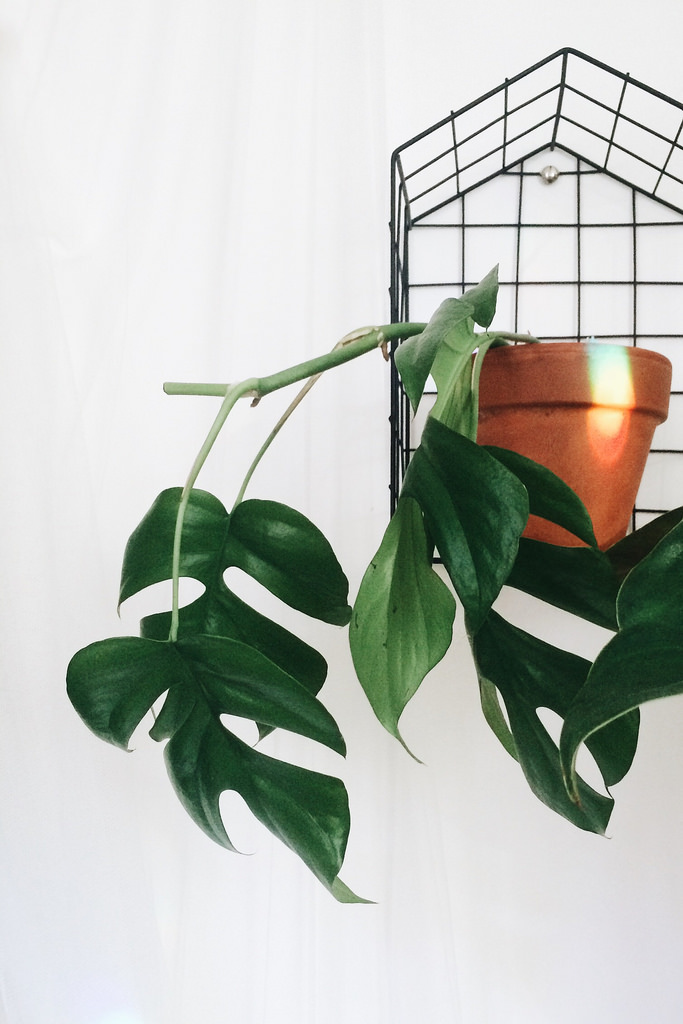
Photo: Theoperatingsystem, CC BY-SA 4.0 · source

Houseplant · Araceae
Mini monstera
Rhaphidophora tetrasperma
The mini monstera (Rhaphidophora tetrasperma) comes from the rainforests of southern Thailand and Malaysia, where it climbs tree trunks with aerial roots. Despite its name it is not a true monstera, but a related plant from the arum family. The heart-shaped leaves develop splits and holes as the plant matures and has something to climb, just like the large monstera, but in miniature. It grows fast, loves to climb and reaches about 2 m indoors, which makes it popular as a small houseplant for a moss pole or trellis. Take care: the plant is poisonous to children and pets.
Caution: Poisonous if chewed or swallowed: the sap contains calcium oxalate crystals that can irritate the mouth, throat and skin. Keep the plant out of reach of children, cats and dogs and wear gloves when pruning. If swallowed: call the Belgian Poison Centre (070 245 245) or the vet.
Light
Partial shade
no harsh midday sun
Moisture
Normal
no wet feet
Legal basis
Potting soil
Hardiness
Houseplant
min. 12 °C
Size
2 m
tall, 0.5 m wide
| Pruning months | March–April |
|---|---|
| Height | 2 m |
| Poisonous to people and pets | Yes, take care with children and pets |
Identify
Mini monstera: how do you recognise it?
- Habit
- Climber with a slender stem, about 2 m tall and 50 cm wide indoors when it has support.
- Foliage
- Young leaves are heart-shaped to oval and whole; on mature, climbing plants they are larger with splits and holes.
- Aerial roots
- It forms aerial roots at the nodes of the stem, which it uses to cling to a moss pole.
- Flower
- Rarely flowers indoors. In the wild it bears a spadix with a spathe, typical of the arum family.
- Origin
- Rainforests of southern Thailand and Malaysia: warm, humid and filtered light.
Plants: March–May · Pruning: March–April
In your garden
Why grow it?
- Attractive, split leaves in a small size: the look of a monstera without taking up much room.
- Grows fast and loves to climb, so you soon have a green wall or a full moss pole.
- Evergreen and rewarding in a bright room.
- Easy to propagate from cuttings, even for beginners.
- Flexible: it can climb up a pole or trellis, or trail from a tall pot.
Mini monstera: where does it grow best?
- Bright light to half shade: a light spot without direct sun, which scorches the leaves. In too little light the stems become long and the leaves stay small.
- Airy, humus-rich potting compost with perlite or bark, slightly acid to neutral.
- Evenly moist but free-draining; ideally 18–25 °C and never below 12 °C.
- Put it against a moss pole, trellis or other support so it can climb: it then develops larger, split leaves.
- It tolerates ordinary room air, but grows better with a little extra humidity.
- Light
- Bright, out of direct sun
- Potting soil
- Multi-purpose compost or airy, humus-rich compost
- Acidity
- Acid or neutral
- Watering
- Moderately
- Size
- 2 m tall, 0.5 m wide
- Temperature
- Minimum 12 °C
Goes well with
- Pothos: Same care; a trailing or climbing plant with yellow or white variegation.
- Philodendron: A related climber with recognisable foliage that goes well on the same moss pole.
- Boston fern: A light, shaggy leaf shape in the same bright, humid corner.
Maintenance
Mini monstera: when and how to plant it?
Plant in March–May.
- Repot in March–May, when the plant is growing again.
- Choose a pot with a drainage hole that is 2–3 cm wider than the old one.
- Mix ordinary potting compost with a third perlite or bark for an airy mix.
- Set the plant at the same depth as before and put a moss pole or support at the back of the pot straight away.
- Tie the stems loosely to the support; the aerial roots cling on by themselves.
- Water until it runs out at the bottom and empty the saucer after a quarter of an hour.
Care
- Water
- Let the top 2–3 cm dry out between waterings, then water generously. Too much water causes yellow leaves and rotten roots.
- Feeding
- From March to September, a foliage plant fertiliser every 2–4 weeks at half strength. Little or none in winter.
- Humidity
- Mist now and then, especially when heated air is dry, and wipe the leaves with a damp cloth.
- Support
- A moss pole or trellis is ideal. Keep the moss pole slightly damp: the aerial roots then attach more easily.
- Repotting
- Every 1–2 years in spring, as soon as the roots grow out of the pot.
Tip: Put three or four cuttings together in one pot for a full plant and give it a moss pole: with support it develops larger, split leaves.
Mini monstera: when to prune it?
Pruning months: March–April.
When: In March–April, before the growing season starts. A stem that is too long can also be trimmed later in the season.
How:
- Cut long stems back to just above a leaf or node (the thickening where the leaf and aerial root emerge).
- Pinch out the tips if you want a bushier plant: the side buds then grow out.
- Remove yellow or dead leaves and stems.
- Use the cut pieces that have a node as cuttings.
Caution: Wear gloves: the sap can irritate the skin and eyes.
Propagation
- Stem cuttings
- From March to August: cut a piece of stem of 10–15 cm with at least one node (preferably with an aerial root) and one leaf. Put it in water or in moist perlite or potting compost; roots appear after 2–4 weeks.
- Several cuttings
- Put 3–4 cuttings together in one pot for a full plant.
Mini monstera: how does it get through the winter?
- Not hardy: keep it indoors at 12 °C or more; 16–22 °C is ideal.
- Give it a bright spot, as it hardly grows in low light, away from draughts and radiators.
- Water less: let the compost dry out a little more than in summer, and do not feed until March.
- Mist if the air is dry to prevent brown leaf edges.
Diseases and pests
- Yellow leaves: Usually too much water or a pot without drainage. Let the compost dry out a few centimetres deep, check the roots and repot if necessary.
- Long, bare stems with small leaves: Too little light or no support. Move it somewhere brighter and let it climb up a moss pole.
- Brown leaf edges: Air that is too dry or too little water. Mist, raise the humidity and water a little more often.
- Spider mite and thrips: Fine webs or silvery flecks on the leaves. Rinse the plant, raise the humidity and repeat weekly.
- Mealybug: White fluff in the leaf axils. Wipe it off with a cloth and soapy water.
Through the year
- January: Rest. Bright spot, moderate watering.
- February: Rest. Check for spider mite.
- March: Prune. Repot and take cuttings. Start feeding again.
- April: Prune. Repot. Put in a moss pole.
- May: Repot if needed. Take cuttings. Feed every 2–4 weeks.
- June: Feed. Water. No fierce sun.
- July: Feed. Take cuttings. Water in dry spells.
- August: Feed. Watch for spider mite and thrips.
- September: Last feed.
- October: Water less. Bright spot.
- November: Rest. Do not feed.
- December: Rest. Let the compost dry out a little more.
Use
Edible and useful
Not edible. All parts of these houseplants of the arum family are poisonous: the sap is full of needle-shaped crystals (calcium oxalate) which, when chewed, at once cause burning pain and swelling of the lips, mouth and throat, with drooling and sometimes vomiting. Most at risk are cats, which like to chew trailing stems and leaves, dogs, and young children playing on the floor. Hang climbers and trailing plants out of their reach, clear up cut stems and cuttings straight away, and do not put a glass of cuttings in water where a cat drinks from it. Wear gloves when pruning and repotting, do not rub your eyes, and wash your hands afterwards. If your cat or dog drools or its mouth swells, call your vet. If any is swallowed, call a poison centre (in Belgium 070 245 245) or your doctor at once.
You and this species
Did you know?
- Despite its nickname it is not a monstera: it belongs to a different genus in the same arum family (Araceae).
- It is sometimes sold under the wrong name ‘Monstera minima’.
- The higher it climbs, the larger its leaves become and the more splits and holes they develop.