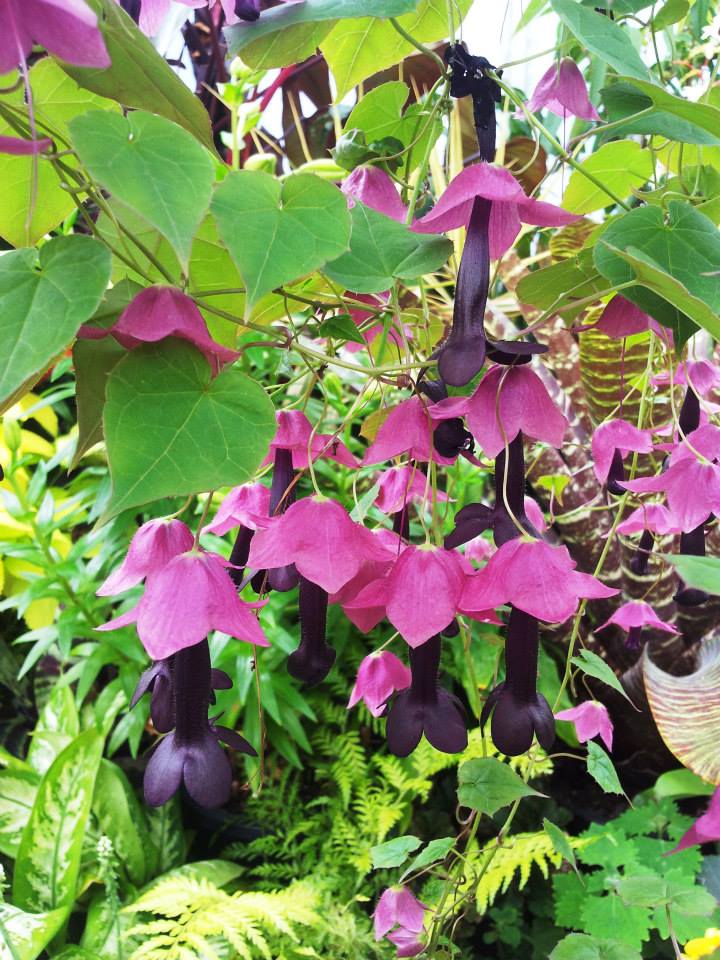
Photo: Nzfauna, CC BY-SA 3.0 · source

Annual · Plantaginaceae
Purple bell vine
Rhodochiton atrosanguineus
In other languages: Rhodochiton (Nederlands) · Rhodochiton (Français)
Purple bell vine comes from the mountainous regions of Mexico, where it is a perennial climber. Here you grow it as an annual: in a single season it climbs to 2–2.5 m with heart-shaped leaves and, from July to October, remarkable hanging flowers. Each flower consists of a pink-purple calyx from which a dark purple, tubular corolla hangs like the clapper of a bell. The calyx stays in place after the corolla has fallen, so the plant remains decorative for weeks. It climbs with twining leaf stalks and is perfect for a trellis, obelisk or hanging basket.
Light
Sun or partial shade
preferably some sun
Moisture
Normal
no wet feet
Legal basis
Sand or loam
acid to neutral
Hardiness
down to 0 °C
protect in harsh winters
Size
2.5 m
tall, 0.5 m wide
Flowering
July–October
| Pruning months | March |
|---|---|
| Height | 2.5 m |
| Native to Belgium | No, planted |
| Poisonous to people and pets | Not known to be poisonous |
| Flowering | July–October |
Identify
Purple bell vine: how do you recognise it?
- Habit
- Perennial climber grown here as an annual; twines up to 2–2.5 m high by its leaf stalks.
- Leaves
- Heart-shaped with a pointed tip and toothed edge, often tinged purple, with long leaf stalks that act as tendrils.
- Flowers
- Hanging: a bell-shaped, pink-purple calyx with a dark purple, tubular corolla of about 4–5 cm emerging from it, from July to October.
- Colour
- Pink-purple calyx and almost black-purple corolla: a striking contrast.
- Roots
- Fine and fibrous; it likes moist, humus-rich soil.
Flowering: July–October · Sowing: February–March · Plants: May–June · Pruning: March
In your garden
Why grow it?
- Very striking hanging flowers in two colours, from July to October.
- Climbs to 2–2.5 m in one season, handy for quickly covering a screen, obelisk or fence.
- Also pretty as a trailing plant in a basket or tall pot, where the flowers are clearly visible.
- The calyces stay after flowering and give the plant a long season of interest.
- Does well in sun and partial shade, in a sheltered spot.
Purple bell vine: where does it grow best?
- Sun to partial shade; in full sun it needs more water, in partial shade it flowers a little less richly.
- Humus-rich, free-draining, moisture-retentive soil: sand or loam, acid to neutral. In a pot, good-quality compost.
- Evenly moist: the root ball must not dry out or become waterlogged.
- Sheltered from strong wind; it is brittle and climbs best against a wall or trellis in the lee.
- Plant 30–40 cm apart against a trellis, or one to three plants in a 30–40 cm pot.
- Light
- Sun and partial shade
- Soil type
- Sand or loam
- Acidity
- Acid or neutral
- Moisture
- Normal
- Size
- 2.5 m tall, 0.5 m wide
- Hardiness
- Frost tender: plant out after the last frost (mid-May)
Goes well with
- Nasturtium: Orange and yellow flowers that contrast nicely with the dark purple.
- Sweet pea: Scented flowers on a trellis next to the purple bells.
- Fuchsia: The same partial shade and hanging flowers in pink and purple.
- Begonia: A low, free-flowering underplanting in red and pink at the foot of the trellis.
Maintenance
Purple bell vine: when and how to plant it?
Plant in May–June.
- Sow indoors in February–March and plant out after mid-May, when night frost is no longer expected.
- First put the plants outside for a week by day to harden off and bring them in at night.
- Put the support in place before planting: a fine trellis, strings, an obelisk or thin branches.
- Dig a hole slightly larger than the root ball and mix in compost; in a pot use compost and a pot with drainage holes.
- Plant at the same depth as in the nursery pot, firm in and water generously.
- Gently guide the first shoots towards the support.
Care
- Water
- Keep evenly moist, in pots daily in warm weather. Water at the base.
- Feeding
- From June to September give a flowering-plant feed in the water every two weeks.
- Support
- Provide a fine trellis, strings or branches; it clings with its leaf stalks and usually does not need tying in.
- Faded flowers
- Not needed: the calyces stay attractive. Remove only dried-out parts.
- Pinching
- Pinch out young plants at 20–30 cm for richer branching.
Tip: Sow indoors in February–March and plant out after mid-May against a fine trellis, strings or an obelisk in the lee. You can also let it hang from a basket; water regularly and give flowering-plant feed.
Purple bell vine: when to prune it?
Pruning months: March.
When: It is hardly pruned; cut overwintered plants back in March.
How:
- Pinch out the shoot tips of young plants for more branching.
- In summer, remove dead or weak shoots right at the base.
- Cut overwintered plants back to 20–30 cm in March.
Propagation
- Sowing
- In February–March indoors at 18–20 °C: sow on the surface, press in the fine seed and barely cover it. It germinates in 2–4 weeks. Prick out into small pots as soon as the first true leaves appear and harden off in May.
- Cuttings
- In August–September: cuttings of 8–10 cm from semi-ripe shoots, lower leaves removed, in moist cutting compost. Keep them bright and frost-free; they root within a few weeks.
Purple bell vine: how does it get through the winter?
Hardy to 0 °C: protect in harsh winters.
- Not hardy: it tolerates at most a light frost around 0 °C and dies in an ordinary winter. Bring it indoors in October, before the first night frost, if you want to keep it.
- Overwinter in a bright, frost-free place at 5–10 °C with little water. Cut back in March and repot in fresh compost.
- Simpler: take a few cuttings in August–September, or sow again from seed every spring.
Diseases and pests
- Aphids and whitefly: Sticky leaves and small insects on young shoots. Rinse off with water, use a mild soap solution and let ladybirds help.
- Spider mite: Fine webs and yellowish speckles on the leaves in dry, warm air. Mist the leaves now and then and remove affected parts.
- Slugs: Young plants are eaten. Collect slugs in the evening or set slug traps.
- Poor flowering: Too much nitrogen feed or too little light gives lots of leaf and few flowers. Give flowering-plant feed and choose a brighter spot.
- Root rot: Limp plant and brown roots in wet, cold soil. Ensure good drainage and water less.
Through the year
- February: Sow indoors at 18–20 °C.
- March: Sow and prick out. Cut back overwintered plants.
- April: Pot on. Keep bright and cool.
- May: Plant out after mid-May. Put the support in place.
- June: Guide the first shoots. Feed every two weeks.
- July: Flowering begins. Water and keep feeding.
- August: Flowering. Take cuttings if wanted.
- September: Full flower, the calyces adorn the plant.
- October: Last flowers. Bring indoors or collect seed.
- November: Winter rest: bright, frost-free, little water.
You and this species
Did you know?
- The name Rhodochiton comes from the Greek: rhodon (rose) and chiton (tunic), after the pink calyx that wraps the flower.
- It climbs not with tendrils but with twining leaf stalks, which wind around a support.
- The calyx stays in place after the corolla falls, so the plant looks in flower until late autumn.