Photo: Wikimedia Commons, CC BY-SA 3.0 · source

Shrub · Ericaceae
Marsh Labrador tea
Rhododendron tomentosum
In other languages: Moerasrozemarijn (Nederlands) · Lédon des marais (Français)
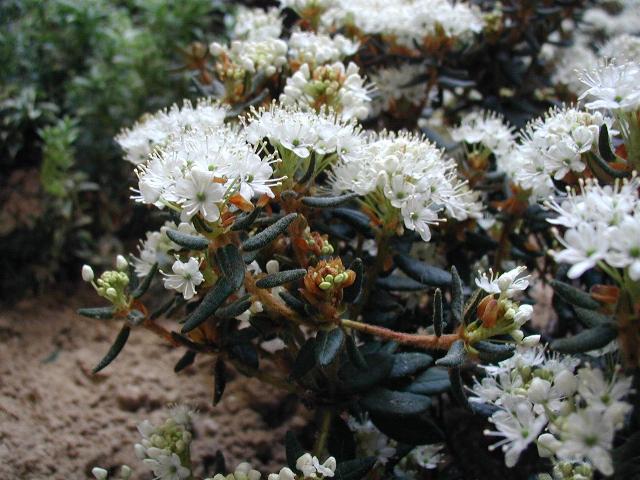
Marsh Labrador tea (Rhododendron tomentosum, formerly Ledum palustre) grows in raised bogs and wet, acid woods in northern Europe, Asia and North America. It is an evergreen shrub about 1 m tall with narrow, leathery leaves whose undersides are covered in rusty-brown felt and which smell strongly spicy and resinous. From May to July it bears rounded clusters of white flowers that attract bees. The plant has nothing to do with culinary rosemary and is toxic. It is extremely hardy, but always needs a wet, acid, peaty spot, such as a bog bed or the edge of a pond in a heather garden.
Caution: All parts are toxic, including the strongly scented leaves. Children, cats, dogs and grazing animals such as sheep, goats and horses can fall ill if they eat it. Never use the plant as a herb or tea, even though the Dutch name suggests rosemary, and do not let children put leaves or flowers in their mouths.
Light
Sun or partial shade
preferably some sun
Moisture
Moist to wet
must not dry out
Legal basis
Sand or peat
acid
Hardiness
Fully hardy
down to -40 °C
Size
1 m
tall, 1 m wide
Flowering
May–July
| Height | 1 m |
|---|---|
| Native to Belgium | No, planted |
| Good for bees, butterflies and birds | Yes, for bees |
| Poisonous to people and pets | Yes, take care with children and pets |
| Flowering | May–July |
Identify
Marsh Labrador tea: how do you recognise it?
- Habit
- Compact, evergreen shrub about 1 m tall and wide, with upright stems.
- Foliage
- Narrow, oblong and leathery, 1.5–5 cm long, with rolled edges. Dark green above, with dense rusty-brown felt below; the young shoots are felted.
- Flower
- Small white flowers in rounded clusters at the shoot tips, from May to July.
- Scent
- The leaves smell strongly spicy and resinous, especially when rubbed or warmed by the sun.
- Fruit
- Narrow capsules that split open in autumn and release very fine seed.
Flowering: May–July · Plants: March–April and September–October
In your garden
Why grow it?
- An evergreen shrub for the wet, acid spot where few other shrubs grow.
- A long flowering season from May to July, with rounded clusters of white flowers.
- Strongly aromatic leaves with rusty-brown felt underneath.
- Extremely hardy, to about −40 °C.
- The flowers are visited by bees and bumblebees.
Marsh Labrador tea: where does it grow best?
- Sun to half shade; in full sun the soil must stay wet at all times.
- Acid, peaty soil (pH about 4–5.5). No lime. Preferably use peat-free ericaceous compost with leaf mould as an alternative to peat.
- Always wet to very moist: a bog bed, a boggy corner or the edge of a pond with acid water. It cannot cope with drying out.
- Allow 80–100 cm of space per plant. Shelter from hot afternoon sun is welcome.
- Light
- Sun and partial shade
- Soil type
- Sand or peat
- Acidity
- Acid
- Moisture
- Wet
- Size
- 1 m tall, 1 m wide
- Hardiness
- Hardy (to -40 °C)
Goes well with
- Cross-leaved heath: A native heather for the same wet, acid soil.
- Cottongrass: Fluffy seedheads in summer and a natural bog feel.
- Sundew: A small carnivorous plant for an acid bog bed.
- Bog myrtle: An aromatic bog shrub for a wet, acid spot.
Maintenance
Marsh Labrador tea: when and how to plant it?
Plant in March–April and September–October.
- Plant in March–April or September–October.
- Make a bog bed: dig a pit 40–50 cm deep, line it with pond liner with a few small holes and fill it with peat-free ericaceous compost and leaf mould. This keeps the soil wet.
- Soak the root ball in a bucket of water until no more air bubbles rise, then gently tease out the roots.
- Set the plant at the same depth as in its pot and firm the soil. Water straight away with rainwater.
- Spread a 5 cm layer of needle mulch or pine bark around the base.
Care
- Water
- The soil must never dry out. In dry spells give generous rainwater every day or every other day; tap water often contains lime.
- Feeding
- Hardly any. In nature it grows on nutrient-poor peat. Fertiliser harms it more than it helps.
- Mulching
- Renew the needle mulch or pine bark every spring to keep the soil moist and acid.
- Weeds
- Pull grass and weeds out by hand: the roots are shallow, so no digging or hoeing.
- Spent flowers
- Not essential. You can snap off spent clusters for a tidier shrub.
Tip: Make a bog bed with perforated liner underneath and top it up with rainwater: marsh Labrador tea does not survive a dry summer, but grows for years in a wet, acid spot.
Marsh Labrador tea: when to prune it?
When: It needs hardly any pruning. Cut off dead twigs in March.
How:
- Remove dead or frosted twigs back to healthy wood.
- Snap off spent clusters in August if you wish, without damaging the young shoots below.
- Do not clip it into shape: keep the natural, compact habit.
Caution: It grows slowly, so prune as little as possible.
Propagation
- Semi-ripe cuttings
- In July–September: take 5–8 cm cuttings of this year’s shoots, remove the lower leaves and insert in a mix of acid seed compost and sand under plastic. They root slowly.
- Seed
- Scatter the dust-fine seed in January–March on moist acid seed compost without covering it, and keep it light and cool. Seedlings grow slowly.
Marsh Labrador tea: how does it get through the winter?
Hardy to −40 °C.
- Extremely hardy, to about −40 °C: no protection is needed in Flanders.
- In severe frost the leaves may curl or droop; this is a normal reaction and they recover in spring.
- In a pot: stand the pot against a wall and wrap it in hessian so the roots do not freeze. Do not let the compost dry out.
Diseases and pests
- Drought damage: Brown leaf edges and drooping, curling leaves in summer. Water generously with rainwater and apply a thick mulch.
- Chlorosis: Yellow leaves with green veins on soil that is too chalky or with hard water. Acidify the soil with needle mulch and leaf mould and water with rainwater.
- Root rot: Limp, wilting leaves in stagnant, foul water. Make sure the water can seep through gently and renew it regularly with fresh rainwater.
- Vine weevil: Half-moon notches in the leaf edges in summer; the grubs eat the roots, especially on potted plants or on a drier part of the bog bed. Apply nematodes in August–September to warm, moist soil.
Through the year
- March: Plant. Cut off dead twigs. Top up the mulch.
- April: Plant. Check the bog bed and top up with rainwater.
- May: Flowering begins. Always keep wet.
- June: Flowering. Check daily for drying out.
- July: Flowering and heat: give extra rainwater.
- August: Snap off spent clusters if wished. Apply nematodes against vine weevil grubs.
- September: Plant. Take cuttings.
- October: Plant. Top up the mulch.
- December: Rest. In severe frost, leave the curled leaves alone.
Use
Edible and useful
Not edible. Labrador tea and marsh Labrador tea are poisonous in all their parts: the fragrant leaves contain substances such as ledol, which act on the nervous system and can cause vomiting and dizziness. The names are misleading. In North America the leaves were brewed as a tea, but do not make tea from them yourself; and their narrow leaves with rolled edges recall rosemary, but rosemary leaves are whitish underneath, these have a rusty-brown felt. Also dangerous to sheep, goats and horses: do not give the clippings to animals. If any is swallowed, call a poison centre (in Belgium 070 245 245) or your doctor at once.
Good for wildlife
- Bees
- Nectar and pollen for honeybees and wild bees.
You and this species
Did you know?
- The plant is not related to culinary rosemary: the Dutch name ‘moerasrozemarijn’ (marsh rosemary) only refers to its strong, spicy scent.
- The species name tomentosum means ‘felted’ and refers to the dense felt under the leaf and on the young shoots.
- It used to be called Ledum palustre. DNA studies showed that it belongs in the genus Rhododendron.