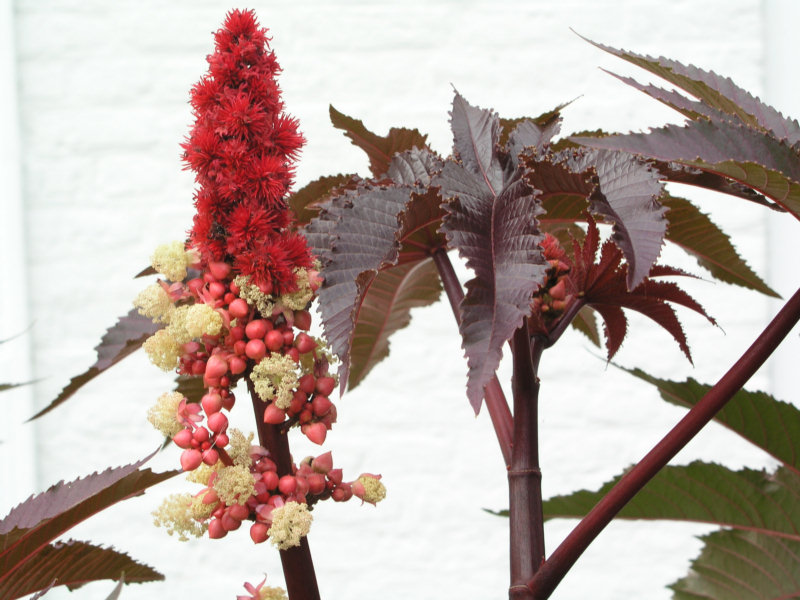
Photo: Wikimedia Commons, CC BY-SA 3.0 · source

Annual · Euphorbiaceae
Castor oil plant
Ricinus communis
In other languages: Wonderboom (Nederlands) · Ricin (Français)
The castor oil plant comes originally from tropical East Africa and in warm regions grows as a fast-growing tree or shrub several metres high. Here you grow it as an annual: from seed it grows in a single summer into an imposing plant of 1.5–2 m with enormous, palmate leaves more than 30 cm across, green, bronze or reddish purple, often on red stems. The flowers are inconspicuous, but they are followed by spiny, often red seed capsules. As a foliage plant it gives borders and containers a tropical feel. The plant is, however, highly poisonous, especially the seeds: use it only if you are sure children and animals cannot reach it.
Caution: Highly poisonous: the seeds contain ricin, one of the strongest plant poisons, and the leaves and stems are poisonous too. A few seeds can already be life-threatening to children and to animals such as dogs, cats, horses and livestock. Do not plant it where children or pets go, cut off the seed capsules before they ripen, wear gloves and wash your hands. If swallowed: call the Poison Centre (070 245 245 in Belgium) or the emergency number 112 immediately.
Light
Full sun
warm and bright
Moisture
Normal
no wet feet
Legal basis
Sand, loam or clay
any pH
Hardiness
down to 2 °C
protect in harsh winters
Size
2 m
tall, 1 m wide
Flowering
July–September
| Height | 2 m |
|---|---|
| Native to Belgium | No, planted |
| Poisonous to people and pets | Yes, take care with children and pets |
| Flowering | July–September |
Identify
Castor oil plant: how do you recognise it?
- Habit
- Upright plant grown as an annual, 1.5–2 m high and about 1 m wide; in the tropics a perennial shrub or small tree.
- Leaves
- Large, palmate with 5–11 lobes, up to more than 30 cm across, green, bronze or reddish purple, often on red leaf stalks.
- Flowers
- Inconspicuous greenish or red flowers in clusters, July to September; the female flowers have red stigmas.
- Fruit
- Spiny seed capsules, often red, with glossy, mottled seeds that are extremely poisonous.
- Stems
- Thick and hollow, often red or purplish with a waxy bloom.
Flowering: July–September · Sowing: March–April · Plants: May–June
In your garden
Why grow it?
- Grows to 1.5–2 m in a single summer: a fast, tropical-looking foliage and structure plant.
- Enormous palmate leaves in green, bronze or reddish purple give an exotic effect in a border or container.
- The spiny, often red seed capsules add interest, but cut them off for safety before they ripen.
- A colourful, fast-growing screen or eye-catcher among flowering summer plants.
- Easy to grow from seed that you sow yourself indoors in April.
Castor oil plant: where does it grow best?
- Full sun and warmth for the strongest growth and the best leaf colour.
- Rich, humus-rich, free-draining but moisture-retentive soil: sand, loam or clay, acid to chalky.
- Evenly moist; in drought it lets its leaves hang. In a pot at least 30–40 litres.
- Sheltered from wind: the large leaves tear and the stems can snap.
- Plant 80–100 cm apart or as a single plant in a large pot.
- Light
- Sun
- Soil type
- Sand, loam or clay
- Acidity
- Not fussy
- Moisture
- Normal
- Size
- 2 m tall, 1 m wide
- Hardiness
- Frost tender: plant out after the last frost (mid-May)
Goes well with
- Canna: Large tropical leaves and bright flowers that need the same sun and feeding.
- Dahlia: Rich flowering in the same warm summer colours.
- Sunflower: Tall, straight stems and yellow flowers that need the same sun and feeding.
- Ornamental grasses: Fine stems and plumes contrast nicely with the coarse foliage.
Maintenance
Castor oil plant: when and how to plant it?
Plant in May–June.
- Soak the seed overnight (12–24 hours) in lukewarm water and sow indoors in April, one seed per 9 cm pot, 2 cm deep, at 20–25 °C.
- The seed germinates in 1–3 weeks; keep the young plants bright, warm and evenly moist.
- First put the plants outside by day for a week to harden off, then plant out after mid-May, when night frost is no longer expected.
- Dig a large hole and mix in a few spadefuls of compost or well-rotted manure.
- Plant at the same depth as in the nursery pot, 80–100 cm apart, and water generously straight away.
- Spread a thick layer of mulch around the base and, in windy spots, put a sturdy stake next to the stem.
Care
- Water
- In warm weather water generously and regularly, at the base. In a pot this may be daily.
- Feeding
- From June to August give a rich feed in the water every two weeks; it is a hungry plant.
- Support
- In wind or for a tall plant, put in a sturdy stake or pole and tie the stem loosely.
- Seed capsules
- Cut off the flower clusters before the seeds ripen, so no poisonous seeds end up in the garden.
- Mulching
- A thick layer of compost or bark keeps the soil moist and the roots cool.
Tip: Soak the seed overnight and sow indoors in April; plant out after mid-May in rich, moist soil in the sun and protect from wind. All parts are poisonous, the seeds deadly: do not plant it where children play and cut off the seed capsules.
Castor oil plant: when to prune it?
When: It is not pruned; during the season just cut off the flower clusters and any yellowed lower leaves.
How:
- Cut off the flower clusters in July–August before the capsules ripen; always wear gloves.
- Remove yellow or damaged lower leaves at the leaf stalk.
- Pull out the dead plant in October after the first frost; put any capsules in the household waste, not on the compost heap.
Caution: Wear gloves and wash your hands after pruning: all parts of the plant are poisonous, the seeds most of all.
Propagation
- Sowing
- In March–April indoors at 20–25 °C: soak the seed overnight and sow it one per 9 cm pot, 2 cm deep. The seed germinates in 1–3 weeks. Harden off the plants in May and plant them out after mid-May. Wear gloves when handling the seed.
Castor oil plant: how does it get through the winter?
Hardy to 2 °C: protect in harsh winters.
- Not hardy: the plant suffers already below about 2 °C and dies in frost. It is therefore grown in a single season.
- Remove the dead plant after the first frost in October and put any seed capsules in the household waste.
- If you want it next year, sow again from seed in March–April.
Diseases and pests
- Spider mite: Fine webs and yellowish speckles on the leaves in dry, warm air. Mist the leaves now and then and remove affected leaves.
- Wind damage: Torn leaves and broken stems in strong wind. Choose a sheltered spot and put in a sturdy stake.
- Cold or drought damage: Limp, yellow or spotted leaves, especially after cold nights or drought. Water and only put outside in warm weather.
- Slugs: Young plants are eaten. Collect slugs in the evening or set slug traps.
- Grey mould: Grey mould on flower clusters and seed capsules in wet weather. Remove affected parts and allow space and airflow.
Through the year
- March: Soak the seed and sow indoors at 20–25 °C.
- April: Sow and pot on. Keep warm and bright.
- May: Harden off and plant out after mid-May. Mulch.
- June: Fast growth. Water and feed every two weeks.
- July: Flowering. Cut off flower clusters before the seeds ripen.
- August: Full growth. Water and feed; cut off seed capsules.
- September: Last growth. Remove capsules and protect from wind.
- October: After the first frost remove the plant; seed in the household waste.
Use
Edible and useful
Not edible. The beautiful mottled seeds of the castor oil plant contain ricin, one of the most powerful plant poisons: a few well-chewed seeds can kill a child. Cut off the seed capsules before they ripen, do not grow it where children play and never use the seeds for jewellery or crafts. If any is swallowed, call a poison centre (in Belgium 070 245 245) or your doctor at once.
You and this species
Did you know?
- Ricinus is the Latin word for tick: the mottled, glossy seeds resemble a blood-swollen tick.
- Castor oil is pressed from the seeds and used industrially, for example in lubricants, soap and paint; the poisonous ricin stays behind in the press cake.
- An old name is Palma Christi (‘hand of Christ’), after the hand-shaped leaves.