Photo: Wikimedia Commons, Public domain · source

Ornamental grass · Poaceae
Little bluestem
Schizachyrium scoparium
In other languages: Schizachyrium scoparium (Nederlands) · Schizachyrium scoparium (Français)
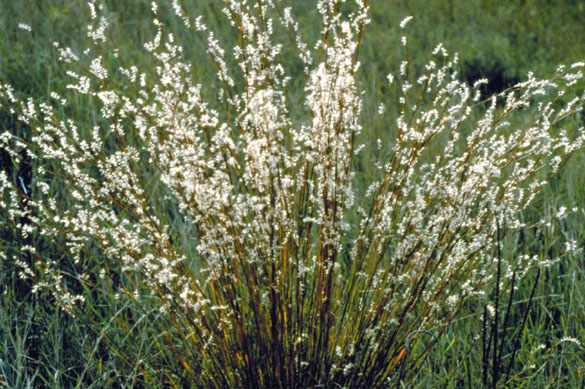
Little bluestem, sold in Belgium mostly under its botanical name Schizachyrium scoparium, is one of the best-known grasses of the North American prairie, growing wild from Canada to Mexico. It forms narrow, upright clumps of blue-green leaves. In August–September fine spikelets appear along the upper stems, developing in autumn into silvery white, fluffy seeds that glow when backlit. The autumn colour is its finest feature: the leaves turn orange-red, copper or purplish and stay a warm reddish brown all winter. Well-known cultivars are ‘Blaze’ and ‘The Blues’, which has extra blue foliage.
Light
Full sun
warm and bright
Moisture
Dry
tolerates drought
Legal basis
Sand or loam
any pH
Hardiness
Fully hardy
down to -30 °C
Size
0.9 m
tall, 0.4 m wide
Flowering
August–September
| Pruning months | February–March |
|---|---|
| Height | 0.9 m |
| Native to Belgium | No, planted |
| Good for bees, butterflies and birds | Yes, for birds |
| Poisonous to people and pets | Not known to be poisonous |
| Flowering | August–September |
Identify
Little bluestem: how do you recognise it?
- Habit
- Narrow, upright clump 60–90 cm tall and 30–40 cm wide.
- Leaves
- Narrow, blue-green to grey-blue; orange-red, copper or purplish in autumn, reddish brown in winter.
- Flowers
- Small, inconspicuous spikelets along the upper stems in August–September.
- Seed
- Silvery white, fluffy seeds in autumn, lovely when backlit.
- Roots
- Deep and fibrous, reaching more than a metre down: that is why it is so drought-tolerant.
- Growth cycle
- A warmth-loving grass that starts into growth late in spring, often not until May.
Flowering: August–September · Plants: April–May · Pruning: February–March
In your garden
Why grow it?
- Spectacular autumn colour in orange, copper and red, lasting deep into winter.
- A narrow, upright clump that takes up little room.
- Excellent for dry, poor soil where other plants struggle.
- Seed-eating birds feed on the seeds and the clumps give shelter in winter.
- Beautiful when backlit, with its silvery seed fluff.
Little bluestem: where does it grow best?
- Full sun; in shade it flops open and colours less well.
- Poor, free-draining soil: sand or loam, acid to chalky. On rich soil it falls over.
- Dry; it dislikes wet, heavy soil in winter.
- Plant 30–40 cm apart, ideally in groups or in a prairie-style border.
- Light
- Sun
- Soil type
- Sand or loam
- Acidity
- Not fussy
- Moisture
- Dry
- Size
- 0.9 m tall, 0.4 m wide
- Hardiness
- Hardy (to -30 °C)
Goes well with
- Purple coneflower: Pink flowers in summer, a classic from the same prairie.
- Michaelmas daisy: Blue or purple flowers in September–October beside the orange leaves.
- Globe thistle: Steel-blue globes on the same dry soil.
- Ice plant: Pink to rusty red flower heads in autumn that change colour along with the grass.
Maintenance
Little bluestem: when and how to plant it?
Plant in April–May.
- Plant in April–May as the soil warms up: this warmth-loving grass establishes best then.
- Loosen the soil, but add no compost or fertiliser.
- Set the plant at the same depth as in the pot.
- Plant 30–40 cm apart, in groups of three to seven.
- Water well after planting and in dry spells during the first weeks.
- Mulch with gravel or leave the soil bare; no compost as mulch.
Care
- Water
- Only in dry spells during the first season. After that it is not needed.
- Feeding
- Never: fertiliser makes it floppy and then it falls over.
- Patience
- It starts late and looks dead until May. That is normal.
- Winter interest
- Leave the clumps standing all winter, for the colour, for the seeds for birds and as shelter for insects.
Tip: Plant it in poor soil without compost or fertiliser and stop watering after the first year: the leaner the soil, the better it stays upright.
Little bluestem: when to prune it?
Pruning months: February–March.
When: Once a year, from late February into March, before the new shoots appear.
How:
- Cut all stems and old leaves back to 10–15 cm above the ground.
- Hedge shears are quicker than secateurs.
- Pile the cut stems in a corner of the garden or compost them.
Propagation
- Division
- In April–May, as new growth begins: lift a clump and split it with a sharp spade. Warm-season grasses are not divided in autumn.
- Seed
- Sow in spring in pots in a cold frame or greenhouse; seedlings may differ in colour from the cultivar.
Little bluestem: how does it get through the winter?
Hardy to −30 °C.
- Very hardy to about −30 °C: no protection needed.
- The reddish brown clumps look good all winter; leave them until late February.
- The biggest risk is wet soil: make sure drainage is good.
Diseases and pests
- Flopping: On rich, moist soil or in shade the clump falls open. Choose poor soil and full sun, and do not feed.
- Late start: Still no green in April: be patient, it only starts when the soil is warm.
- Rot: The clump dies after a wet winter. Plant it in free-draining soil, slightly raised if needed.
- Bare centre: Old clumps die out in the middle. Divide them in spring and replant the young outer pieces.
Through the year
- January: Reddish brown clumps in winter.
- February: Late February: cut clumps back to 10–15 cm.
- March: Cut back if not done yet.
- April: Plant and divide.
- May: New shoots appear. Plant.
- June: Blue-green leaves. No water or feeding needed.
- August: Flowering begins.
- September: Flowering. Autumn colour starts.
- October: Orange-red autumn colour and silver seed fluff.
- November: Leave the clumps for birds and insects.
Use
Good for wildlife
- Birds
- Berries, seeds or insects as food, or a place to nest.
You and this species
Did you know?
- Little bluestem is the official state grass of Kansas and Nebraska.
- ‘Scoparium’ comes from the Latin scopa, broom, and refers to the broom-like bundles of stiff stems.
- Its roots go more than a metre deep, which lets it survive long droughts on the prairie.