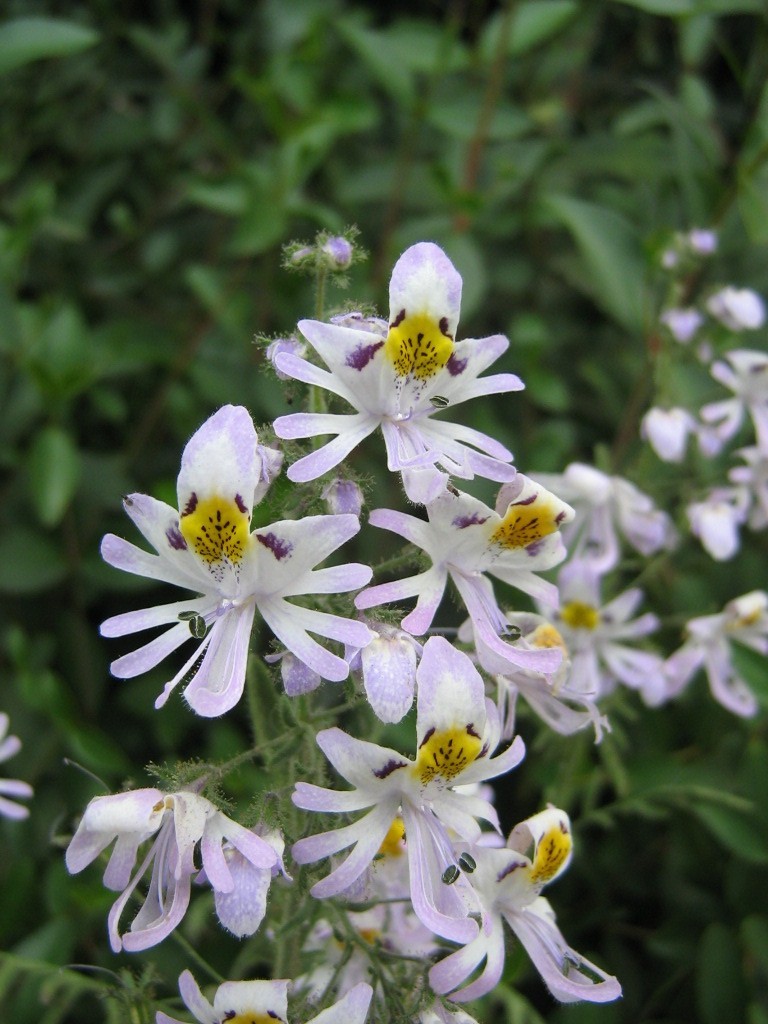
Photo: Penarc, CC BY-SA 3.0 · source

Annual · Solanaceae
Poor man’s orchid
Schizanthus pinnatus
In other languages: Schizanthus (Nederlands) · Schizanthe (Français)
Poor man’s orchid comes from Chile and, like petunia and tomato, belongs to the nightshade family. It is a bushy, fine-leaved annual of 30–50 cm with feathery leaves that resemble fern fronds. From June to September it is covered in small, two-lipped flowers of 2–3 cm with deeply cut lobes, in pink, lilac, purple, white or red and often with a yellow blotch and dark veins. This marking makes them look like tiny orchids, hence the name. It flowers best in cool, changeable weather and is ideal for pots and containers on a sheltered patio or balcony.
Light
Sun or partial shade
preferably some sun
Moisture
Normal
no wet feet
Legal basis
Sand or loam
acid to neutral
Hardiness
down to 0 °C
protect in harsh winters
Size
0.4 m
tall, 0.3 m wide
Flowering
June–September
| Height | 0.4 m |
|---|---|
| Native to Belgium | No, planted |
| Poisonous to people and pets | Not known to be poisonous |
| Flowering | June–September |
Identify
Poor man’s orchid: how do you recognise it?
- Habit
- Bushy, branching annual 30–50 cm high and about 30 cm wide; the stems are brittle and slightly glandular-hairy.
- Leaves
- Finely pinnate, twice divided, with an airy, fern-like effect; slightly sticky from glandular hairs.
- Flowers
- Small, 2–3 cm, two-lipped with deeply cut lobes and often a yellow blotch; in loose, abundant clusters from June to September.
- Colour
- Pink, lilac, purple, red and white, with dark veins and yellow markings.
- Relations
- Belongs to the nightshade family, with petunia, tomato and potato.
Flowering: June–September · Sowing: March–April · Plants: May
In your garden
Why grow it?
- Richly marked, orchid-like little flowers in a wide range of colours, from June to September.
- Flowers exuberantly in pots, containers and hanging baskets on a sheltered patio.
- The fine, fern-like foliage gives an airy effect, even when there are no flowers.
- Does well in sun and light partial shade and likes slightly cooler summers.
- Easy to grow from seed that you sow yourself indoors in March–April.
Poor man’s orchid: where does it grow best?
- Sun to light partial shade; in a very hot spot it flowers less, and in too much shade it becomes sparse.
- Humus-rich, free-draining, moisture-retentive soil: sand or loam, acid to neutral. In a pot: good-quality compost.
- Evenly moist but never wet; it does not tolerate wet feet.
- Sheltered from strong wind and driving rain; the brittle stems snap easily.
- Plant 25–30 cm apart or four to five plants in a 30 cm pot.
- Light
- Sun and partial shade
- Soil type
- Sand or loam
- Acidity
- Acid or neutral
- Moisture
- Normal
- Size
- 0.4 m tall, 0.3 m wide
- Hardiness
- Frost tender: plant out after the last frost (mid-May)
Goes well with
- Lobelia: Little blue flowers that appreciate the same cool, bright spot.
- Fuchsia: Hanging flowers in the same partial shade.
- Snapdragon: Upright spikes next to the airy, fine-leaved plant.
- Nemesia: Flowers in the same summer colours and likes a cool, sunny spot.
Maintenance
Poor man’s orchid: when and how to plant it?
Plant in May.
- Sow indoors in March–April and plant out after mid-May, when night frost is no longer expected.
- First let the young plants get used to the outdoors by day for a week and bring them in at night.
- Loosen the soil and mix in a few spadefuls of compost; in a pot use light potting compost.
- Set the plant at the same depth as in the nursery pot, 25–30 cm apart, and firm the soil.
- Water straight away and then regularly, without letting the soil become waterlogged.
- In a pot, put a thin stake or small twigs next to taller plants, because the stems are brittle.
Care
- Water
- Regular and even, at the base and preferably in the morning, so the foliage stays dry. In pots more often in warm weather.
- Feeding
- Every two weeks give a low-nitrogen flowering-plant feed during flowering.
- Pinching
- Pinch out young plants twice, at 8–10 cm, for a bushy shape with many flowers.
- Support
- A few thin twigs or a support ring stop the stems snapping in wind and rain.
- Faded flowers
- Cut off faded flowers and seed pods to prolong flowering.
Tip: Sow indoors in March–April and pinch out the young plants for a bushy shape. Grow it in a pot on a sheltered patio, water regularly at the base and cut off faded flowers.
Poor man’s orchid: when to prune it?
When: It is not really pruned; pinch out young plants and, during flowering, cut off faded flowers and limp stems.
How:
- Pinch out the tip of the main stem when the plant is 8–10 cm high and repeat on the side shoots.
- Cut faded flowers off back to a side shoot.
- Remove the dead plants in October.
Propagation
- Sowing
- In March–April indoors at 15–18 °C: sow the fine seed thinly and cover it lightly. It germinates in about 10–14 days. Prick the seedlings out into small pots, pinch them out and harden them off in May.
Poor man’s orchid: how does it get through the winter?
Hardy to 0 °C: protect in harsh winters.
- Not hardy: it tolerates at most a light night frost around 0 °C and dies off in autumn.
- Clear the plants in October and put them on the compost heap.
- Sow again next spring in March–April; you can collect the seed yourself from the dried seed capsules.
Diseases and pests
- Aphids: Small insects on young shoots and buds. Rinse off with water or a mild soap solution; ladybirds help.
- Grey mould: Grey mould on flowers and stems in wet, cold weather. Allow space and airflow, water at the base and cut off affected parts.
- Damping-off: Seedlings fall over at the base. Use clean seed compost, do not sow too thickly and do not overwater.
- Spider mite and whitefly: Fine webs and yellowish speckles, or sticky leaves with small white flies. Rinse off with water and remove affected parts.
- Slugs: Young plants are eaten. Collect slugs in the evening or set slug traps.
Through the year
- March: Sow indoors at 15–18 °C.
- April: Sow, prick out and pinch out for the first time.
- May: Plant out after mid-May. Put supports in.
- June: Flowering begins. Feed every two weeks.
- July: Full flower. Water and cut off faded flowers.
- August: Flowering. Water in dry weather.
- September: Last flowers. Collect seed.
- October: Clear the plants.
You and this species
Did you know?
- The name Schizanthus comes from the Greek: schizein (to split) and anthos (flower), after the deeply cut corolla.
- It is related to petunia, tomato and potato, which also belong to the nightshade family.
- The English name ‘poor man’s orchid’ refers to the orchid-like flowers, although it is not an orchid.